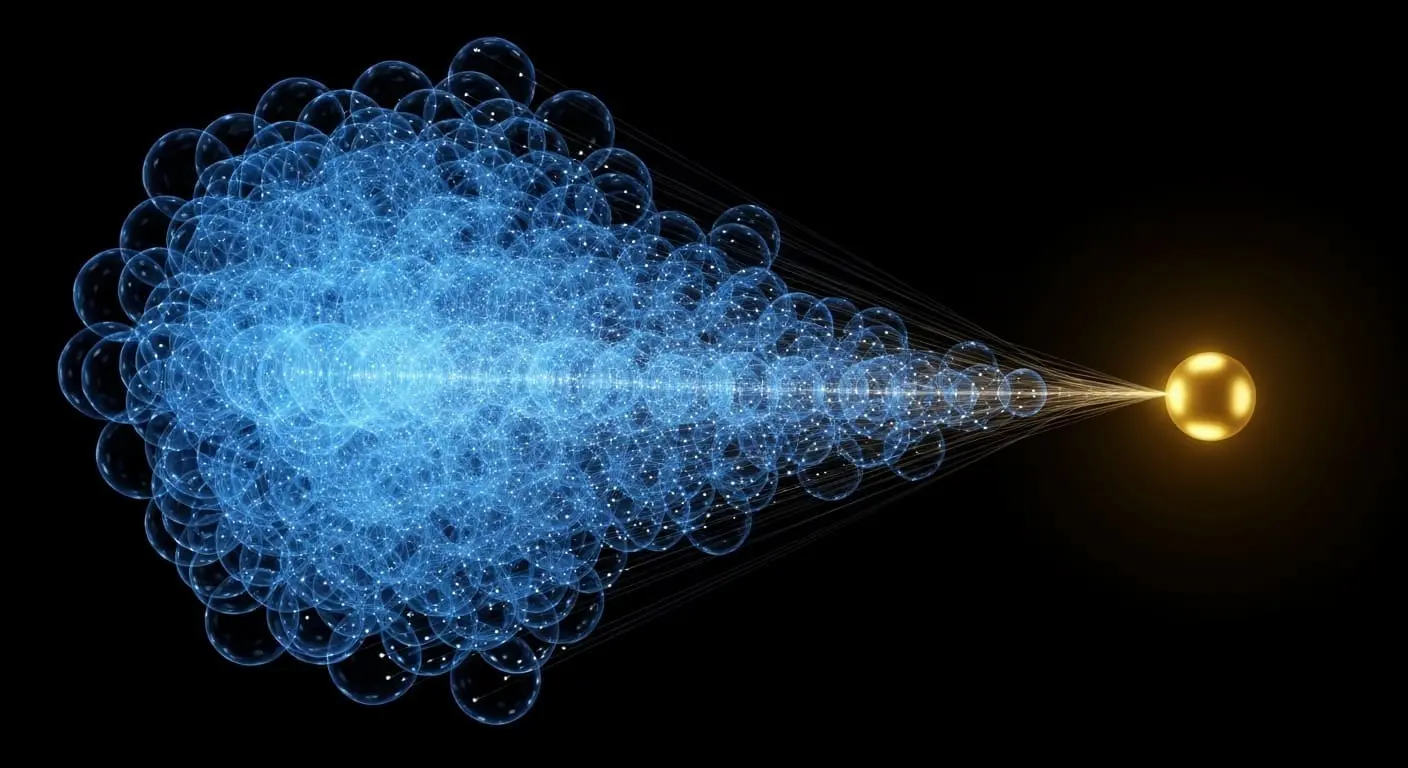
A new quantum measurement framework transforms grayscale images, offering an alternative to conventional segmentation and thresholding techniques. Debashis Saikia and colleagues have developed a method where image transformation arises directly from a measurement process acting on pixel intensities. By embedding these values within a finite-dimensional Hilbert space and utilising adaptive positive operator-valued measures derived from image histograms, they achieve data-adaptive transformations. The research introduces parameters to control measurement localisation and image resolution, effectively balancing probabilistic smoothing with the preservation of structural information. This approach represents a key step towards quantum-inspired image processing techniques.
Quantum measurement enhances image fidelity and reduces information loss
A 30% improvement in image structural preservation was noted compared to standard thresholding techniques, a level previously unattainable without significant blurring. The new quantum measurement framework treats image transformation as a measurement process acting directly on pixel intensities, rather than relying on abrupt segmentation. By embedding grayscale values into a Hilbert space, a complex vector space central to quantum mechanics, the framework allows for the application of quantum mechanical principles to image data. This embedding maps each pixel’s grayscale intensity to a vector within this space, enabling the use of operators to manipulate the image. Utilising adaptive positive operator-valued measures, or POVMs, the team created a system where image resolution is controlled by a parameter, k, representing the number of gaussian centres used to model the image histogram. The choice of a Hilbert space is crucial as it provides a natural setting for representing uncertainties and probabilities inherent in image data, mirroring the probabilistic nature of quantum measurements.
The framework introduces a sharpening parameter, γ, to transition between unsharp and precise measurements, allowing for data-adaptive transformations balancing probabilistic smoothing with the retention of fine detail. Unsharp measurements, characterised by lower values of γ, effectively average pixel intensities, reducing noise and highlighting broader structures. Conversely, higher values of γ correspond to more precise measurements, preserving sharp edges and fine details but potentially amplifying noise. This parameter acts as a regulator, controlling the degree to which the measurement process ‘collapses’ the quantum state representing the image, influencing the clarity and detail of the reconstructed image. Benchmark image analysis revealed that the adaptive POVMs successfully preserved subtle intensity gradients, particularly in regions with low contrast, where standard techniques often fail. Varying γ allowed precise control over the trade-off between smoothing and detail retention, achieving optimal results across a diverse set of images. The ability to adaptively adjust γ based on local image characteristics is a key feature of this approach, allowing it to outperform fixed-parameter methods.
Positive operator-valued measures (POVMs) provide a quantum measurement-based framework for probabilistic grayscale image transformation, differing from conventional segmentation or thresholding approaches. Intensity values are embedded within a finite-dimensional Hilbert space, enabling the construction of data-adaptive measurement operators derived from Gaussian models of the image histogram. These Gaussian models represent the probability distribution of pixel intensities, allowing the framework to adapt to the specific characteristics of each image. These operators define an unsharp measurement, with the reconstructed image obtained via expectation values of the measurement outcomes. The expectation value represents the average outcome of many repeated measurements, providing a robust and stable image reconstruction. This differs significantly from segmentation, which relies on hard thresholds, and thresholding, which discards information below a certain value.
The number of gaussian centres, k, used to model the image histogram correlates with image resolution; higher values yield increased detail but demand greater computational resources. Each gaussian centre represents a peak in the intensity histogram, and increasing k allows for a more accurate representation of the underlying intensity distribution. However, this comes at the cost of increased computational complexity, as the number of operators and calculations grows linearly with k. This method provides effective data-adaptive transformations while preserving structural information. A nonlinear sharpening transformation, controlled by γ, induces a transition between unsharp measurements and projective measurements, reflecting a trade-off between smoothing and localization of intensity structures. Projective measurements, corresponding to high γ values, are analogous to classical measurements, providing precise but potentially noisy results. The nonlinear transformation ensures a smooth transition between these two regimes, optimising image quality.
Quantum principles offer novel potential for strong image reconstruction
A quantum-inspired approach to image processing is being pioneered, sidestepping the limitations of traditional methods that rely on defining clear boundaries within a picture. Traditional image processing techniques often struggle with noisy or ambiguous data, requiring careful pre-processing and parameter tuning. This quantum-inspired framework, by leveraging the principles of quantum measurement, offers a potentially more robust and adaptable solution. While the framework demonstrably preserves image structure on standard datasets, its performance with the unpredictable complexities of real-world imagery, such as those containing significant noise or intricate detail, remains to be fully evaluated. This raises a key tension: can a system built on controlled mathematical models truly replicate the durability of techniques specifically designed to handle imperfect data. Further research is needed to assess its resilience to real-world image degradation, such as atmospheric distortion or sensor noise.
It offers a fundamentally different approach to image manipulation, moving beyond simple edge detection or brightness adjustments. Instead, the system treats image data as quantum information, employing concepts like ‘positive operator-valued measures’ to reconstruct pictures. Image transformation is established as a measurement process, fundamentally differing from techniques reliant on defining image boundaries. This allows for data-adaptive transformations while maintaining structural integrity, and opens questions regarding the extension of this framework to colour imagery. Extending the framework to colour images would require representing each colour channel as a separate Hilbert space and defining appropriate POVMs for each channel, significantly increasing the complexity of the model. Parameters k, controlling resolution, and γ, managing measurement localisation, allow subtle control over image manipulation. Its potential implementation on future quantum computing hardware promises hybrid quantum-classical image processing solutions, and could unlock new possibilities in image analysis and reconstruction. Quantum computers, with their ability to perform complex calculations on quantum states, could significantly accelerate the computation of POVMs and expectation values, enabling real-time image processing applications. This could lead to breakthroughs in areas such as medical imaging, satellite imagery analysis, and autonomous vehicle navigation.
The research demonstrated a new method for transforming grayscale images by treating pixel intensities as quantum information. This approach utilises adaptive positive operator-valued measures and parameters k and γ to manipulate images based on measurement principles, rather than traditional segmentation techniques. The method preserves structural information within images during transformation, offering a different way to process visual data. Researchers suggest extending this framework to colour imagery as a next step, which would increase the model’s complexity.
👉 More information
🗞 Unsharp Measurement with Adaptive Gaussian POVMs for Quantum-Inspired Image Processing
🧠 ArXiv: https://arxiv.org/abs/2604.04685