Detecting objects and measuring distances using faint light sources presents a significant security challenge, as these systems are vulnerable to interference and deliberate deception. Richard J. Murchie from the European Space Agency and John Jeffers from the University of Strathclyde investigate a new approach to quantum illumination, enhancing its resilience against such spoofing attacks. Their work extends existing object detection protocols, allowing the system’s performance to be characterised by its experimental settings rather than relying on extensive detector data, which is often impractical to obtain. The researchers demonstrate that an attacker’s effectiveness depends on their chosen detection strategy, and importantly, identify scenarios where object detection remains possible even when the system is vulnerable to spoofing, paving the way for intrusion recognition and secure signal recovery. This achievement reinforces the advantages of quantum illumination for robust detection in challenging environments.
Conventional object detection using weak light is vulnerable to jamming and spoofing, where an intruder interferes with or mimics the signal. This work explores the performance of a quantum illumination LIDAR system when faced with an adaptive spoofing adversary, one that actively tries to create false targets. The team modelled both the quantum signal and the spoofing signal as coherent states, allowing them to analyse the detection process mathematically.
This analytical framework enabled the calculation of the probability of false alarms and successful detection, considering the signal strength and the adversary’s power. The researchers then developed a metric to quantify the system’s resilience, balancing detection performance with the adversary’s ability to generate convincing false targets. Results demonstrate that quantum illumination offers significant advantages over classical illumination when facing an adaptive spoofing adversary, remaining superior across a wide range of adversary powers and signal-to-noise ratios, highlighting its potential for secure object detection and range finding. Simultaneous, phase-insensitive coincidence measurements provide improved resilience to jamming compared to classical illumination. Researchers extended a quantum illumination-based protocol to characterise the system by its experimental parameters and quantum states, exploring spoofing resilience without needing detector data for all possible settings. The results demonstrate that, in certain conditions, an intruder has limited ability to deceive the system.
Quantum Key Distribution, Security, and Ranging
This collection of research papers details advancements in quantum key distribution (QKD), quantum ranging, and related quantum technologies, representing a comprehensive overview of the field’s evolution. Early papers by Bennett and Brassard, and Ekert, laid the foundational principles of QKD, with subsequent work focusing on security proofs and analysing potential attacks, including collective attacks and the development of more robust protocols. The importance of finite-key security, addressing practical limitations of infinite key lengths, is also highlighted. Research also explores quantum memories, aiming to extend the range of QKD systems by storing quantum information.
Both free-space and fiber-based QKD are well-represented, with free-space QKD offering cost and deployment advantages, while fiber-based QKD focuses on improving performance and security over long distances. A trend towards integrated photonics is evident, with research focused on miniaturising QKD components onto a single chip. Papers by Maccarone et al. demonstrate the use of Twin-Field QKD, a protocol that can overcome transmission distance limitations. Several papers explore the use of quantum technologies for precise distance measurement and localisation, investigating quantum ranging for secure communication, navigation, and metrology, and quantum entanglement for precise localisation. Advanced protocols, such as Continuous-Variable QKD and Measurement-Device-Independent QKD, are also explored. Integration and miniaturisation are key trends, and overcoming the distance limitations of QKD remains a major challenge.
Quantum Security Against Jamming and Spoofing
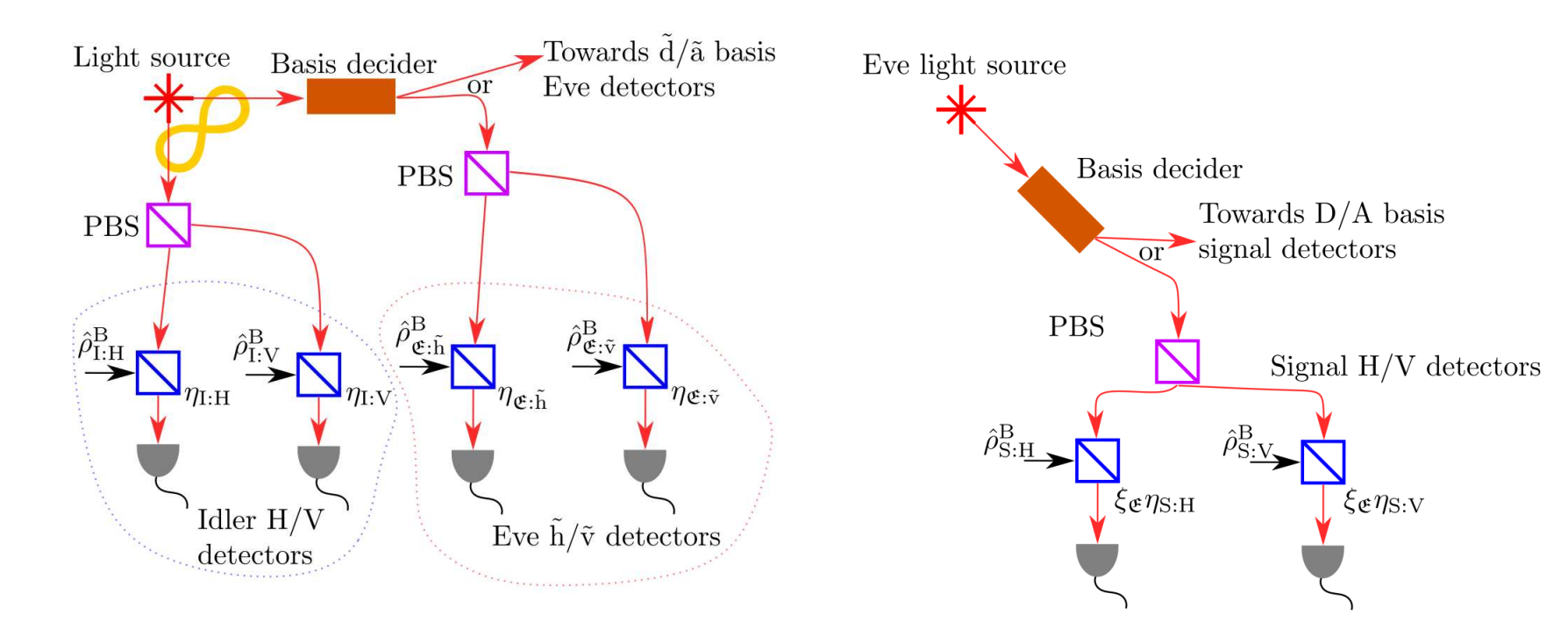
This research demonstrates a new approach to secure object detection and range finding, addressing vulnerabilities to jamming and spoofing attacks that plague conventional weak light sources. Scientists have developed a protocol based on non-classical correlations between light fields, utilising quantum states where signal and idler photons are linked. By analysing detector click probabilities, the system can detect the presence of an object and recognise attempts by an intruder to manipulate the signal. The team showed that the system’s security is dependent on specific experimental parameters, allowing for the identification of regimes where spoofing is more difficult. Importantly, they found that even in scenarios with excessive noise, object detection remains possible, indicating the system is not entirely blinded by an attack. This reinforces the advantages of using illumination with quantum correlations for resilience against spoofing, compared to traditional methods.
🗞 Spoofing resilience for simple-detection quantum illumination LIDAR
🧠 ArXiv: https://arxiv.org/abs/2510.23228