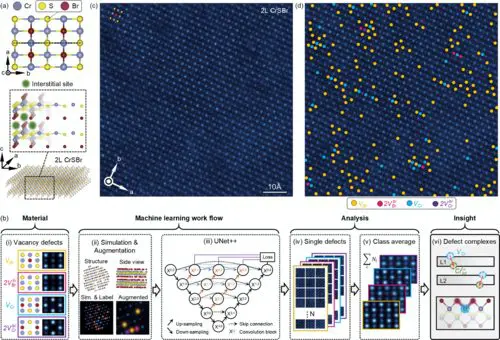
Atomic defects fundamentally determine the properties of van der Waals materials, and understanding these imperfections is crucial for advancing this exciting field. Van der Waals materials, characterized by weak interactions between layers, exhibit a diverse range of physical phenomena, including superconductivity, magnetism, and unique optical responses. These properties are highly sensitive to the presence of defects, which can scatter electrons, modify electronic structures, and create localized energy states. Consequently, precise control and characterization of atomic defects are essential for tailoring material properties and creating novel devices.
Defect Identification via Deep Learning and STEM
This research presents a comprehensive study of defects in the two-dimensional magnetic semiconductor CrSBr, utilizing advanced experimental techniques, including scanning transmission electron microscopy (STEM), and theoretical calculations. The researchers identified various types of defects, including vacancies, interstitials, and complexes, and investigated their impact on the material’s structure and properties. A key innovation is the use of deep learning to automate the analysis of atomically resolved STEM images, enabling the identification and characterization of defects with unprecedented accuracy. The findings provide crucial insights into the origin of defects, their influence on the material’s magnetic and electronic behavior, and potential strategies for controlling defect density in CrSBr for advanced device applications.
Diverse Defects Enable Quantum Emission Potential
Researchers have achieved a breakthrough in understanding atomic defects within bilayer chromium sulfide bromide (CrSBr), a two-dimensional magnetic semiconductor, revealing a surprising diversity of defect types and their potential for quantum emission. Combining high-angle annular dark-field scanning transmission electron microscopy (HAADF-STEM) with a custom-developed machine learning workflow, the team quantitatively identified and classified individual atomic defects, overcoming the challenges posed by low signal-to-noise ratios in thicker materials. This innovative approach enabled the detection of previously unknown defect complexes, significantly expanding the understanding of defect behavior in this material. The study revealed a range of defects, including single point vacancies and vertically stacked vacancies, but most notably, the discovery of complex combinations of defects.
Researchers identified a unique complex involving both a chromium vacancy and a chromium interstitial, existing in various configurations due to the material’s layered structure and the energy landscape within the van der Waals gap. Additionally, a combined chromium and bromine vacancy complex, characteristic of CrSBr, was observed, where bromine atoms share bonds with only two chromium atoms. Statistical analysis of bromine vacancies further revealed extended defect lines of varying lengths, suggesting a correlated formation mechanism. These observations are strongly supported by theoretical calculations, which accurately predict the structures and binding energies of the observed defects.
Calculations demonstrate that the interstitial defect complexes exhibit highly localized electronic states, suggesting promising quantum emission properties. The findings lay a foundation for harnessing the versatile range of defects within CrSBr, and can be extended to over 20 materials sharing the same structural type. The exceptional properties of CrSBr, combined with its responsiveness to electron beam-induced structural transformation, suggest exciting opportunities for controlled defect complex engineering and the development of novel magneto-correlated and optically active devices.
Machine Learning Maps CrSBr Defects Precisely
This research establishes a comprehensive library of defects within the material CrSBr, achieved through a combination of advanced electron microscopy, deep learning, and theoretical calculations. The study reveals a diverse range of defects and defect complexes, including single and stacked vacancies, and combinations of interstitial and vacancy defects, stemming from the material’s unusual crystal structure. Importantly, the team demonstrates the effectiveness of machine learning in identifying these defects, particularly when imaging beam-sensitive materials with limited exposure. The enhanced visualization enabled by deep learning allowed the researchers to resolve complex defect configurations, revealing that structures initially appearing as simple vacancies were, in fact, more intricate arrangements.
Specific defects, such as those involving chromium interstitials, were detected at locations predicted by theoretical models, and the presence of extended defect lines suggests correlated growth patterns. These findings lay a crucial foundation for future theoretical investigations into the electronic, magnetic, and optical properties influenced by defects. The authors anticipate that certain defects, specifically those involving chromium interstitials and bromine vacancies, may exhibit particularly interesting correlated properties. Furthermore, this work represents the first experimental atomic-scale defect study of this structural type, offering a blueprint for understanding similar defects in a wider range of predicted compounds, including transition metal oxyhalides and chalcogenide halides.
🗞 Defect Complexes in CrSBr Revealed Through Electron Microscopy and Deep Learning
🧠 DOI: http://link.aps.org/doi/10.1103/PhysRevX.15.021080