The quantum Hall effect, a phenomenon where electrons conduct electricity without resistance under strong magnetic fields, typically occurs in materials with specific band structures, but scientists are now observing this effect in a surprising new context, namely lightly hydrogenated graphene. I. G. van Rens from Radboud University and Nikhef, along with O. O. Zheliuk, M. W. de Dreu, and colleagues, demonstrate that introducing just a few percent of hydrogen atoms fundamentally alters graphene’s electronic properties. Their measurements reveal a shift from the material’s characteristic linear energy-momentum relationship to a quadratic one, effectively giving electrons a mass where previously they had none, and enabling the observation of the quantum Hall effect under altered conditions. This achievement expands the range of materials exhibiting this valuable quantum phenomenon and offers new avenues for manipulating electronic properties at the nanoscale.
Tritium Adsorption and Graphene Surface Interactions
This research investigates the interaction of tritium, a radioactive isotope of hydrogen, with graphene, driven by the need to understand its suitability for future neutrino detectors, such as the PTOLEMY experiment. Tritium is a key component in these detectors, and its behaviour on graphene surfaces is crucial for their success. The research explores how tritium adheres to graphene, alters its structure, and affects its electronic properties, aiming to ensure graphene functions reliably as a detection medium. The team investigates whether tritium simply sticks to the surface or chemically bonds with the graphene, potentially altering its structure, and examines how tritium adsorption affects graphene’s conductivity and band structure, critical factors for detector sensitivity.
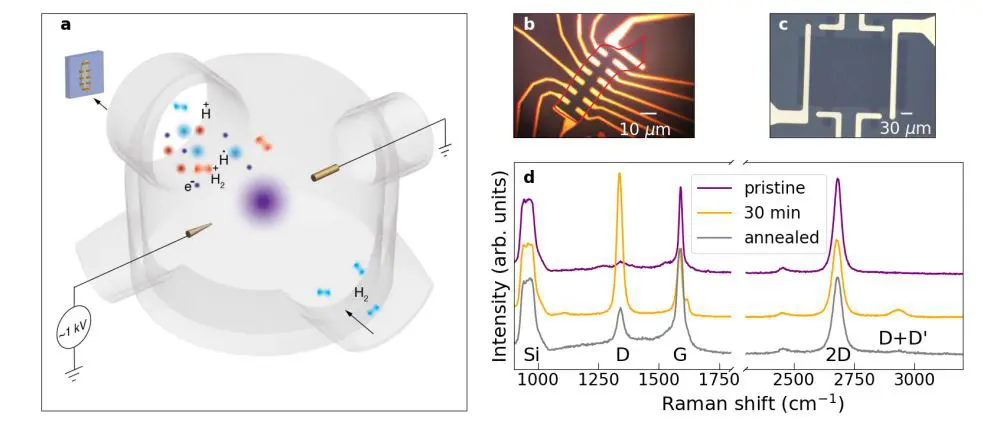
The researchers primarily use Raman spectroscopy to characterize graphene, identifying structural changes and monitoring the degree of hydrogenation, and employ theoretical calculations, including density functional theory and tight-binding methods, to complement experimental results and gain a deeper understanding of the underlying mechanisms. Hydrogen plasma is used to induce hydrogenation of graphene in a controlled manner, allowing scientists to study the effects of hydrogen adsorption on its properties. The research suggests that tritium chemically adsorbs onto graphene, leading to the formation of defects, and that hydrogen plasma treatment induces hydrogenation, creating defects, the extent of which depends on the plasma parameters. Raman spectroscopy proves to be a powerful tool for monitoring these structural changes.
Tritium adsorption and hydrogenation can modify graphene’s electronic properties, potentially affecting its conductivity and band structure. The degree of tritium coverage on graphene plays a crucial role in determining the extent of structural and electronic changes. These findings highlight the importance of ensuring the long-term stability of graphene in the presence of tritium, as significant structural changes could compromise detector performance. Changes in graphene’s electronic properties could also affect detector sensitivity, informing the selection of appropriate graphene materials and surface treatments for use in neutrino detectors, and influencing the detector’s design to minimize the effects of tritium adsorption.
The research utilizes Raman spectroscopy as the primary characterization technique, hydrogen plasma to induce hydrogenation, and density functional theory and tight-binding methods for theoretical modeling. Graphene field-effect transistors are used for sensing applications, and QuantumATK serves as the software package for electronic structure calculations. Key terms include tritium, a radioactive isotope of hydrogen; graphene, a single layer of carbon atoms arranged in a hexagonal lattice; hydrogenation, the addition of hydrogen atoms to a material; sp3 hybridization, a type of atomic hybridization resulting in tetrahedral geometry; physisorption, adsorption due to weak van der Waals forces; chemisorption, adsorption due to chemical bonding; the quantum Hall effect, a quantum mechanical phenomenon observed in two-dimensional electron systems; and PTOLEMY, a proposed experiment to detect relic neutrinos from the early universe.
Hydrogenation Induces Graphene Band Structure Transition
Scientists have directly measured changes in the electronic properties of graphene following exposure to hydrogen plasma, revealing a significant alteration in its band structure. Experiments demonstrate that even a small degree of hydrogenation dramatically decreases the distance between energy levels, known as Landau levels, and changes how this distance responds to magnetic fields. This observation indicates a transition in the graphene’s band structure from a linear to a quadratic form, accompanied by an effective electron mass. These findings align with theoretical calculations of hydrogen-decorated graphene, confirming the structural changes induced by hydrogenation.
Further characterization using Raman spectroscopy revealed the emergence of defect-induced peaks, confirming the incorporation of hydrogen. Analysis of measurements showed a shift in the charge neutrality point to higher voltages following plasma exposure, indicative of p-type doping, alongside an increase in resistance and broadening of the peak due to decreased charge carrier mobility. Measurements of the charge neutrality point resistance as a function of exposure time showed consistent changes, with increased exposure leading to a measurable opening of a band gap and increased temperature dependence. Magnetotransport experiments, conducted in strong magnetic fields, allowed scientists to resolve the Landau level structure and extract the cyclotron mass of charge carriers.
Resistance minima, typically observed in pristine graphene, remained visible in hydrogenated samples but diminished at lower temperatures. Fitting the temperature dependence of these minima using an Arrhenius plot, scientists determined activation gaps, revealing a substantial reduction compared to pristine graphene after exposure to plasma. The minimal magnetic field required to observe the quantum Hall effect increased, indicating a broadening of energy levels. The dependence of the activation gap on the magnetic field shifted from a square root relationship to a linear one, providing further evidence of a change from linear to parabolic dispersion in the band structure.
Hydrogenation Induces Quadratic Dispersion in Graphene
This research demonstrates a clear modification of graphene’s electronic properties through exposure to hydrogen plasma. Scientists observed a significant decrease in the distance between Landau levels within hydrogenated graphene samples, coupled with a change in how this distance responds to magnetic fields. These findings indicate a transition in the graphene’s band structure from a linear to a quadratic dispersion relation as a result of hydrogenation. Importantly, these experimental observations align with theoretical calculations of hydrogen-decorated graphene, confirming the validity of the observed changes.
The team determined that even low levels of hydrogen coverage induce measurable alterations to the graphene’s electronic structure. By correlating the observed changes in Landau level distance with calculated effective electron masses, they estimated the degree of hydrogen coverage required to produce these effects. While acknowledging that the study focused on graphene, the authors suggest that similar behaviour may be expected with tritium. Future work could explore the potential of this method for tailoring graphene’s properties for specific electronic applications, and further refine the understanding of hydrogen-graphene interactions.
🗞 Quantum Hall effect in lightly hydrogenated graphene
🧠 ArXiv: https://arxiv.org/abs/2512.13193