Detecting faint signals is a fundamental challenge in quantum sensing, where even minuscule disturbances can overwhelm delicate measurements, limiting the ability to observe subtle phenomena. So Chigusa, Masashi Hazumi, Ernst David Herbschleb, and colleagues address this issue by developing a novel technique for shielding quantum sensors from both direct current (DC) and alternating current (AC) magnetic noise. Their approach, termed hybrid-spin decoupling, exploits the differing responses of individual spins within a cluster to target fields and local noise, offering a significant advantage over existing methods like comagnetometers. This breakthrough dramatically increases the range of noise frequencies that sensors can ignore, paving the way for more sensitive searches for elusive particles like dark matter, as well as improvements in technologies such as gradient sensing, data storage, and gyroscopes.
Hybrid Spin Decoupling Boosts Axion Search Sensitivity
This research details a theoretical analysis of a novel hybrid-spin decoupling protocol to enhance the sensitivity of axion dark matter searches using nitrogen-vacancy (NV) centres in diamond. The study compares this protocol to traditional Ramsey-based methods, focusing on mitigating the impact of external magnetic noise. Key findings demonstrate that the hybrid-spin decoupling protocol can significantly improve sensitivity, particularly at low frequencies where external noise typically dominates. The technique aims to cancel external magnetic noise by correlating the dynamics of nuclear and electron spins within the NV centre, effectively nullifying the 1/f noise component of the external magnetic field and resulting in a flatter sensitivity curve.
The analysis reveals that the protocol outperforms the traditional Ramsey method when external noise is substantial, with sensitivity influenced by the number of NV centres, observation duration, and the number of nuclear spins used in the decoupling process. Projections suggest that future setups with larger numbers of NV centres and longer observation times could achieve sensitivities competitive with existing dark matter search proposals. This work presents a theoretical framework for a more sensitive axion dark matter search by actively cancelling external magnetic noise through a clever correlation of nuclear and electron spins.
Hybrid Spin Decoupling Extends Quantum Coherence
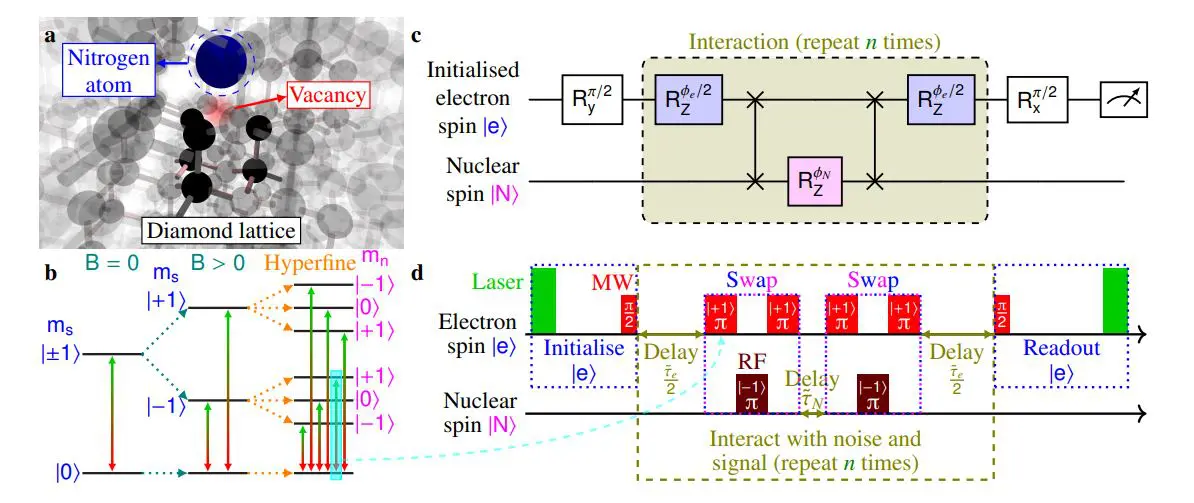
This work presents a novel hybrid-spin decoupling protocol that dramatically improves coherence times in quantum systems, specifically utilizing electron-spin nuclear-spin pairs within nitrogen-vacancy (NV) centres in diamond. The core achievement lies in the ability to decouple specific DC magnetic fields from both DC and AC magnetic noise, representing a significant advancement over existing decoupling techniques. Researchers demonstrate that by manipulating the interaction between electron and nuclear spins, they can effectively suppress noise and extend the duration of quantum coherence. The team developed a protocol based on repeating a unit cell consisting of electron-spin accumulation, a swap operation, and nuclear-spin accumulation, resulting in enhanced noise cancellation across a broader range of frequencies.
Crucially, the protocol targets DC fields, which are typically difficult to address with conventional AC-sensitive decoupling sequences. Mathematical modelling reveals that the rate of relaxation depends on the hierarchy of relevant timescales, including the correlation time of the noise, the electron spin relaxation time, and the nuclear spin relaxation time. Simulations demonstrate that for noise with a long correlation time, the coherence time scales proportionally to the number of repetitions, paving the way for improved sensitivity in applications such as light dark-matter searches, gradient sensing, memory devices, and gyroscopes.
Spin Noise Cancellation Boosts Quantum Sensing
This research demonstrates a new method for enhancing the sensitivity of quantum sensors by effectively decoupling unwanted noise from target signals. The team successfully developed a protocol that exploits the differing responses of coupled electron and nuclear spins to external fields, allowing for the cancellation of common noise sources while preserving sensitivity to subtle variations, significantly broadening the range of detectable frequencies and extending effective coherence times. The technique was explored using nitrogen-vacancy centres in diamond, where the interaction between electron and nuclear spins provides a suitable platform for implementing the protocol. By carefully controlling the time spent in each spin state, the researchers achieved cancellation of shared signals, enhancing the sensor’s ability to detect weak fields. This advancement has potential applications in diverse areas, including the search for dark matter, high-resolution gradient sensing, and the development of advanced memory and gyroscope technologies. Further research is needed to explore the method’s applicability to other quantum sensing platforms, and optimizing pulse sequences and addressing potential sources of error will be crucial for realizing the full potential of this technique.
🗞 Hybrid-spin decoupling for noise-resilient DC quantum sensing
🧠 ArXiv: https://arxiv.org/abs/2511.16732