

Gaussian process regression offers powerful probabilistic predictions in machine learning, but its computational demands limit its application to large datasets due to the need for complex matrix calculations. Kerem Bükrü, Steffen Leger, and M. Lautaro Hickmann, along with colleagues at the German Aerospace Center, now present a hybrid quantum-classical approach that overcomes these limitations. Their method leverages the power of quantum computation to solve the linear equations at the heart of Gaussian process regression, but crucially, it does so using a relatively small number of qubits suitable for today’s emerging quantum hardware. This innovative technique achieves regression accuracy comparable to traditional methods, while paving the way for applying Gaussian processes to significantly larger and more complex problems than previously possible.
Variational Quantum Solvers for Gaussian Processes
Scientists are exploring how hybrid quantum-classical algorithms can accelerate Gaussian process regression, a powerful machine learning technique hampered by computational limitations. Traditional Gaussian process models struggle with large datasets because calculating the model requires inverting a covariance matrix, a process that becomes increasingly difficult as the data grows. Researchers are now reformulating this computationally intensive step as a series of linear equations that can be solved using a Variational Quantum Linear Solver, a technique well-suited for current, relatively small quantum computers. This approach avoids the need for a large number of qubits, a significant obstacle for existing quantum hardware, and allows for practical implementation on near-term quantum devices.
By reformulating the problem, scientists can compute the posterior distribution of a Gaussian process without the prohibitive computational cost of classical matrix inversion, enabling accurate predictions even with limited data. This is particularly valuable in applications where data acquisition is expensive or time-consuming. The success of this method hinges on carefully designing the quantum circuit, known as the ansatz, to efficiently represent and manipulate the data. Experiments demonstrate that this quantum-enhanced approach delivers regression quality comparable to that of classical techniques, while offering a pathway to scalability for larger datasets. This research pioneers a new direction in quantum machine learning, showcasing how hybrid algorithms can bridge the gap between theoretical quantum advantages and practical implementation on existing hardware. This opens possibilities for applying Gaussian processes to complex problems in fields like robotics, engineering, healthcare, and optimization, where accurate predictions with quantified uncertainties are essential.
Quantum Variational Gaussian Process Regression
Scientists developed a novel approach to Gaussian process regression that harnesses the power of hybrid quantum-classical computation to overcome limitations in classical methods. The study addresses the computational bottleneck of training Gaussian process models, which traditionally requires inverting a covariance matrix with cubic time complexity, becoming intractable for datasets exceeding 10 5 data points. Researchers reformulated the matrix inversion step as a series of linear equations solvable using the Variational Quantum Linear Solver, a technique particularly suited for current noisy intermediate-scale quantum computers. This method avoids the need for large numbers of qubits, a significant hurdle for existing quantum hardware.
The core innovation lies in leveraging a variational quantum circuit, optimized using a classical computer, to efficiently solve the linear systems arising from the Gaussian process inference. This hybrid approach circumvents the need for fault-tolerant quantum computers, which are currently unavailable, and allows for practical implementation on near-term quantum devices. The team demonstrated that by reformulating the problem, they could compute the posterior distribution of a Gaussian process without the prohibitive computational cost of classical matrix inversion. This allows the model to make accurate predictions even with limited data, a crucial advantage in applications where data acquisition is expensive or time-consuming.
Quantum Algorithm Scales Gaussian Process Regression
The research team developed a novel method for Gaussian process regression, a powerful technique in supervised machine learning, by integrating a hybrid quantum-classical algorithm called the Variational Quantum Linear Solver. Traditional Gaussian process models require computationally expensive matrix inversions that scale cubically with the size of the dataset, limiting their application to relatively small problems. The VQLS circumvents this limitation by reformulating the matrix inversion as a series of linear equations solvable using a quantum-assisted approach. The VQLS utilizes a quantum circuit with a number of qubits determined by the logarithm of the dataset size, enabling it to tackle larger problems than conventional methods. The core of the algorithm involves preparing a quantum state representing the solution vector and ensuring that, when acted upon by a matrix representing the problem, it corresponds to the desired output vector. The team demonstrated that this approach successfully computes the posterior distribution required for Gaussian process regression, achieving regression quality comparable to that of classical methods.
Quantum Gaussian Process Regression with MUHEA
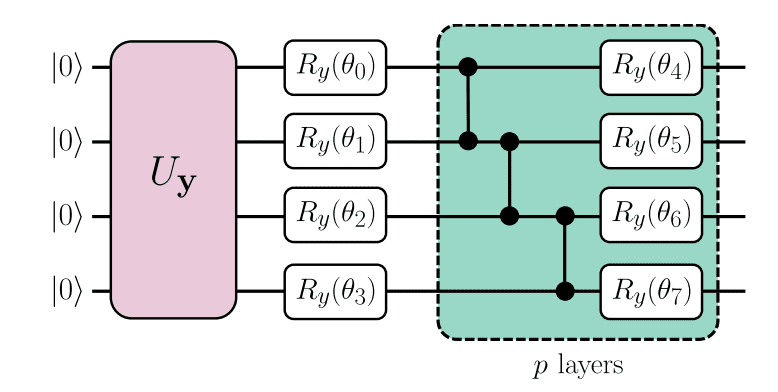
This research presents a novel approach to Gaussian process regression, addressing the computational challenges of traditional methods through a hybrid quantum-classical algorithm. The team successfully reformulated Gaussian process inference as a series of linear equations solvable using a quantum-assisted linear solver, circumventing the need for computationally expensive matrix inversions. Results demonstrate that this method achieves regression performance comparable to standard Gaussian process models, even with a reduced number of computational steps. Specifically, employing a multi-layer data re-uploading technique within the quantum circuit, known as MUHEA, further enhanced performance, reducing the mean squared error and the number of iterations needed for convergence. While hyperparameter optimization was performed classically for simplicity, the study establishes a viable pathway for leveraging near-term quantum computers for Gaussian process regression.
👉 More information
🗞 A Hybrid Quantum Solver for Gaussian Process Regression
🧠 ArXiv: https://arxiv.org/abs/2510.15486

