Quantum key distribution promises secure communication, but its reach and efficiency depend critically on maintaining the integrity of photons travelling through optical fibres. Mariella Minder, Sophie Albosh, and colleagues at the Universities of York, Bristol, and Southampton investigate a promising new fibre technology, hollow-core nested antiresonant nodeless fibre, to address this challenge. Their work focuses on characterising phase noise, a key factor limiting the distance and key rate of quantum communication systems, particularly those employing advanced protocols like Twin-Field quantum key distribution. By performing detailed experiments with a two-kilometre hollow-core fibre and comparing its performance to standard single-mode fibre, the team demonstrates that this novel fibre exhibits characteristics suitable for long-distance, phase-based quantum communication, potentially paving the way for more secure and efficient networks.
Hollow-Core Fiber Enables Long-Distance QKD
Scientists have demonstrated that hollow-core fiber (HCF) offers a promising solution to overcome distance limitations in quantum key distribution (QKD). This research establishes that HCF, specifically nested antiresonant nodeless fiber (NANF), significantly reduces thermal noise and signal loss, paving the way for more secure long-distance quantum communication. The team successfully demonstrated QKD over a substantial distance with improved performance compared to traditional single-mode fiber. The research addressed the challenges of long-distance QKD, namely signal loss and thermal noise inherent in standard single-mode fiber.
Hollow-core fiber was introduced as a potential solution, offering lower attenuation and reduced thermal sensitivity, building upon advancements in both HCF technology and QKD protocols like Twin-Field QKD. The team focused on NANF, a specific type of HCF designed to minimize signal loss and thermal noise through its unique structural properties and careful fabrication. A detailed QKD system was constructed, incorporating a laser source, detectors, and optical components, with the HCF carefully integrated into the setup. The experimental configuration and measurement procedures were precisely controlled, utilizing parameters optimized for the QKD protocol, including key rate and bit error rate.
The resulting data revealed improved performance compared to traditional fiber, demonstrating the potential of HCF for long-distance quantum communication. Detailed analysis of the experimental results, including measurements of key rate, bit error rate, and Quantum Bit Error Rate (QBER), confirmed the superior performance of the HCF-based QKD system. These findings highlight the advantages of HCF over traditional fiber and its potential for future quantum communication networks.
Hollow Core Fibre Phase Noise Measurement
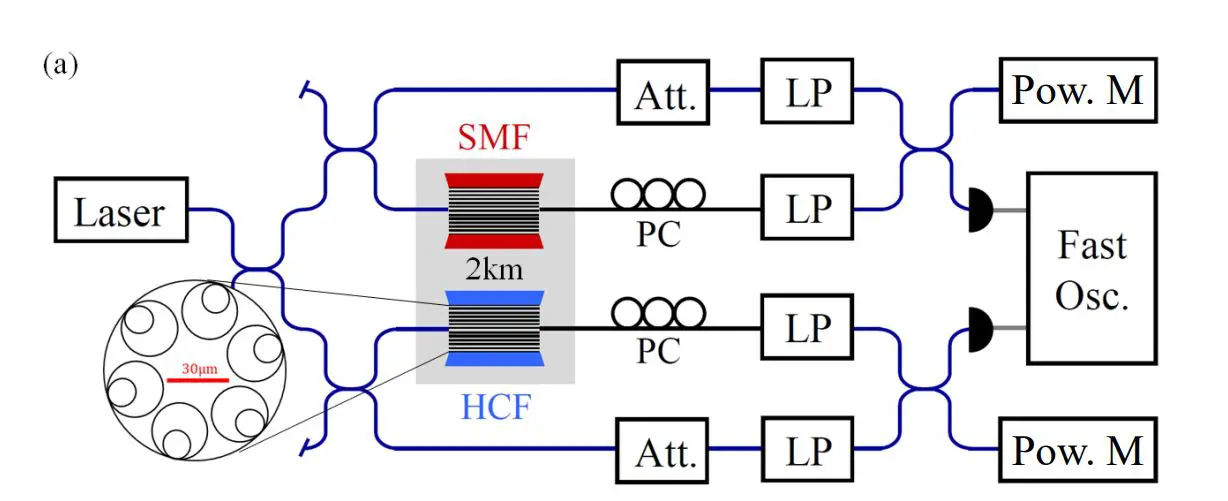
Scientists engineered a sophisticated experimental setup to assess the viability of hollow core fibre for advanced quantum key distribution protocols. The study focused on establishing whether hollow core fibre could maintain the necessary phase coherence for protocols like Twin-Field QKD, which demands minimal phase noise over long distances. To achieve this, researchers constructed two parallel Mach-Zehnder interferometers, one utilizing 2km of hollow core fibre and the other a standard 2km spool of single mode fibre as a control, allowing for direct comparison of the two fibre types. The hollow core fibre, containing six nested tubes, was carefully spliced to single mode fibre patch cables, accounting for optical loss at each connection.
A narrow linewidth laser module emitting continuous wave light was simultaneously directed into both interferometers, optimizing interference visibility and balancing signal loss through the use of manual variable optical attenuators and polarization controllers. Polarization maintaining components were used where possible to maximize throughput. Researchers employed both power meters and fast 5GHz photodetectors to capture the interference patterns. Power meters monitored optical power during setup and optimization, while the photodetectors recorded voltage traces on a 36GHz oscilloscope, enabling resolution of fast phase fluctuations.
Voltage traces were captured at multiple sampling frequencies, providing comprehensive data for spectral analysis. By performing a moving average of the voltage traces, conservative estimates of interference visibility were deduced, revealing values exceeding 99% for the single mode fibre and greater than 92% for the hollow core fibre. These visibility measurements were then converted into phase values, allowing scientists to calculate the phase noise power spectral density using Welch’s method. The resulting phase noise PSDs revealed characteristic ripples attributable to temporal asymmetry between the interferometer arms. Precise measurements of these delays indicated asymmetries aligning with the periodicity observed in the PSD plots. This detailed analysis established a baseline for assessing the performance of hollow core fibre in demanding quantum communication applications.
Hollow Core Fibre Enables Twin-Field QKD
Scientists have demonstrated the suitability of hollow core fibre (HCF) for advanced quantum key distribution (QKD) protocols, specifically Twin-Field QKD, by meticulously characterizing its phase noise properties. The research addresses a critical need for improved long-distance quantum communication channels, moving beyond standard single-mode fibre (SMF). Experiments involved concurrent measurements using both 2km spools of HCF and SMF within a double asymmetric Mach-Zehnder interferometer configuration, alongside a dedicated Twin-Field QKD-like setup. Initial assessments focused on quantifying phase noise, a key factor limiting the performance of phase-based QKD.
The team constructed two interferometers to directly compare the phase properties of HCF and SMF, utilizing a narrow linewidth laser and fast 5GHz photodetectors. Voltage traces were recorded at multiple sampling frequencies to resolve fast phase fluctuations, providing a detailed comparison of the noise characteristics inherent to each fibre type. Further experiments involved constructing a Twin-Field QKD-like setup, integrating both HCF and SMF channels. This configuration allowed scientists to directly assess the suitability of HCF for the demanding requirements of this advanced QKD protocol. The HCF sample used in the study contained six nested tubes and was spooled around a bobbin, with splices contributing optical loss. The SMF control sample exhibited a standard attenuation coefficient at 1550nm. The results indicate that HCF exhibits comparable phase noise characteristics to SMF, suggesting its viability as a future channel for long-distance, secure quantum communication.
Hollow Core Fibre Enables Robust QKD
This research demonstrates the suitability of hollow core fibre for use in advanced quantum key distribution protocols, particularly twin-field quantum key distribution. Through a series of experiments utilising both concurrent measurements and a twin-field interferometer, scientists established that hollow core fibre exhibits remarkable resistance to phase noise, a critical factor limiting the range and performance of quantum communication systems. The fibre’s performance in this regard is comparable to, and in some cases exceeds, that of standard single mode fibre, which has already proven effective in twin-field implementations. These findings represent a significant step towards realising long-distance, secure quantum communication networks. Beyond its phase noise resilience, hollow core fibre offers additional advantages, including excellent polarisation stability and extremely low nonlinearity. These properties simplify system alignment and enable the multiplexing of quantum and classical signals without compromising.
🗞 Phase noise characterisation of a 2-km Hollow-Core Nested Antiresonant Nodeless Fibre for Twin-Field Quantum Key Distribution
🧠 ArXiv: https://arxiv.org/abs/2512.04605