The search for exotic states of matter exhibiting topological order continues to drive condensed matter physics, and the non-Abelian quantum Hall phases represent a particularly intriguing frontier. Misha Yutushui from the Weizmann Institute of Science, and Arjun Dey from both the PSI Center for Scientific Computing and École Polytechnique Fédérale de Lausanne (EPFL), alongside David F. Mross from the Weizmann Institute, present compelling numerical evidence that these elusive phases can be reliably identified by examining their “daughter” states, related quantum states that act as fingerprints of the parent phase. Their work demonstrates that interactions stabilizing well-known phases like the Pfaffian and anti-Pfaffian, within bilayer and wide quantum well systems, also consistently produce these diagnostic daughter states, effectively ruling out competing possibilities. This ability to deduce the properties of a parent phase from its daughters represents a significant step forward in characterizing and ultimately harnessing the potential of these exotic quantum systems.
Non-Abelian quantum Hall states are accompanied by nearby ‘daughter’ states, which are proposed to identify their topological order. Researchers provide numerical evidence that daughter states reliably predict the parent topological phase, offering a new way to characterize these complex quantum systems. In bilayer graphene and wide GaAs quantum wells, the team demonstrates that the same interactions simultaneously stabilize Pfaffian, anti-Pfaffian, and their daughters, while suppressing more conventional states.
Composite Fermions and FQHE Hierarchy
A substantial body of research focuses on the Fractional Quantum Hall Effect (FQHE), composite fermions, and related topological states of matter. This work explores the foundational theory of composite fermions, which explains many FQHE states, and investigates hierarchical structures where complex states are built from simpler ones. Researchers frequently utilize the Laughlin wavefunction as a starting point for descriptions of these systems, modifying and extending it to explore various configurations. Significant attention is given to Moore-Read and Pfaffian states, non-Abelian states with exotic excitations potentially useful in topological quantum computation.
Much of this research centers on the ν = 5/2 FQHE state, a particularly important non-Abelian candidate. Researchers investigate the effects of Landau level mixing, where electrons are not perfectly confined, on the properties of this state and others. Studies extend to other fractional fillings, such as 12/5, 13/3, 8/3, and 8/5, in the search for new non-Abelian states. A considerable portion of the research focuses specifically on bilayer graphene, a material with unique properties due to its band structure and the possibility of orbital and valley quantum numbers. The interplay of these degrees of freedom leads to a richer variety of FQHE states, including shifted states and daughter states, which help characterize the different phases.
Researchers employ various computational methods, including exact diagonalization and Monte Carlo simulations, to study the properties of FQHE states. They use wavefunction ansatzes, or trial wavefunctions, to approximate the ground state of the system and calculate interactions between electrons using Haldane pseudopotentials. Current research emphasizes understanding the FQHE in bilayer graphene, particularly the role of orbital and valley degrees of freedom and the emergence of unconventional pairing mechanisms. A significant effort is dedicated to identifying and characterizing non-Abelian phases through the study of daughter states and their properties.
Advanced computational methods are increasingly used to explore the phase diagram of FQHE states and to test theoretical models. Researchers are also exploring unconventional FQHE states beyond the standard Laughlin or Pfaffian paradigms, and utilizing data-driven approaches to refine theoretical models and identify new phases of matter. This research is highly interdisciplinary, combining theoretical physics, materials science, and computational methods, and remains a very active field with new discoveries constantly emerging. The potential applications of FQHE states in topological quantum computation continue to drive research in this area.
Daughter States Reveal Quantum Hall Phase Types
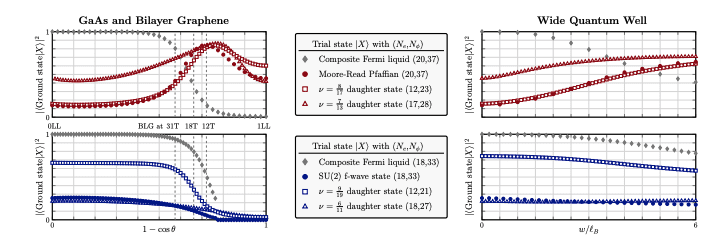
Researchers have made significant progress in identifying and understanding non-Abelian quantum Hall states by focusing on the presence of “daughter” states. These daughter states serve as reliable indicators of the underlying topological order. The research demonstrates that the presence of specific daughter states accurately predicts the type of quantum Hall phase present. The team investigated how interactions influence the stability of different quantum Hall states, including the Pfaffian and anti-Pfaffian phases, within both bilayer and wide GaAs quantum wells. They found that these interactions can simultaneously stabilize both the Pfaffian and anti-Pfaffian states, alongside their respective daughter states, while suppressing more conventional states.
Importantly, the competition between the Pfaffian and anti-Pfaffian phases, determined by subtle asymmetries in the system, can also be deduced by examining their daughter states, further solidifying their role as diagnostic tools. The research extends to wide quantum wells, where the width of the confining structure acts as a tuning parameter. By adjusting this width, researchers can promote the formation of paired states, even at unusual filling fractions. Results show that increasing the well width favors the Pfaffian order and its daughters, aligning with experimental observations. Furthermore, the team distinguished between daughter states and Jain states, which can sometimes mimic similar behavior.
They found that a well-developed quantum Hall state accompanied by weaker or absent Jain states at lower filling fractions is highly likely to be a daughter state, providing a clear criterion for identification. To account for real-world imperfections, the researchers also considered the effects of Landau level mixing. They demonstrated that even with these imperfections, the presence of specific daughter states strongly indicates the realization of the Pfaffian topological order. By perturbing a particle-hole symmetric Hamiltonian, they achieved approximately 84% overlap between the ground state and the Pfaffian daughter wavefunction, while the overlap with the anti-Pfaffian daughter remained below 1%, providing compelling evidence for the reliability of this approach. These findings offer a powerful new method for identifying and characterizing exotic quantum Hall states, paving the way for further exploration of these fascinating phases of matter.
Daughter States Reveal Quantum Hall Phase Competition
This research provides numerical evidence supporting a method for identifying topological order in certain quantum Hall states by examining their “daughter” states. The team demonstrates that these daughter states reliably predict the properties of the parent quantum Hall phase, offering a way to understand complex quantum systems through their more easily studied relatives. Specifically, the findings show that interactions within bilayer and wide GaAs quantum wells can simultaneously stabilize Pfaffian, anti-Pfaffian, and their respective daughter states, while suppressing other competing states. Importantly, the study establishes that the competition between Pfaffian and anti-Pfaffian phases can be determined by analyzing their daughter states, independent of specific perturbations to the system.
The researchers confirm that the observed daughter states flanking half-filled states in bilayer graphene and GaAs quantum wells align with predictions based on this method. While the study focused on specific pairing channels, the authors note that this daughter-state approach could, in principle, diagnose other types of quantum Hall states. The team estimates that their numerically obtained wave functions closely approximate the exact solutions, with squared overlaps exceeding 99%.
👉 More information
🗞 The numerical case for identifying paired quantum Hall phases by their daughters
🧠 ArXiv: https://arxiv.org/abs/2508.14162