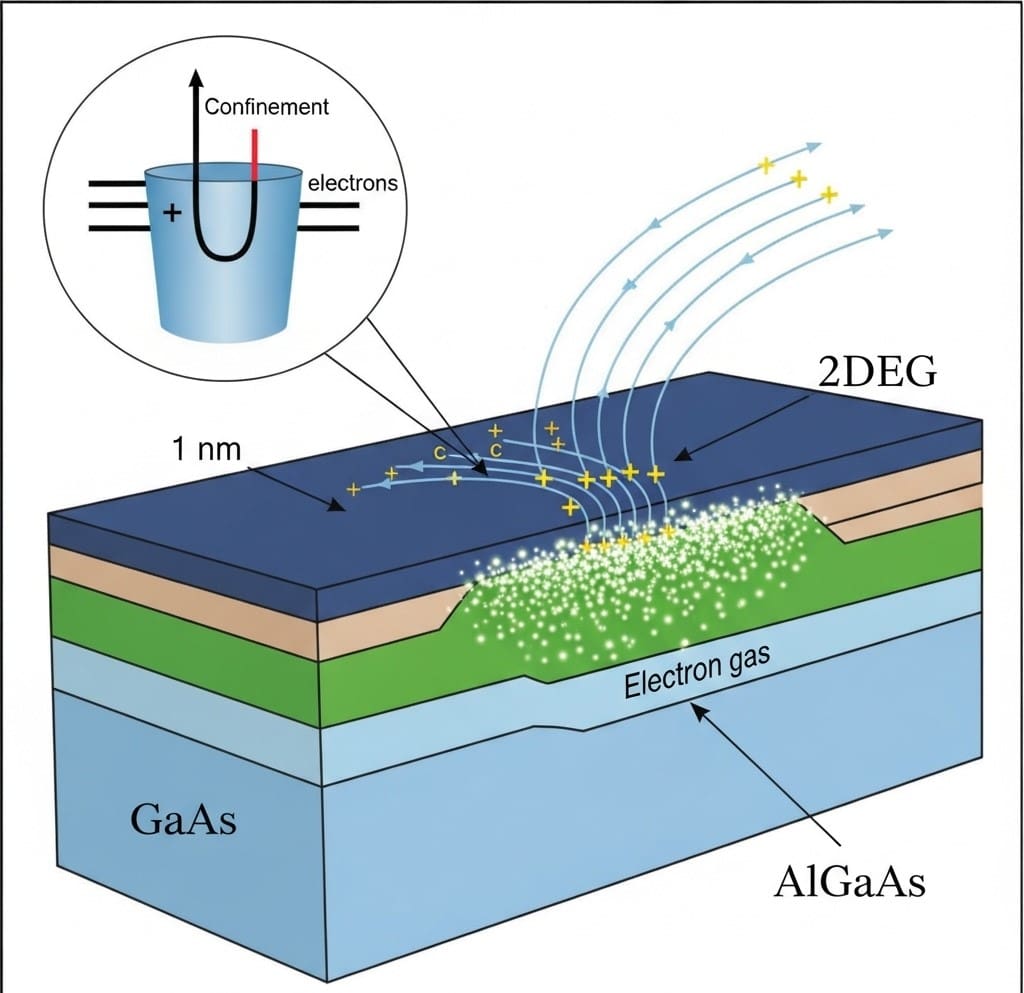
The quantum Hall effect, a phenomenon where electron flow becomes precisely quantised in strong magnetic fields, continues to reveal surprising subtleties, and understanding the precise relationships between different measurable properties remains a key challenge. Yurii Arapov, Svetlana Gudina, and Vladimir Neverov, along with their colleagues at the M. N. Mikheev Institute of Metal Physics, now demonstrate a robust two-parameter scaling law governing conductance in these systems. This work establishes a clear connection between experimental observations and theoretical predictions, offering a refined understanding of electron behaviour in two-dimensional semiconductors and providing a valuable benchmark for future investigations into the fundamental physics of the quantum Hall effect. The team’s comprehensive analysis of experimental data confirms the predicted scaling behaviour, solidifying a crucial theoretical framework and paving the way for more accurate modelling of electron transport in these materials.
Results on constructing scaling diagrams for conductance in 2D semiconductor structures, as well as in graphene, are displayed. A comparative analysis of scaling diagrams obtained from experimental data with calculated ones is carried out. The integer quantum Hall effect (IQHE) is a universal phenomenon that occurs when two-dimensional (2D) semiconductor systems are exposed to a perpendicular magnetic field at low temperatures. The magnetic field splits the constant density of states into discrete Landau levels, which.
Quantum Hall Effect and Scaling Diagrams
This research provides a comprehensive overview of the quantum Hall effect (QHE), its connection to electron localization in disordered 2D materials, and its relevance to novel materials like graphene. The study focuses on scaling diagrams, also known as renormalization group flow diagrams, as a powerful tool for understanding the quantum phase transitions that occur within the QHE regime. It represents a thorough review of the theoretical foundations, experimental observations, and recent advancements in the field. The paper explores the fundamental principles of the QHE, beginning with its discovery and highlighting its importance in both precision measurements and fundamental physics.
It then delves into the theory of localization in disordered systems, explaining how imperfections can suppress electron wave functions and lead to insulating behavior. Key concepts such as scaling theory and critical exponents are introduced to describe the behaviour of systems near critical points. A central theme of the work is the use of scaling diagrams to visualize and understand quantum phase transitions in the QHE. These diagrams reveal information about critical exponents and the nature of the transitions between different quantum states. The research reviews experimental observations of the QHE in various materials, including traditional 2D electron gases found in semiconductor heterostructures and, importantly, in graphene.
A significant portion of the study is dedicated to the QHE in graphene, a material with unique electronic properties. The research discusses how graphene’s Dirac-like electronic structure and Berry phase influence the QHE, and explores its potential for realizing novel quantum phenomena. The paper concludes with a discussion of recent advancements in the field and potential future research directions. The research demonstrates a strong command of the existing literature and provides a valuable contribution to the understanding of this fascinating area of physics. It lays a strong foundation for further investigations into the behaviour of electrons in strongly correlated systems.
Delocalized States Drive Integer Quantum Hall Effect
Scientists have comprehensively investigated the integer quantum Hall effect (IQHE), a phenomenon occurring in two-dimensional semiconductor systems exposed to strong magnetic fields and low temperatures. The work centers on understanding how electron behavior transitions between localized and delocalized states within these systems, utilizing a two-parameter scaling theory to explain the coexistence of both types of states. Researchers constructed scaling diagrams based on experimental data, analyzing conductance in various 2D structures, including graphene and semiconductor heterostructures. The study confirms the existence of narrow bands of delocalized states near the center of each Landau subband, crucial for the IQHE to occur, despite earlier theories suggesting complete localization in 2D systems.
Experiments demonstrate that the scaling diagrams constructed from experimental data align with theoretical predictions, validating the two-parameter scaling hypothesis. This work builds upon the foundational understanding of electron behaviour in quantizing magnetic fields, confirming the presence of both localized and delocalized states within the energy spectrum. The team meticulously analyzed the magnetic field and temperature dependence of resistivity components during transitions between quantum Hall plateaus, providing further support for the scaling hypothesis. By constructing scaling diagrams in coordinates of Hall and longitudinal conductances, scientists were able to visually confirm the theoretical predictions regarding the interplay between localization and delocalization. This research delivers a robust validation of the two-parameter scaling theory, solidifying its importance in understanding the fundamental physics of the IQHE and providing a framework for future investigations into electron behaviour in strongly correlated systems.
Quantum Hall Transitions and Scaling Theory
This research presents a comprehensive analysis of the integer quantum Hall effect, focusing on the behaviour of conductance in two-dimensional semiconductor structures and graphene. By combining theoretical modelling with experimental data, the team successfully constructed and compared scaling diagrams that illustrate the transitions between localized and extended electron states within the quantum Hall regime. This work reinforces the understanding of the quantum Hall effect as a series of quantum phase transitions driven by magnetic field strength and disorder, effectively linking it to established theories of metal-insulator transitions. The study demonstrates the effectiveness of two-parameter scaling theory in describing the complex interplay between localization and delocalization of electrons in strong magnetic fields. By validating this theoretical framework with experimental observations, the team provides further insight into the fundamental mechanisms responsible for the quantized Hall resistance and vanishing longitudinal resistance characteristic of the effect.
👉 More information
🗞 Two parameter scaling of conductance in quantum Hall effect
🧠 ArXiv: https://arxiv.org/abs/2510.19739