

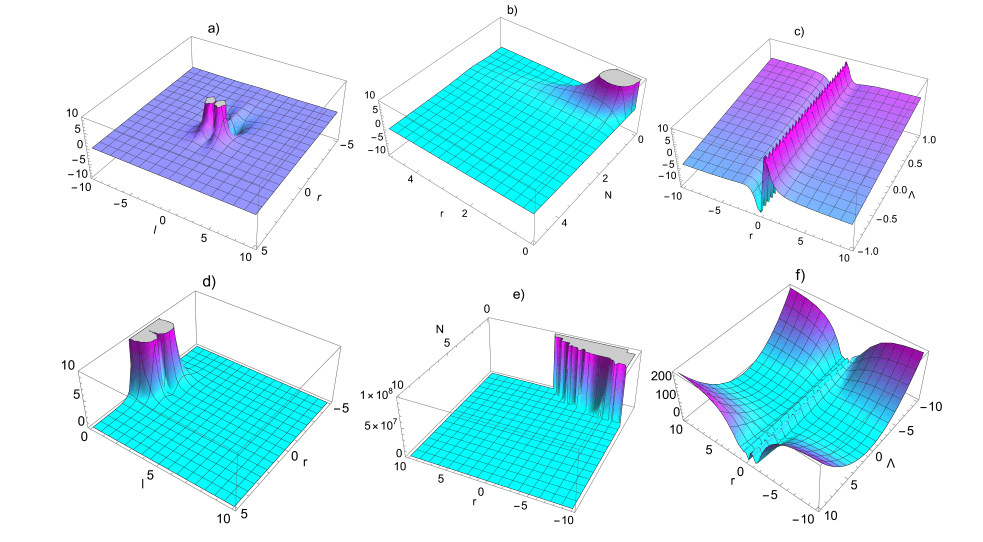
The enduring mystery of black holes and the accelerating expansion of the universe receive fresh scrutiny in new research demonstrating a connection between these phenomena within a framework of quantum gravity. Diego A. Martínez-Valera, from the Instituto de Física at the Benemérita Universidad Autónoma de Puebla, and colleagues reveal that the well-known Schwarzschild-de Sitter spacetime emerges as a natural solution within a specific class of quantum theories, eliminating the need for an artificially imposed cosmological constant. This achievement allows the team to construct a remarkably regular black hole spacetime through conformal rescaling, ensuring completeness by verifying the predictable paths of both massive and massless particles. By broadening the range of viable solutions in this finite conformal theory, the research not only advances our theoretical understanding of black holes, but also paves the way for more precise tests using astrophysical observations of the universe’s expansion.
Conformal Gravity Resolves Black Hole Singularities
This research explores conformal gravity as a means of resolving singularities within black hole spacetimes and developing a more complete theory of gravity. Scientists aim to construct a super-renormalizable conformal gravity theory, avoiding the mathematical inconsistencies that often arise in quantum gravity. The team successfully constructs singularity-free black hole solutions, models that do not possess a central singularity, a long-standing problem in general relativity. These theoretical models are then rigorously tested against real-world astrophysical observations, including data from megamasers and the supermassive black hole at the center of our galaxy, Sgr A*.
The research also investigates connections to other areas of theoretical physics, such as renormalization group flow, quantum field theory, and the concept of asymptotic safety, where gravity remains well-defined at all energy scales. This comprehensive approach combines theoretical development with observational verification, building upon a long history of work in conformal gravity and quantum gravity. The research draws upon ideas from general relativity, quantum field theory, and astrophysics, demonstrating a high level of mathematical and theoretical rigor.
Weak Non-Locality and Cosmological Constant Emergence
This research demonstrates that the classical Schwarzschild-de Sitter spacetime satisfies the field equations of a novel, weakly non-local conformal theory without requiring an explicit cosmological constant in the fundamental equations. Instead, the observed cosmological constant arises naturally from the coupling constants within the theory itself. Scientists constructed this theory using a Lagrangian incorporating higher-order curvature terms and a carefully designed operator, eliminating problematic ghost fields and ensuring weak non-locality. The researchers rigorously demonstrate that the Schwarzschild-de Sitter metric emerges as a solution to these field equations, effectively bypassing the need for an artificially imposed cosmological constant.
This achievement involved detailed calculations of the field equations and verification that the resulting equations are satisfied by the Schwarzschild-de Sitter metric. The team further expands the theory by allowing the conformal factor parameter to take on real values, maintaining spacetime completeness and rigorously investigating the regularity of curvature invariants and geodesic completeness for both massive and massless particles. Finally, scientists construct a Penrose diagram to map the global causal structure of the regular spacetime, providing a comprehensive understanding of its properties and potential astrophysical implications.
Non-Local Conformal Theory Resolves Black Hole Singularities
This work demonstrates that the classical Schwarzschild-de Sitter spacetime represents an exact solution within a class of weakly non-local, ultraviolet-finite conformal theories, eliminating the need for an explicit cosmological constant. Scientists associate the effective cosmological constant observed in the metric with the coupling constants inherent within the theory, offering a novel perspective on cosmological expansion. By exploiting the inherent conformal symmetry, the team constructed a regular spacetime through conformal rescaling of the Schwarzschild-de Sitter solution, effectively addressing the singularity problem at the black hole’s center. The analysis ensures spacetime completeness by rigorously investigating the regularity of curvature invariants and confirming geodesic completeness for both massive and massless particles, establishing a robust mathematical framework for the spacetime model.
Explicit construction of the Penrose diagram further elucidates the global causal structure of this regular spacetime, providing a comprehensive visualization of light cone behavior and potential particle trajectories. The team generalized the range of conformal factors that generate regular spacetimes, considering the conformal factor parameter as a real number with a lower bound, a significant departure from previous studies constrained to positive integers. This broadened range of solutions expands the scope of the finite conformal theory and opens avenues for more precise observational tests using astrophysical data, particularly concerning the accelerated expansion of the universe.
Cosmological Constant Emerges From Conformal Theory
This research demonstrates that the classical Schwarzschild-de Sitter spacetime emerges as an exact solution within a specific class of finite, non-local conformal theories, achieved without requiring an explicit cosmological constant in the theoretical framework. Instead, the observed cosmological constant in the metric is linked to the coupling constants inherent within the theory itself, representing a significant step towards unifying gravity with quantum principles. By leveraging the conformal symmetry of the theory, scientists constructed a regular spacetime through conformal rescaling of the Schwarzschild-de Sitter solution, effectively addressing the issue of spacetime singularities. The team rigorously verified the completeness of this regular spacetime by examining the behaviour of curvature invariants and confirming geodesic completeness for both massive and massless particles, alongside a detailed analysis of its global causal structure using Penrose diagrams.
Importantly, this work expands upon previous studies of regular black holes by demonstrating a broader range of permissible conformal factors, allowing for a more flexible and potentially realistic description of spacetime geometry. The authors acknowledge that the parameter defining the conformal factor was previously constrained to positive integer values, but this analysis establishes it as a real parameter with a lower bound, opening new avenues for exploration. Future research may focus on refining observational tests of the theory using astrophysical data, particularly by considering the accelerated expansion of the universe and leveraging megamaser observations to constrain the parameters governing the regular spacetime.
👉 More information
🗞 Nonsingular Schwarzschild-de Sitter black holes in finite conformal quantum gravity
🧠 ArXiv: https://arxiv.org/abs/2510.05466


