

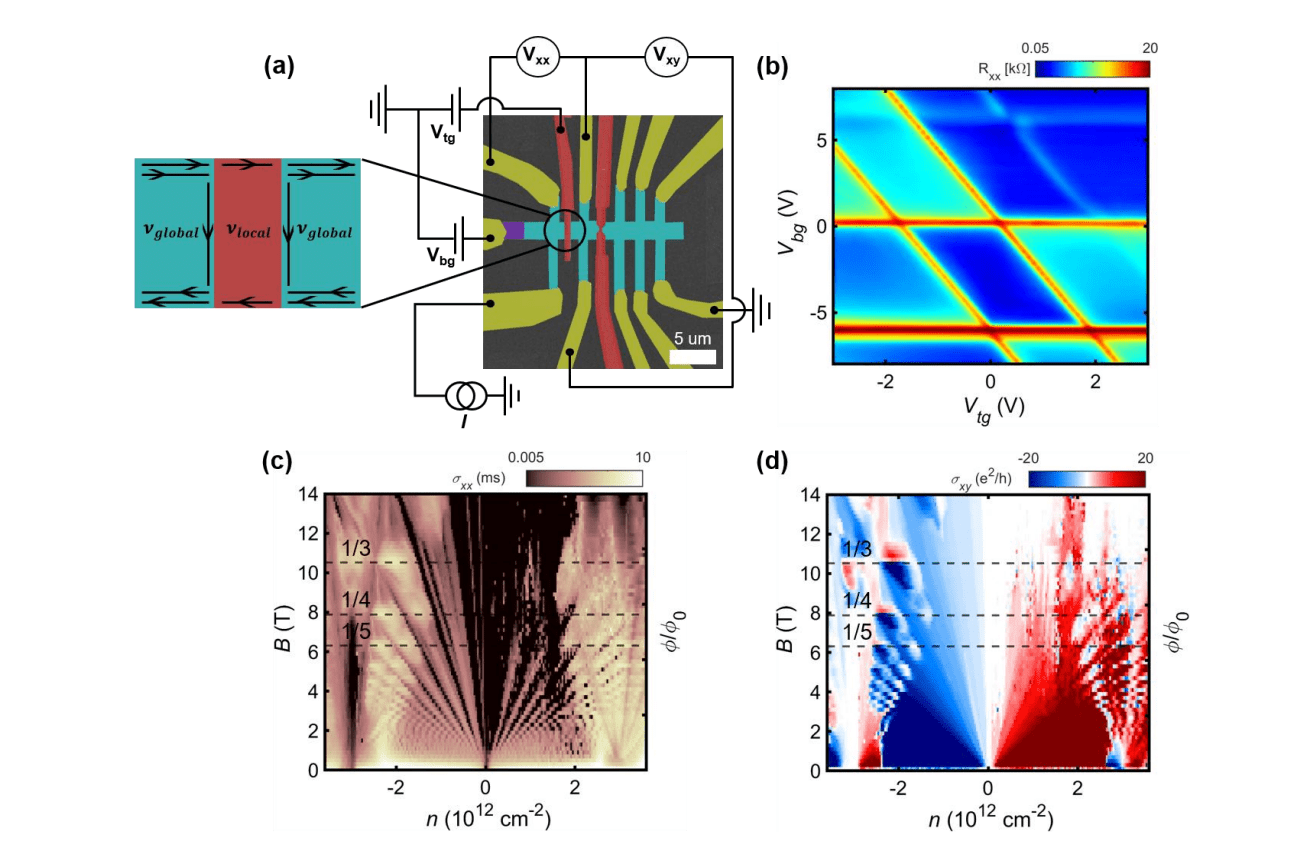
Controlling the flow of electrons in one-dimensional quantum channels represents a crucial step towards realising advanced quantum technologies, owing to their exceptional ballistic and phase coherence properties. Won Beom Choi, Myungjin Jeon, and colleagues at Seoul National University and the Institute for Basic Science now demonstrate a novel approach to manipulating these channels within a locally gated graphene junction. The team observes unique interactions between quantum Hall edge channels, even in the absence of conventional band gaps or zeroth Landau level suppression, by creating a special type of p-n junction aligned with hexagonal boron nitride. This innovative design generates a van Hove singularity at the junction under magnetic fields, allowing researchers to study interactions between channels with opposing doping, and offering new insights into superlattice-induced quantum phenomena.
Graphene’s Helical States and Edge Transport
This research investigates the quantum properties of graphene, focusing on how different quantum Hall states interact and how external factors influence electron behavior. Scientists explored the interplay between chiral and helical states in graphene devices, examining the impact of local and global doping, magnetic fields, and surrounding materials like hexagonal boron nitride and silicon dioxide. The team discovered that helical states form in specific regions of their graphene devices, particularly when a thin layer of hexagonal boron nitride is present, creating unique pathways for electrons and modifying the electrical resistance of the device. Researchers identified and characterized distinct quantum Hall regimes, including chiral and helical states, distinguished by their resistance behavior.
The thickness of surrounding materials, both hexagonal boron nitride and silicon dioxide, plays a crucial role in determining the type of quantum Hall state that forms, with thin layers of hexagonal boron nitride promoting helical states and thicker layers supporting chiral states. The clarity of these states decreases with increasing temperature, and magnetic fields influence the formation of helical states. The team’s findings provide a comprehensive understanding of the interplay between different quantum Hall states in graphene, highlighting the crucial role of surrounding materials and local control in manipulating electron behavior and edge transport.
Heterostructure Fabrication and Alignment Procedures
Scientists engineered a novel device platform using layers of hexagonal boron nitride and graphene to investigate fundamental quantum phenomena in one-dimensional electron channels. The fabrication process involved peeling off thin flakes of hexagonal boron nitride and a single layer of graphene, followed by removal of imperfections using an atomic force microscope. A dry transfer method was employed to stack the materials, including a graphite flake serving as a global bottom gate, onto a silicon dioxide wafer at elevated temperature. Precise alignment of the hexagonal boron nitride and graphene crystal axes was crucial, achieved by visually identifying angles corresponding to multiples of 30° under an optical microscope.
A narrow top gate was subsequently fabricated using electron beam lithography, with careful attention paid to adhesion to the hexagonal boron nitride surface. Devices incorporating both a local top gate and a global bottom gate were fabricated on silicon dioxide wafers, utilizing the silicon bottom gate as a contact gate to minimize electrical resistance and prevent unwanted p-n junction formation. The resulting devices exhibited high electron mobility, demonstrating the high quality of the heterostructures. Magnetotransport measurements, performed at extremely low temperatures, revealed clear signatures of quantum Hall states, with quantized plateaus in transverse conductivity and suppressed longitudinal conductivity, indicating the emergence of unique quasiparticles due to the alignment of the lattice periodicity with electron orbits.
Quantum Hall Effects in Graphene Heterostructures
Scientists achieved precise control over electron behavior in graphene aligned with hexagonal boron nitride, creating a novel platform for studying quantum phenomena relevant to quantum information. The research team fabricated devices incorporating independently tunable gates, allowing investigation of interactions between oppositely flowing quantum Hall edge channels. Magnetotransport measurements at extremely low temperatures identified clear quantum Hall states, with quantized plateaus in transverse conductivity coinciding with suppressed longitudinal conductivity, particularly on the hole-doped side. Further experiments demonstrated the creation of p-n junctions, revealing oscillations in electrical resistance when tuned to specific doping configurations.
The team observed interference patterns, with an insulating phase at a specific energy point enhancing visibility of the oscillations. The energy gap at this point was estimated to be approximately 30 meV at zero magnetic field, increasing with higher field strengths, and contributing to stable electron wave coherence essential for quantum interference. These findings establish a new pathway for manipulating and studying electron behavior in two-dimensional materials, with potential applications in quantum computing and advanced electronics.
Graphene Junctions Show Unique Channel Interactions
This research demonstrates the successful fabrication and study of p-n junctions within graphene devices aligned with hexagonal boron nitride. The team observed unique interactions between co-propagating quantum Hall edge channels, differing significantly from conventional p-n junctions which typically exhibit depletion regions. Instead, these junctions feature a unique energy state, creating a metallic area that facilitates interaction between the channels. By utilizing independently tunable gates, researchers realized two distinct junction types, one with an insulating gap and another promoting enhanced equilibration, allowing direct comparison of channel interaction limits.
The investigation revealed a range of behaviours, including edge transmission, partial and full equilibration, and interference patterns, all stemming from the unique band structure of graphene. Notably, full equilibration in a specific junction configuration provides valuable insight into the interplay between quantum Hall edge channels within a specific energy landscape. This work establishes a platform for studying interactions and suggests potential applications in future quantum information devices and heterostructures.
👉 More information
🗞 Interaction of moire-induced quantum Hall channels in a locally gated graphene junction
🧠 ArXiv: https://arxiv.org/abs/2511.01225

