The second quantum revolution has been ongoing for over two decades, with more than 15 national initiatives and over 30 billion euros of public investments globally. The number of publications, patents, and startups in quantum technologies (QT) has been steadily increasing. This rapid development has triggered a quantum ‘race’ among countries, companies, and institutions.
However, the transformative effects of QT on society will be long-term. A workshop organized by the QuTec project under KIT-ITAS aims to discuss responsibility in QT and introduce it as a topic for technology assessment studies. Key participants include Natasha Oughton (NQCC), Mira Wolf-Bauwens (IBM Research Europe), and Oxana Mishina (CNR-INO c/o UniTS).
The Quantum Revolution and Its Societal Impact
The second quantum revolution has been in progress for over two decades, with its potential being recognized globally. In the past decade, the number of publicly supported national initiatives has grown from zero to over 15, with more than 30 billion euros of public investments allocated or planned worldwide. The number of new publications and patents granted on quantum technologies (QT) has been steadily increasing, as has the number of start-ups and established companies entering the field. Private funding sources have also begun to take notice, leading to what some have termed the ‘quantum gold rush’.
This rapid development has sparked a competitive ‘race’ in the quantum field, with countries, companies, and institutions vying to achieve milestones or set new benchmarks in quantum technology. However, many observers note that the transformative effects of QT on society will be realized in the long term. This has led to discussions on responsibility and the introduction of QT as an emerging topic for technology assessment (TA) studies.
The Responsible Quantum Technologies Workshop
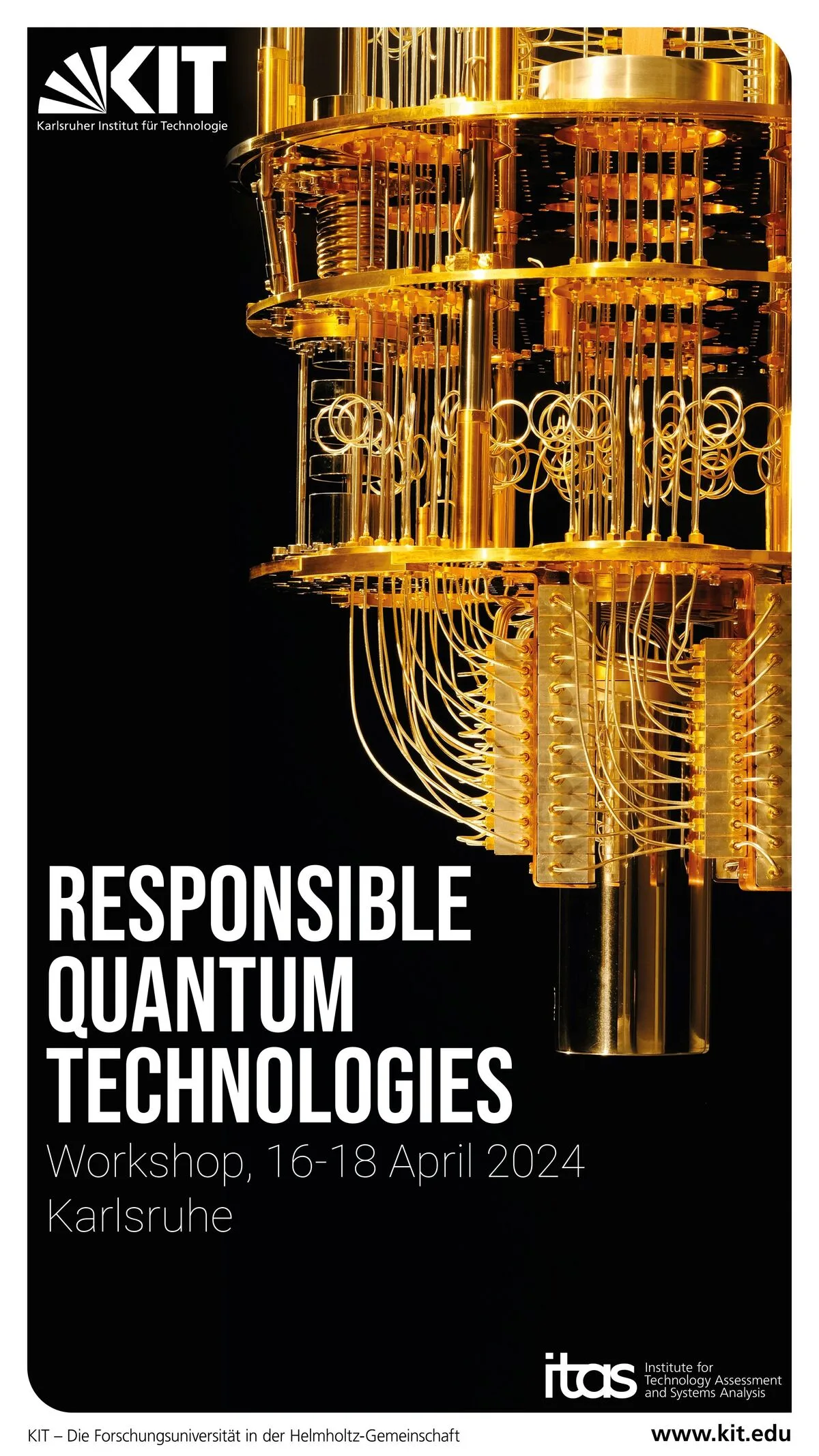
The Responsible Quantum Technologies Workshop, scheduled for April 16-18, 2024, aims to foster connections between the QT and TA communities and introduce current discussions in the QT community to a broader audience. The workshop is organized as a collaboration between the QuTec project under KIT-ITAS.
The workshop will feature presentations on responsible QT efforts, ethics education in QT education and training, new ways to teach and think “quantum”, and grassroots initiatives in QT. It will also host a panel discussion on the “workforce development” narrative in QT education.
Responsible and Ethical Quantum Computing
The workshop will feature presentations from Natasha Oughton of the UK’s National Quantum Computing Centre (NQCC) and Mira Wolf-Bauwens of IBM Research Europe, among others. They will discuss responsible and ethical quantum computing and the need for the era of quantum utility to also be the era of responsible quantum computing. Oxana Mishina from CNR-INO c/o UniTS will present on European and national considerations about the impact of quantum technology on society.
Ethics Education in Quantum Technology Education and Training
The workshop will also focus on the role of ethics in quantum technology education and training. Presentations will be given by Alexandre Artaud from TU Delft, Franziska Greinert from TU Braunschweig, Josephine Meyer from the University of Colorado Boulder/QEP, and Wenzel Mehnert from AIT. They will discuss the challenges, successes, and pitfalls of teaching ethics of QT, the role of ethics within the European framework for QT education, and the development of a modular, research-based curriculum for ethics education in the QT classroom.
Grassroots Initiatives in Quantum Technology
The workshop will also highlight grassroots initiatives in quantum technology. Presentations will be given by Sahar Ben Rached from Universitat Politècnica de Catalunya/QTunisia, Alexander Orlov from TUM/PushQuantum, Josephine Meyer from the University of Colorado Boulder/QEP, Sophia Gürtler from Girls in Quantum, and Ulrike Genenz from RWTH Aachen/KIT. They will discuss global grassroots initiatives for an inclusive future of quantum technology, building and supporting a global network of quantum ethicists, and the values of grassroots organizations involved in QT education and outreach.
External Link: Click Here For More