


Researchers from IonQ and Hyundai demonstrated an end-to-end application of quantum generative adversarial networks (GANs) for enhancing steel microstructure image augmentation using a trapped-ion quantum computer, showcasing potential advancements in materials science data generation.
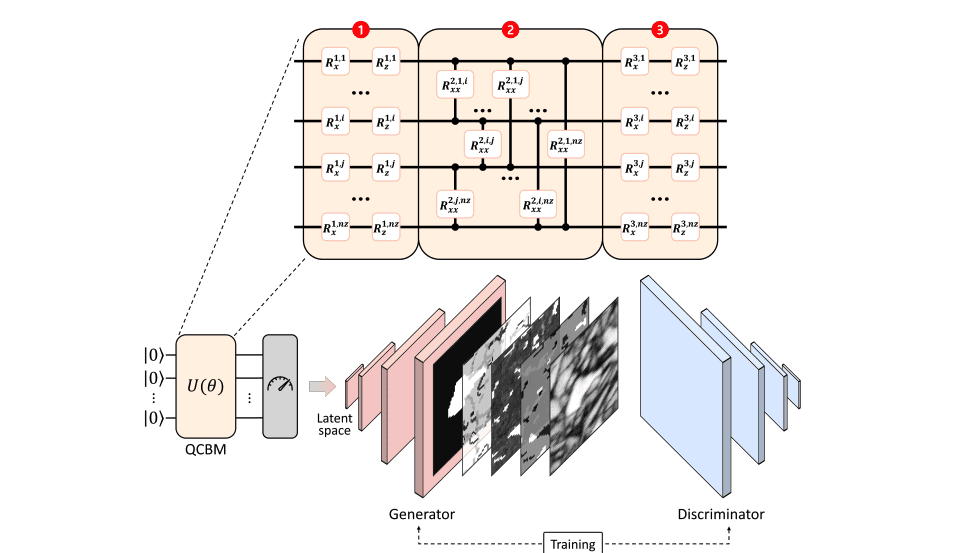
The study integrates quantum circuits into a classical Wasserstein GAN (WGAN) to generate high-quality synthetic electron backscatter diffraction (EBSD) images for steel microstructures. By training a quantum circuit at the input layer of a large WGAN model, researchers successfully mitigate mode collapse and produce complex 5-channel EBSD images of ferrite and bainite phases.
Based on maximum mean discrepancy scores, the hybrid approach outperforms classical Bernoulli GANs in 70% of samples. This method demonstrates potential for scaling to larger quantum systems and enhancing synthetic image quality for materials science applications.
Quantum computing stands at the precipice of revolutionizing machine learning, offering capabilities that classical computers cannot match. Recent advancements have transitioned from theoretical models to practical applications, highlighting quantum computing‘s potential to transform industries.
At the forefront of these innovations are quantum
At the forefront of these innovations are quantum generative models, which excel in learning complex probability distributions. These models are particularly effective in image generation and predictive analytics tasks. A 2022 study by Zhu et al. demonstrated how quantum systems can learn joint probability distributions more efficiently than classical methods. This opens new data analysis and simulation avenues.
The impact of quantum machine learning is evident across various sectors. In finance, Thakkar et al. (2024) reported improved forecasting accuracy using quantum algorithms. Meanwhile, in astrophysics, Schawinski et al. (2017) utilized generative adversarial networks to analyze galaxy images beyond traditional deconvolution limits. These applications underscore the versatility and transformative potential of quantum computing.

The research demonstrates the development of a hybrid quantum-classical model for generating high-quality synthetic electron backscatter diffraction (EBSD) images of steel microstructures. The model combines a quantum circuit-based Boltzmann machine (QCBM) with a Wasserstein Generative Adversarial Network (WGAN).
The hybrid model consistently outperformed a state-of-the-art classical
The hybrid model consistently outperformed a state-of-the-art classical WGAN with the same structure. Performance improvements ranged from 22-99% for ferrite images and -45% to 150% for bainite images, with 70% of cases showing positive improvements. The model was successfully trained end-to-end on IonQ’s Aria-2 quantum processing unit (QPU) despite gate-level noise.
This represents one of the first demonstrations of a quantum generative model applied to complex real-world data that improves upon classical counterparts. The research used 12 qubits for the current implementation but notes the approach is scalable to more qubits.
Future directions include exploring models with more qubits, investigating different quantum circuit architectures, using synthetic images for data augmentation in classification models, and potentially adding quantum components to the discriminator part of the GAN. The work demonstrates the potential of quantum computers to enhance classical machine learning algorithms, particularly for materials science applications where generating physically accurate synthetic images can help overcome data scarcity issues.
🗞 End-to-End Demonstration of Quantum Generative Adversarial Networks for Steel Microstructure Image Augmentation on a Trapped-Ion Quantum Computer
🧠 DOI: https://doi.org/10.48550/arXiv.2504.08728


