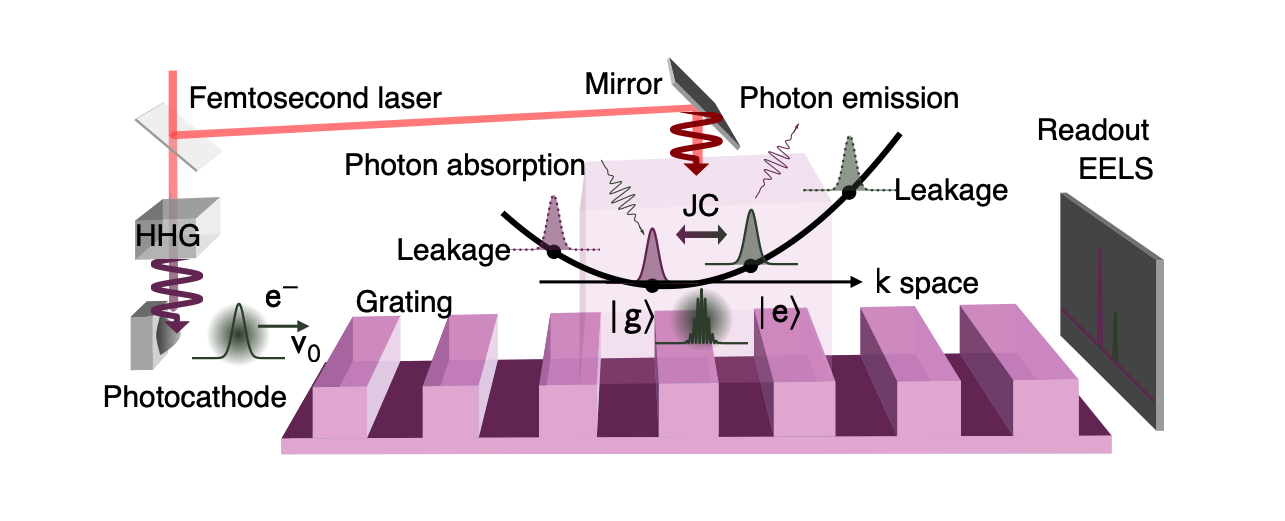
Free-electron quantum optics represents a promising avenue for controlling electrons at the quantum scale, with potential benefits for future quantum technologies. Yongcheng Ding from the University of the Basque Country UPV/EHU, and colleagues, now demonstrate a new architecture for this field, utilising gratings to achieve fully quantized control of electron interactions. The team maps these interactions onto established quantum models, enabling the design of remarkably fast single- and two-qubit gates using free-flying electrons, and crucially, without the need for confining cavities. This achievement establishes a new platform for exploring free-electron quantum optics and paves the way for advancements in quantum simulation, sensing, and information processing.
Relativistic Electrons and Rabi Oscillation Dynamics
This research details a new approach to light-matter interaction using relativistic electrons interacting with a grating, providing a deeper understanding of the fundamental physics governing this process. Scientists explored the dynamics of this interaction, revealing how it transitions between different behaviours depending on electron velocity and the strength of the applied field. The study explains the concepts of collapse and revival in Rabi oscillations, linking these phenomena to the interplay between different photon number components. The team derived equations to calculate the precise timing of these collapse and revival events, providing a theoretical framework for controlling the interaction. Furthermore, the research highlights the importance of considering the discrete nature of the grating, demonstrating how it provides specific momentum values that compensate for any mismatch between the photon and electron momentum, leading to a more accurate phase-matching condition incorporating a quantum correction to the traditional understanding of the grating period.
Relativistic Quantum Optics with Free Electrons
Scientists engineered a novel architecture for fully quantized free-electron quantum optics, establishing a platform for manipulating electrons at the quantum level and advancing quantum technologies. The study pioneered a cavity-free approach, realizing effective Jaynes-Cummings and Tavis-Cummings models to describe photon-electron interactions, enabling ultrafast quantum gates and universal two-electron quantum computing. Researchers defined the total Hamiltonian describing the light-electron interaction, incorporating both quantized light and electron fields, and a relativistic description of electron motion. The team developed a relativistic minimal coupling Hamiltonian, expanding the relativistic dispersion to define electron kinetic energy and the interaction with a classical field.
A laser field, described by a vector potential incorporating amplitude, frequency, and phase, was then defined, with the grating period carefully chosen to satisfy the phase-matching condition between laser frequency and electron velocity. To account for quantum effects, scientists promoted the classical field to a single-mode quantum field, incorporating the photon Hamiltonian. Researchers then applied Floquet-Bloch theory to expand the electron wavefunction as it moved through the periodic grating, defining momentum sidebands and introducing annihilation operators to quantize the electron, yielding a second-quantized electron Hamiltonian incorporating non-linear energy spacing between momentum sidebands.
Electrons as Qubits, Controlled by Light
Scientists have developed a novel framework for manipulating electrons at the quantum level, establishing a platform for advancements in quantum technologies such as simulation, sensing, and information processing. This work centers on a grating-based architecture designed to fully quantize free-electron quantum optics, allowing electron interactions to be mapped onto models analogous to those used in atomic physics, specifically the Jaynes-Cummings and Tavis-Cummings models. The team designed ultrafast single- and two-qubit gates utilizing cavity-free flying electrons, demonstrating the feasibility of universal quantum computing within experimentally accessible setups. Experiments reveal that by carefully controlling the interaction between electrons and light, the team achieved a non-linear energy spacing between electron momentum sidebands, crucial for precise quantum control.
The researchers quantified this spacing, demonstrating its dependence on electron velocity and grating parameters, and successfully derived a total Hamiltonian describing the light-electron interaction. Measurements confirm that under specific conditions, the interaction enters a Bragg regime where only two momentum sidebands participate, leading to an effective Jaynes-Cummings Hamiltonian. Further analysis demonstrates that with multiple electrons, the system can be described by a Tavis-Cummings Hamiltonian, enabling the exploration of phenomena like superradiance and non-equilibrium steady states. The team constructed a native gate set for universal quantum computing, proposing the implementation of Rx, Ry, and iSWAP gates using the derived Hamiltonians.
To preserve gate fidelity, the quantum light must disentangle from the electron wavefunction after each operation, a requirement successfully addressed by operating the system in different regimes. Specifically, for single-qubit rotation gates, the team operated in a resonant regime, achieving a gate duration determined by the effective Rabi frequency and the coherent state amplitude of the light. Measurements show that with a photon number exceeding 1, the effective Rabi frequency can be accurately approximated, enabling precise control over the electron qubit.
Electrons as Qubits in Gratings Demonstrated
This research demonstrates a novel grating-based architecture for fully quantized free-electron quantum optics, establishing a pathway towards manipulating electrons at the quantum level. By applying Bloch-Floquet analysis, scientists successfully map electron interactions onto established quantum models, specifically the Jaynes-Cummings and Tavis-Cummings models, which are fundamental to understanding light-matter interactions. This achievement enables the design of ultrafast single- and two-qubit gates using freely-flying electrons, offering a potentially viable route to building quantum technologies without the need for confining cavities. The team’s work reveals that the grating periodicity defines the momentum transfer between electrons, and importantly, demonstrates a measurable quantum correction to this interaction arising from the discrete nature of the grating harmonics. While the current framework focuses on idealised setups, the researchers acknowledge that practical implementations will require careful consideration of factors such as electron beam quality and grating fabrication tolerances. Future research directions include exploring the potential of this platform for probing fundamental aspects of free-electron quantum optics and developing advanced quantum technologies for simulation, sensing, and information processing.
🗞 Ultrafast quantum gates with fully quantized free-electron quantum optics
🧠 ArXiv: https://arxiv.org/abs/2511.11201