Fault-tolerant quantum computation remains a significant challenge, demanding architectures that balance error correction with practical resource requirements. Yohei Ibe from QunaSys Inc., Yutaka Hirano, Yasuo Ozu, and Toru Kawakubo from The University of Osaka, along with Keisuke Fujii from QunaSys Inc., The University of Osaka, and RIKEN Center for Quantum Computing, present a measurement-based approach to fault tolerance designed for high-connectivity quantum devices. Their architecture utilises verified logical ancillas and a streamlined decoding process, significantly reducing the classical processing overhead typically associated with error correction. The team demonstrates two implementations, one targeting megaquop-scale computation with thousands of qubits and another aiming for gigaquop-scale computation with tens of thousands of qubits, offering a promising pathway towards practical large-scale quantum computation on near-term hardware without the need for complex and resource-intensive coding schemes. This work suggests a resource-efficient strategy for achieving fault tolerance, potentially accelerating the development of useful quantum computers.
Steane Code Error Rates From Analog Rotations
Mitigating Errors in Quantum Gates and Codes
Quantum computers are susceptible to errors, and correcting these errors is crucial for reliable computation. This research focuses on understanding and mitigating errors that arise from imperfections in quantum gates, specifically those used within the Steane code, a foundational technique for quantum error correction. The Steane code encodes quantum information using multiple physical qubits to protect it from noise and disturbances. Quantum error correction relies on encoding quantum information redundantly and detecting/correcting errors without disturbing the quantum state. The Steane code, capable of protecting a single logical qubit using seven physical qubits, serves as a key example.
Codes are described by the number of physical qubits used, the number of logical qubits encoded, and their error-correcting capability, which increases with code distance. Syndrome measurements are vital for quantum error correction, revealing information about errors without revealing the encoded quantum information. These measurements rely on measuring specific operators, called stabilizers, that remain unchanged by the encoded quantum state. The analysis focuses on the impact of analog rotations, prone to imperfections, on the accuracy of these syndrome measurements and how these imperfections translate into errors in the encoded quantum information.
The research highlights that certain errors introduced by analog rotations are undetectable by syndrome measurements. Specifically, the probability of an undetectable error, a logical Z rotation, is directly related to the strength of the noise in the analog rotations. The team derives a bound, known as the p/15 bound, which limits the logical error rate based on the physical error rate, providing a benchmark for evaluating the error correction scheme. The team demonstrates that the p/15 bound arises because only specific errors commute with the initial state of the code. Errors that do not commute are detected and corrected, while those that do commute remain undetected. By analysing these commutation relationships, the team establishes a clear link between the physical error rate and the resulting logical error rate, essential for designing and optimising quantum error correction schemes.
Scalable Architectures Utilizing Logical Ancillas
Scalable Architectures Utilizing Logical Ancillas
Scalable Quantum Computation with Verified Logical Ancillas
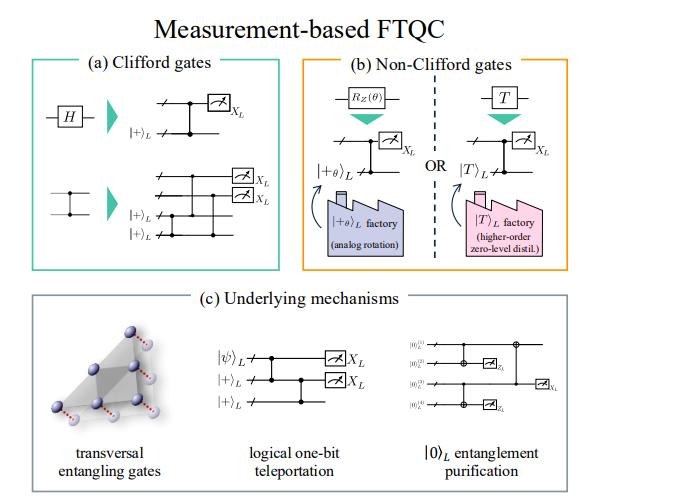
Scientists have developed a new fault-tolerant quantum computing (FTQC) architecture designed for high-connectivity platforms like trapped ions and neutral atoms, achieving significant milestones in scalability and computational power. This work centers around utilising verified logical ancillas and Knill’s error-correcting teleportation, streamlining the decoding process to maintain low computational overhead. The team instantiated this architecture with both the Steane code and the Golay code, demonstrating performance at scales relevant to near-term devices. Experiments utilising the Steane code, with a physical error rate of 10-4, support 5 × 10⁴ logical RZ(θ) rotations, corresponding to approximately 2.
Achieving Gigaquop-Scale Quantum Computational Performance
4 × 10⁶ T gates, and enabling megaquop-scale computation. Furthermore, the Golay code implementation supports more than 2 × 10⁹ T gates, pushing performance into the gigaquop-scale regime. This architecture bypasses the need for resource-intensive surface codes or complex code concatenation by leveraging offline generation and verification of logical ancillas and employing transversal Clifford operations. The team achieved this by reducing logical operations to transversal gates after preparing the logical ancillas, eliminating the need for complex lattice surgery or code deformation. Measurements confirm that this approach delivers practical large-scale quantum computation on near-term hardware, representing a significant step towards scalable fault-tolerant quantum computers.
Billion-Operation Quantum Computation Demonstrated with Surface Codes
Benchmarking Measurement-Based Code Implementations
Benchmarking Measurement-Based Quantum Code Implementations
This research presents a measurement-based quantum error correction architecture designed for high-connectivity platforms such as trapped ions and neutral atoms. The team successfully demonstrates two implementations, a Steane-code version and a Golay-code version, achieving significant milestones in fault-tolerant quantum computation. The Steane code supports logical rotations and enables megaquop-scale computation, performing up to one million quantum operations, while the Golay code extends this capability to the gigaquop regime, exceeding one billion quantum operations. These results indicate that practical, large-scale quantum computation is achievable on near-term hardware without relying on more complex and resource-intensive error correction schemes.
The team benchmarked both codes under realistic circuit-level noise, demonstrating that the architecture scales favourably with increasing qubit numbers. Specifically, the Steane code exhibits error rates scaling with the square of the physical error rate, and the Golay code with the fourth power, suggesting robustness against imperfections in quantum gates and measurements. The authors acknowledge limitations in their simulations, notably the omission of idling errors, which they suggest would not fundamentally alter their conclusions given the long coherence times of the targeted hardware. Future work will likely focus on mitigating these remaining error sources and exploring the performance of the architecture on even larger quantum systems, bringing fault-tolerant quantum computation closer to reality.
🗞 Measurement-Based Fault-Tolerant Quantum Computation on High-Connectivity Devices: A Resource-Efficient Approach toward Early FTQC
🧠 ArXiv: https://arxiv.org/abs/2510.18652