Controlling the interaction between quantum bits is fundamental to building a practical quantum computer, and researchers are continually exploring new ways to achieve this control. Alejandro D. Bendersky, Sergio S. Gomez, and Rodolfo H. Romero, all from the Instituto de Modelado e Innovaci ́on tecnol ́ogica, CONICET-UNNE, and Universidad Nacional del Nordeste, investigate how precisely modulating the connections between tiny structures called quantum dots can create and manipulate quantum information. Their work demonstrates a method for performing both single-qubit and entangling operations, essential building blocks for quantum computation, by carefully tuning the tunnel and exchange couplings between these quantum dots. The team’s analytical approximations and subsequent numerical calculations confirm that this modulation technique achieves high fidelity even when operating slightly away from ideal conditions, representing a significant step towards robust and scalable quantum technologies.
The core focus lies in utilizing quantum dots as qubits, with investigations into different dot types, materials, and control methods, including spin, charge, and hybrid approaches. A major challenge addressed within these studies is controlling and manipulating qubits, employing techniques such as electric and magnetic fields, and microwave or radio frequency pulses. Maintaining quantum coherence is crucial, and researchers investigate factors causing decoherence and strategies to minimize its effects.
Scalability, the ability to create and control a large number of qubits, is also a key area of investigation, with studies exploring various architectures and techniques for building larger quantum systems. Implementing quantum gates and running quantum algorithms are essential components of this research. The references highlight advancements in materials science and device fabrication, crucial for creating high-quality quantum dots and reliable devices. Theoretical modeling and simulation play a vital role in understanding and predicting qubit behavior. Many studies focus on extending qubit coherence times through isotope purification, surface passivation, and optimized device design. Research also explores scaling up quantum dot systems through arrays, molecules, and novel architectures, and combining quantum dots with other qubit technologies to leverage their complementary strengths. Finally, the development of quantum error correction codes to protect quantum information from noise is a prominent theme.
Robust Qubit Control Via Tunnel Coupling Modulation
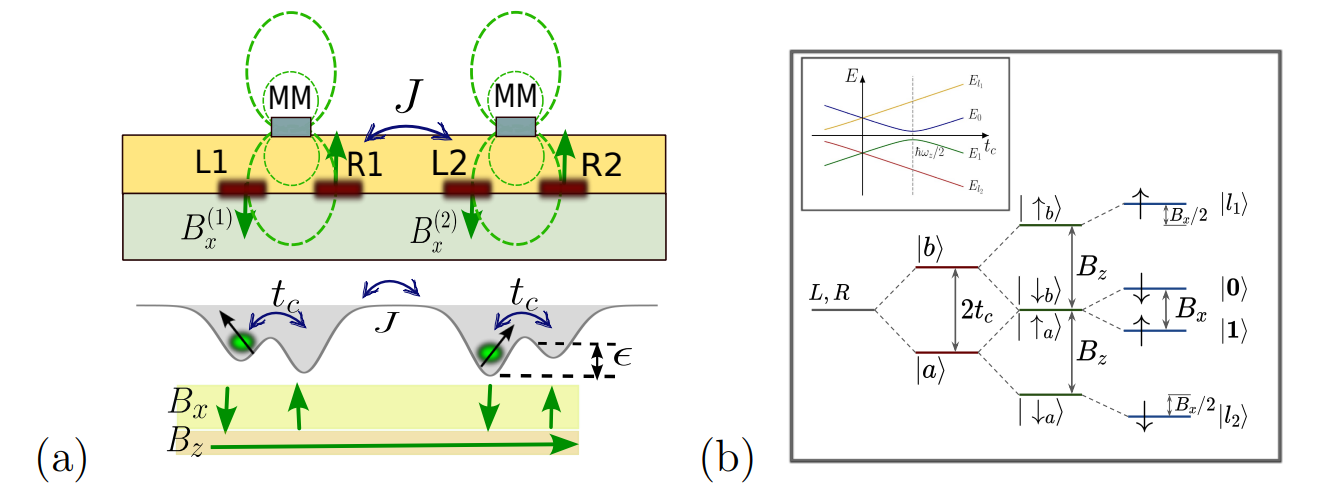
Researchers have demonstrated precise control over qubits within a double quantum dot system by manipulating the interaction between the dots using time-dependent modulation. They engineered a method to control qubit states by modulating the tunnel coupling, creating single-qubit gates, and the exchange coupling, generating entangling gates, essential for quantum computation. Analytical approximations and detailed numerical calculations validate the accuracy of this approach, demonstrating successful operation even with slight deviations from ideal conditions, highlighting the robustness of the technique. The experimental setup involves precise control over magnetic fields and modulation frequencies, with careful characterization of angles relating to the spin quantization axis.
Measurements indicate that the magnetic field component perpendicular to the quantum dots remains relatively low, ensuring simplified calculations and accurate modeling of qubit manipulation. The team developed a mathematical description of the system’s energy, a Hamiltonian, to predict and control the qubit states. Analysis reveals that, under typical conditions, certain terms in the equations can be neglected, further simplifying the calculations. The team explored the impact of the interdot coupling on the energy levels, finding that it primarily shifts the levels and induces transitions between them. Calculations show that transitions to unwanted energy levels occur at frequencies determined by the qubit frequencies, the interdot coupling, and the magnetic field differences. The research focuses on manipulating electron spins within nanoscale structures using precisely tuned magnetic and electrical fields. The team developed a model consisting of two coupled single-electron double quantum dots, subject to longitudinal and transverse magnetic fields, to explore qubit control mechanisms. Experiments reveal that harmonic modulation of the tunnel coupling between quantum dots enables the creation of single-qubit gates, fundamental operations for quantum computation.
By carefully controlling the tunneling process, scientists can manipulate the quantum state of individual electrons, effectively implementing rotations and phase shifts. Furthermore, the team discovered that biharmonic modulation of the exchange interaction between a pair of double quantum dots generates entangling two-qubit gates, essential for complex quantum algorithms. The resulting quantum gates operate within time intervals shorter than the system’s coherence time, preserving the delicate quantum information. Tests demonstrate that the accuracy of these gates is sufficient for implementation with quantum error correction codes, a crucial requirement for building robust quantum computers.
Specifically, the research shows that the analytical approximations used to model qubit behavior accurately predict the system’s evolution, as confirmed by numerical simulations. Measurements of leakage from the computational space, alongside infidelity calculations, validate the precision of the analytical model. The team’s work establishes a pathway towards scalable and reliable quantum computation using semiconductor-based qubits.
Electron Qubit Control Via Harmonic Modulation
This work demonstrates the feasibility of using the states of two electrons within a double quantum dot system as qubits for quantum computation. Researchers successfully propose a method for generating both one- and two-qubit gates through harmonic modulation of the tunnel and exchange couplings between the quantum dots. One-qubit gates are achieved by modulating the tunneling rate, while two-qubit gates rely on modulating the exchange interaction, independently controlling subspaces to create entangled states. Analytical calculations and numerical simulations confirm that the designed operations maintain controllability even with slight deviations from ideal parameters, indicating robustness. The team highlights a significant difference in timescales between one- and two-qubit gates, with one-qubit operations occurring much faster, potentially influencing overall computational speed. Future work may focus on optimising these parameters and exploring strategies to mitigate the effects of any resulting errors, further refining the system for practical quantum computing applications.
🗞 Quantum gates in coupled quantum dots controlled by coupling modulation
🧠 ArXiv: https://arxiv.org/abs/2510.02267