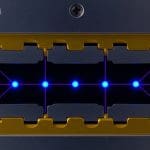
Researchers demonstrated a method to construct a high-fidelity controlled-NOT (CNOT) gate – a fundamental component of quantum computation – using locally driven interactions. Counterdiabatic control techniques effectively mitigated errors arising from finite gate duration and environmental noise, achieving near-perfect gate performance in open quantum systems.
Maintaining the integrity of quantum information remains a central challenge in the development of scalable quantum technologies. Errors accumulate during quantum computations due to imperfections in the physical realisation of quantum gates and environmental interactions. Researchers are actively pursuing methods to mitigate these errors and improve the reliability of quantum operations. A new study, detailed in ‘Correcting noisy quantum gates with shortcuts to adiabaticity’, by Cavalcante et al. from the University of Maryland, Baltimore County, Farmingdale State College – SUNY, and The University of Campinas, demonstrates a technique utilising counterdiabatic control to enhance the performance of two-qubit controlled-NOT (CNOT) gates, even when subject to decoherence – the loss of quantum information due to interaction with the environment. The team engineered a locally driven Hamiltonian, effectively steering the system’s evolution to minimise the impact of noise and achieve high-fidelity gate operations.
Enhanced Quantum Gate Fidelity Through Counterdiabatic Control
Maintaining the delicate quantum states necessary for computation remains a significant challenge. Environmental interactions induce noise and decoherence – the loss of quantum information – limiting the fidelity of quantum operations. Current research concentrates on precise qubit manipulation, employing control strategies to achieve high-performance quantum gates and advance the field of quantum computation. Trapped ions and nitrogen-vacancy (NV) centres in diamond are prominent qubit platforms used to develop and refine these control protocols.
Recent studies demonstrate the successful implementation of a high-fidelity controlled-NOT (CNOT) gate – a fundamental operation in quantum computation – utilising a locally driven two-qubit Hamiltonian. The Hamiltonian, representing the total energy of the system, is engineered such that its lowest energy state naturally generates the desired gate operation. The CNOT gate operates by conditionally flipping the state of the target qubit only when the control qubit is in a specific state; it forms a core component of many quantum algorithms.
A critical challenge in practical quantum computing lies in finite gate implementation times. Real-world gate operations are not instantaneous, introducing non-adiabatic effects – deviations from the ideal quantum evolution – and increasing susceptibility to external noise. Researchers mitigate these issues through the application of counterdiabatic control. This technique actively compensates for unwanted transitions induced by the finite duration and noise, effectively steering the quantum system back towards the desired evolution path.
Results indicate that counterdiabatic control significantly restores gate performance, achieving near-perfect gate fidelities even when the system experiences decoherence. This represents a substantial improvement, as decoherence is a major obstacle to building stable and scalable quantum computers. The method effectively suppresses errors arising from both non-adiabaticity and environmental noise.
This work presents a robust approach to implementing high-fidelity two-qubit gates in the presence of realistic imperfections. The successful application of counterdiabatic control offers a promising strategy for mitigating errors and enhancing the performance of quantum computations. Researchers build upon a substantial body of theoretical research, referencing publications from journals like Reviews of Modern Physics and Physical Review Letters, demonstrating a strong foundation in established quantum control principles.
The research also draws upon recent pre-print publications available on arXiv, indicating an engagement with the cutting edge of the field. Researchers focus on robust control strategies rather than solely on hardware improvements. This approach offers a promising pathway towards building practical and reliable quantum computers, and the technique is potentially applicable to a wide range of qubit platforms.
Researchers actively investigate dynamical decoupling techniques, error correction codes, and topological protection schemes to enhance qubit coherence and resilience. These efforts aim to overcome the limitations imposed by environmental noise and imperfections in quantum devices.
Future research directions include exploring novel qubit modalities, developing more efficient error correction protocols, and designing fault-tolerant quantum architectures. Researchers also investigate hybrid quantum systems, combining the strengths of different qubit technologies to achieve enhanced performance and scalability. These advancements will pave the way for building practical quantum computers capable of solving complex problems beyond the reach of classical computers.
👉 More information
🗞 Correcting noisy quantum gates with shortcuts to adiabaticity
🧠 DOI: https://doi.org/10.48550/arXiv.2505.20000