

Researchers benchmarked gate fidelity across up to 52 qubits, achieving 63.09% for a 44-qubit parallel CZ gate. Introducing a metric to quantify crosstalk, they demonstrated global fidelity optimises gate performance, increasing a 6-qubit gate’s fidelity from 87.65% to 92.04% and reducing correlation from 3.53% to 3.22%.
Maintaining coherence and minimising error represent significant challenges in scaling quantum computation. Accurate characterisation of multi-qubit gate performance is therefore essential, moving beyond assessments of individual gate operations to encompass the complex interplay of errors across an entire quantum processor. Researchers at the University of Science and Technology of China, led by Jian-Wei Pan and Cheng-Zhi Peng, alongside colleagues from the Center for Quantum Information, report the benchmarking of quantum gates involving up to 52 qubits in a superconducting processor. Their work, titled ‘Calibrating quantum gates up to 52 qubits in a superconducting processor’, details a character-average benchmarking protocol used to achieve a fidelity of 63.09 ± 0.23% for a 44-qubit parallel CZ gate, alongside a novel metric to quantify inter-gate correlations and inform gate optimisation strategies. The team, comprising Daojin Fan, Guoding Liu, Shaowei Li, Ming Gong, Dachao Wu, Yiming Zhang, Chen Zha, Fusheng Chen, Sirui Cao, Yangsen Ye, Qingling Zhu, Chong Ying, Shaojun Guo, Haoran Qian, Yulin Wu, Hui Deng, Gang Wu, Xiaobo Zhu, and Xiongfeng Ma, demonstrate the utility of global fidelity metrics in enhancing gate performance and mitigating correlated noise.
Global Optimisation Boosts Fidelity in Multi-Qubit Quantum Gates
Recent advances in quantum computing necessitate innovative strategies for error mitigation and performance enhancement. A new study demonstrates that optimising for global fidelity – the overall success rate of parallel quantum gates – yields superior results compared to optimising individual gate fidelities. This approach offers a promising pathway towards building more robust quantum circuits capable of executing complex algorithms. Researchers benchmarked gate performance across up to 52 qubits, achieving a fidelity of 63.09 ± 0.23% for a 44-qubit parallel CZ gate – a controlled-Z gate – highlighting the potential for scaling quantum operations while maintaining acceptable error rates.
Quantum computation relies on the precise manipulation of qubits, but these systems are inherently susceptible to errors arising from environmental noise and imperfections in control signals. These errors accumulate during computations, limiting the depth and reliability of quantum algorithms. While error correction aims to eliminate errors entirely, mitigation techniques seek to reduce their impact. This study investigates a novel optimisation strategy that targets the collective performance of parallel gates, recognising that interactions between qubits significantly impact overall fidelity. By optimising for global fidelity, researchers aim to minimise error propagation and enhance computational stability.
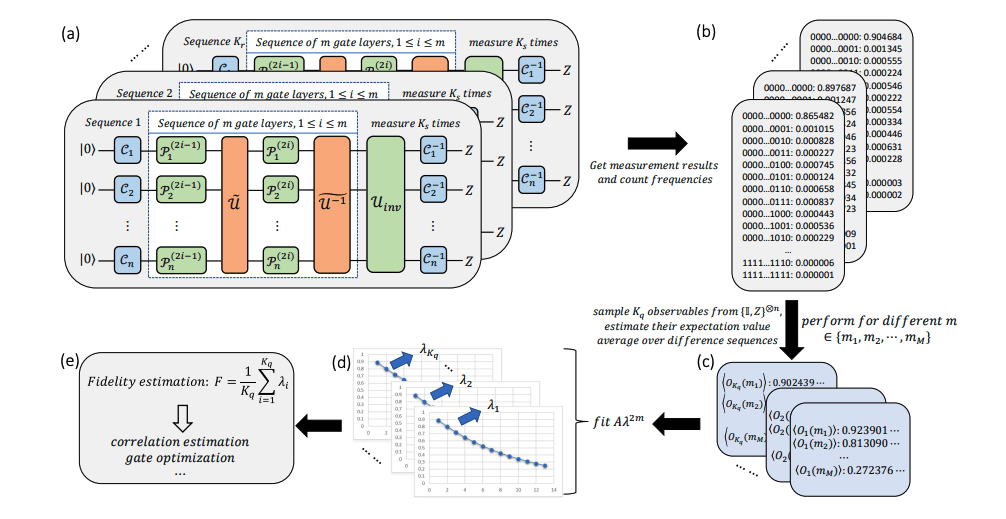
The research team conducted experiments on a superconducting quantum processor, systematically varying control parameters of parallel CZ gates and measuring the resulting fidelity. They employed a character-average benchmarking protocol, a technique for assessing gate performance and identifying error sources. This protocol involves applying a series of randomly chosen gate sequences and measuring the average fidelity of the output state, providing a quantitative measure of accuracy and reliability. Meticulous data analysis identified control parameters strongly influencing global fidelity, leading to the development of an optimisation algorithm to maximise performance. The results consistently demonstrated that global fidelity optimisation outperforms optimisation based on individual gate fidelities.
A key advancement of this work is the introduction of an ‘inter-gate correlation metric’. This metric quantifies crosstalk error – the influence of one gate’s errors on the performance of others. Researchers observed that CZ gates within a parallel sequence are interdependent, with errors propagating and affecting subsequent gates. Optimising individual gates can become trapped in local optima, hindering further improvement as the process fails to account for these interactions. Global fidelity optimisation circumvents this limitation by considering the entire system, capturing system-level errors and enabling a more holistic approach to error mitigation. The team validated their methodology by comparing experimental results with a composite noise model incorporating depolarising and ZZ-coupling noises, confirming the accuracy and reliability of their findings.
Specifically, applying global fidelity optimisation to a six-qubit parallel CZ gate elevated its performance from 87.65% to 92.04%, representing a substantial increase in fidelity and a reduction in inter-gate correlations.
These findings have significant implications for the development of practical quantum computers, paving the way for more complex and reliable quantum algorithms. The research team plans to extend these techniques to larger qubit systems and more complex gate arrangements, investigating the interplay between different noise sources and their impact on inter-gate correlations. Developing automated optimisation algorithms to efficiently navigate the parameter space and identify optimal gate configurations will be essential for realising practical quantum computation. Expanding the character-average benchmarking protocol to encompass a wider range of gate types and qubit connectivity patterns will also be valuable, enabling a more comprehensive assessment of quantum hardware capabilities and facilitating tailored optimisation strategies for specific architectures.
Ultimately, a deeper understanding of correlated noise and its mitigation will be critical for achieving fault-tolerant quantum computation, requiring a collaborative effort between theorists and experimentalists. Researchers must develop new theoretical models that accurately capture the complex interactions between qubits and noise sources, and they must design experiments that can validate these models and guide the development of improved error mitigation techniques. The pursuit of fault-tolerant quantum computation remains a grand challenge, and these advances in global fidelity optimisation represent a step towards achieving this goal.
This work contributes to the growing body of knowledge on quantum error mitigation and provides valuable insights into the design and optimisation of quantum circuits. By demonstrating the effectiveness of global fidelity optimisation, researchers have opened new avenues for improving the performance and reliability of quantum computers, promising to revolutionise fields including medicine, materials science, and artificial intelligence.
👉 More information
🗞 Calibrating quantum gates up to 52 qubits in a superconducting processor
🧠 DOI: https://doi.org/10.48550/arXiv.2505.22390


