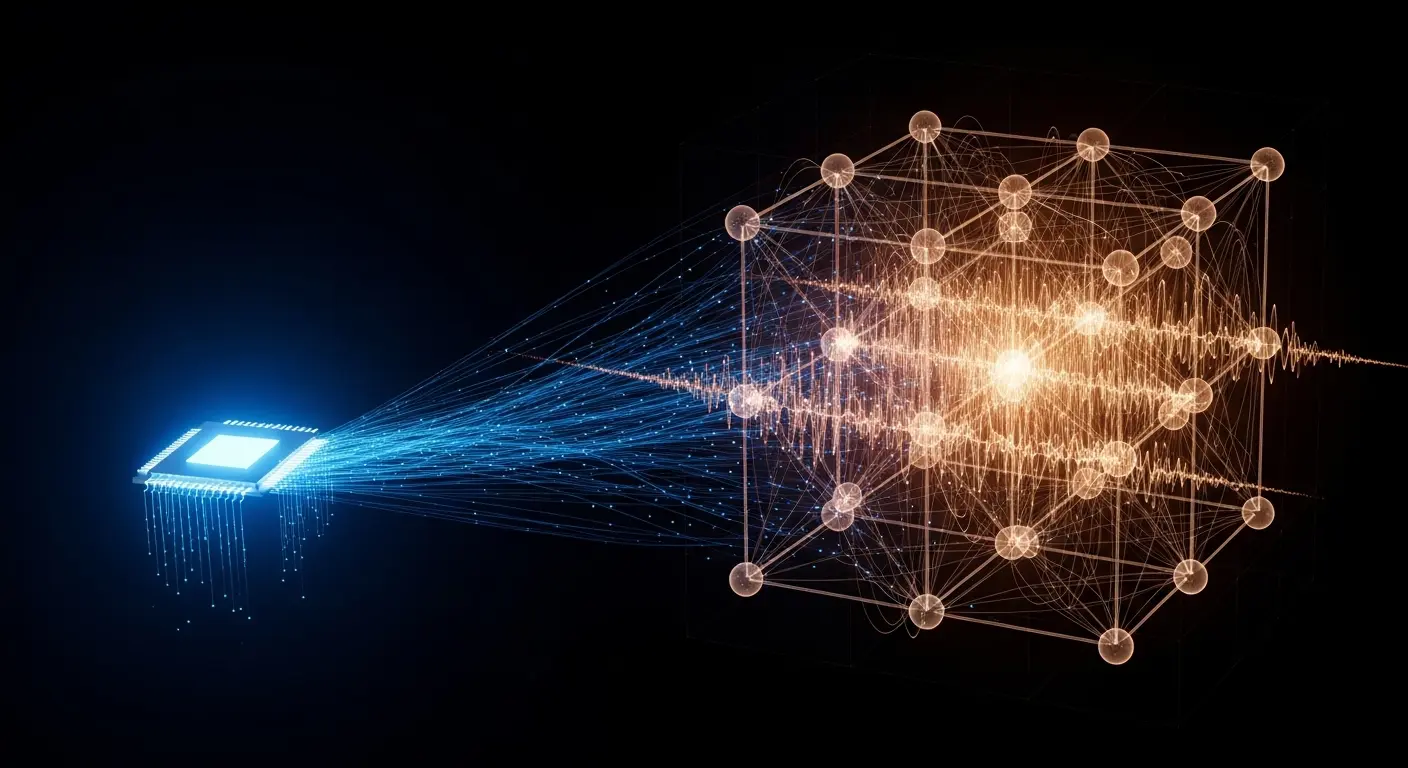
A. Chabchoub and colleagues at the Okinawa Institute of Science and Technology investigate the emergence of extreme nonlinear wave events, known as rogue waves, in ultracold quantum gases. The review details both theoretical developments and recent experimental observations of these phenomena, ranging from fundamental solutions like the Peregrine soliton to more complex multi-peak structures. Ultracold atomic gases offer a controllable platform for generating and studying extreme waves. This provides insights relevant to diverse physical systems including water waves and nonlinear optics. The work details how these waves can be created through various protocols and highlights the first experimental observation of the Peregrine soliton within this unique quantum environment.
Attracting Bose-Einstein condensates overcomes wave collapse for rogue wave observation
Engineered interactions proved key to observing these elusive waves. Precise control enabled scientists at Missouri University of Science and Technology and collaborating institutions to induce an attractive force between atoms, a necessary condition for rogue wave formation. They carefully manipulated the ultracold quantum gases to create effective focusing interactions. Normally, these gases repel each other, but this control was achieved by balancing interactions within a two-component Bose-Einstein condensate, effectively transforming it into a system behaving like a single-component condensate with attractive properties.
The technique bypassed wave collapse, a common problem when directly using attractive atomic gases, offering a stable platform for studying extreme wave behaviour. Experiments utilised ultracold quantum gases, specifically Bose-Einstein condensates, to investigate rogue waves. This approach circumvented wave collapse often seen with directly attractive atomic gases, providing a stable environment for study. Particle imbalance in two-component condensates effectively created a single-component system with attractive properties, enabling the observation of phenomena like the Peregrine soliton and “Christmas-tree” cascades.
Quantum gases recreate oceanic rogue wave phenomena in laboratory conditions
The 1995 Draupner measurement established the existence of extreme ocean waves, and recent work has extended observations to fundamental solutions like the Peregrine soliton and more complex multi-peak structures. This work is significant because it demonstrates the potential of ultracold atomic gases as controllable platforms for generating and studying extreme waves, offering insights relevant to diverse physical systems including water waves and nonlinear optics. For the first time, researchers at the Missouri University of Science and Technology and collaborating institutions have generated a Peregrine soliton, a specific type of rogue wave, within ultracold quantum gases, exceeding the limitations of prior observations restricted to natural settings or limited simulations.
This controllable creation allows detailed study of the soliton’s dynamics, previously inaccessible due to the unpredictable nature of oceanic rogue waves. The experimentally produced soliton manifested as a density spike accompanied by flanking dips and exhibited two π phase jumps, closely matching analytical predictions derived from the nonlinear Schrödinger equation. Reproducibility was confirmed using a two-component repulsive mixture, creating a self-focusing medium essential for soliton formation; conversely, single-component or miscible two-component systems failed to produce the desired wave. Further analysis revealed the soliton dissolved into three equidistant entities after a few milliseconds, and the nonlinear stage of modulational instability was also observed, demonstrating the emergence of dispersive shock waves.
Ultracold gases illuminate fundamental mechanisms despite oceanic simplification
Establishing a controllable system for generating rogue waves, such as the Peregrine soliton, offers a powerful new tool for nonlinear physics, yet replicating the full complexity of natural phenomena remains elusive. While ultracold quantum gases provide unprecedented control, current experiments rely on simplified models, specifically the nonlinear Schrödinger equation, to describe wave behaviour. This raises a vital tension: how accurately do these models capture the subtle, often chaotic, interactions present in real-world systems like the ocean, where factors like turbulence and varying depths sharply influence wave dynamics.
Acknowledging that these ultracold gas experiments simplify oceanic complexities does not diminish their value. They provide a uniquely controllable environment to isolate and study the fundamental physics driving rogue wave formation, something impossible with open-ocean observation alone. Understanding these core mechanisms, even in a simplified system, advances our broader knowledge of nonlinear wave behaviour across diverse fields like optics and hydrodynamics.
Now, controlling wave behaviour within ultracold quantum gases provides a new means of studying extreme, nonlinear events like rogue waves; previously, investigations relied on observing unpredictable natural occurrences or limited simulations. This experimental breakthrough establishes these gases as a flexible platform, enabling detailed probing of wave dynamics across both predictable and complex quantum systems. Successfully generating the Peregrine soliton opens avenues to explore the fundamental physics governing these phenomena and their potential relevance to diverse fields, including optics and fluid dynamics.
Researchers successfully generated a Peregrine soliton, a type of rogue wave, within a controllable ultracold quantum gas system. This achievement is significant because it allows for detailed study of the fundamental physics behind these extreme wave events, something previously limited by reliance on unpredictable ocean observations. By using gases and simplified models of the nonlinear Schrödinger equation, scientists can isolate key mechanisms driving rogue wave formation, improving understanding across fields like optics and hydrodynamics. Future work may focus on incorporating more complex interactions, mirroring oceanic conditions, to test the accuracy of current models and potentially predict rogue wave behaviour in real-world scenarios.
👉 More information
🗞 Extreme (Rogue) Waves: From Theory to Experiments in Ultracold Gases and Beyond
🧠 ArXiv: https://arxiv.org/abs/2603.25908