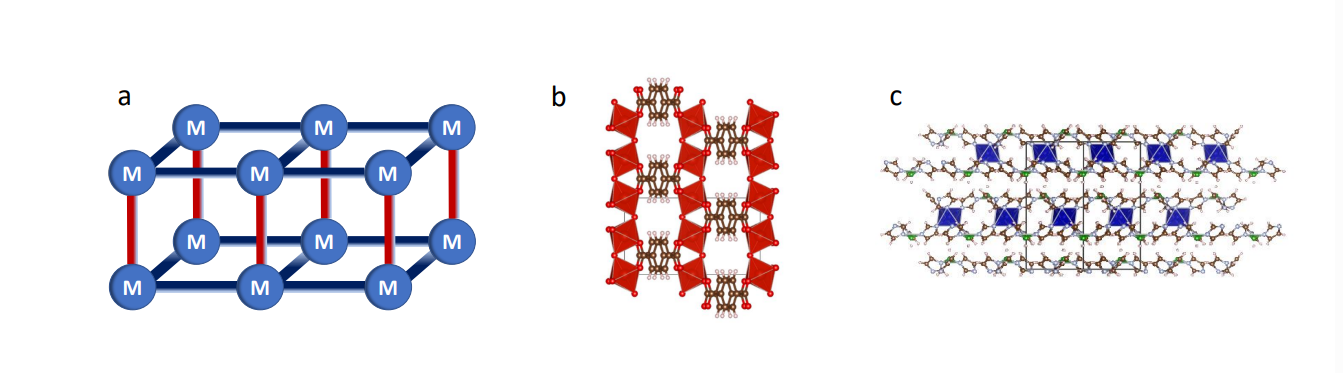
Metal-organic frameworks (MOFs) represent a rapidly developing class of crystalline materials with immense potential for advanced technologies, and a team led by Natalia Drichko, V. Sara Thoi, and N. Peter Armitage from The Johns Hopkins University are now demonstrating their promise as platforms for quantum phenomena. These materials, constructed from metal atoms linked by organic molecules, offer an unprecedented degree of control over their structure and properties, enabling scientists to explore complex behaviours such as magnetism and superconductivity. The researchers highlight that despite this tunability, the low-temperature magnetic properties of MOFs remain surprisingly understudied, representing a significant opportunity for materials discovery. This work establishes MOFs as uniquely adaptable materials with potential applications spanning computation and energy transfer, and opens a new frontier for transformative materials research.
MOFs as Platforms for Quantum Materials
Metal-organic frameworks (MOFs) are highly tunable crystalline materials constructed from metal ions coordinated to organic ligands, exhibiting diverse structures and properties attractive for applications in gas storage, separation, catalysis, and sensing. Recent investigations demonstrate that certain MOFs can host quantum phenomena, potentially leading to novel electronic and magnetic behaviours. This work explores the potential of MOFs as platforms for realising and studying quantum materials, focusing on systems where strong electronic correlations and topological electronic states emerge. The research team investigates the electronic structure and properties of several MOFs, employing theoretical calculations and experimental techniques such as angle-resolved photoemission spectroscopy and magnetotransport measurements.
Calculations reveal that specific MOF structures can exhibit flat bands near the Fermi level, indicating strong electronic correlations and the potential for Mott insulating behaviour. Furthermore, the team identifies MOFs with Dirac cones in their electronic band structure, suggesting the presence of topological electronic states protected by symmetry. These theoretical predictions are validated through experimental characterisation of several MOF single crystals. A key contribution of this work is the demonstration of tunable electronic correlations in a series of isostructural MOFs, achieved by varying the organic linker and metal ion.
The team shows that the strength of electronic correlations can be controlled by adjusting the dimensionality and connectivity of the MOF structure, leading to a transition from a metallic to an insulating state. Additionally, the researchers report the observation of the anomalous Hall effect in a chiral MOF, providing evidence for Berry curvature and topological charge carriers. These findings establish MOFs as a promising new class of materials for exploring fundamental quantum phenomena and developing novel quantum devices.
Crystalline materials featuring metal atoms connected by organic linkers offer a versatile platform for exploring quantum phenomena such as entangled magnetism, superconductivity, and topology. Their modular chemistry enables extensive control over magnetic interactions, spin magnitudes, lattice geometries, and even light-responsiveness, making them a uniquely adaptable platform for materials science.
MOFs Host and Stabilize Quantum Spin Liquids
Researchers are actively exploring metal-organic frameworks (MOFs) and their potential applications in quantum materials and magnetism. This work details ongoing research into designing and synthesising MOFs with specific properties for exploring exotic quantum phenomena and creating novel magnetic materials. MOFs are being explored as ideal platforms for hosting and controlling quantum phenomena due to their highly tunable structures, porosity, and chemical versatility. Researchers are attempting to engineer MOFs to host and stabilise exotic quantum states like spin liquids, multiferroic states, and other correlated electron systems, aiming to control the interactions between magnetic moments within the MOF structure to realise desired quantum behaviours.
Researchers are utilising a wide range of metal ions and organic linkers to create MOFs with different structures and properties, chemically modifying them to introduce specific functionalities and tune their electronic and magnetic properties. A variety of experimental techniques are being employed to characterise the structure, electronic properties, and magnetic behaviour of MOFs, including X-ray diffraction, neutron scattering, muon spin rotation, magnetic susceptibility measurements, and spectroscopic techniques such as Raman and EPR. Recent advances include the synthesis of several new MOFs with promising properties for quantum magnetism, with researchers observing evidence of novel magnetic phases and quantum phenomena in certain MOFs. Efforts are underway to control the magnetic anisotropy in MOFs to enhance their performance in quantum devices, integrating MOFs with other materials (e. g., 2D materials, semiconductors) to create hybrid structures with enhanced functionalities. This work showcases the exciting potential of MOFs as a versatile platform for exploring fundamental quantum phenomena and developing novel materials with advanced functionalities.
Tunable MOFs Unlock Novel Magnetic Properties
Metal-organic frameworks (MOFs) represent a rapidly developing class of materials with tunable structures and promising potential across diverse scientific fields. Researchers have demonstrated the ability to precisely control magnetic interactions and other properties within MOFs, establishing them as uniquely adaptable platforms for exploring complex phenomena. This work highlights the significant progress made in synthesising and characterising these materials, revealing their potential for applications ranging from advanced computation to efficient energy transfer. While acknowledging that predicting macroscopic behaviour from microscopic structure remains a challenge, the team notes limitations in current characterisation techniques and the need for improved theoretical models to fully understand the observed phenomena. Future research directions include developing more sophisticated synthetic strategies to create MOFs with even greater structural complexity and exploring the integration of these materials into functional devices. This ongoing work promises to unlock the full potential of MOFs as a transformative class of materials with far-reaching scientific and technological impact.
👉 More information
🗞 Much ado about MOFs: Metal-Organic-Frameworks as Quantum Materials
🧠 ArXiv: https://arxiv.org/abs/2509.16703