The intriguing interplay between superconductivity and exotic quantum states of matter drives research into novel heterostructures, and a team led by Steffen Bollmann of the Max-Planck Institute for Solid State Research, Andreas Haller from the University of Luxembourg, and Jukka I. Väyrynen of Purdue University now investigates the phases arising when fractional quantum Hall systems meet superconductors. This work explores how these combined materials behave, particularly focusing on the emergence of unusual quasiparticles called parafermions, and establishes a detailed phase diagram revealing both insulating and metallic states. The researchers demonstrate transitions between these phases, identifying characteristics consistent with established theoretical predictions, and importantly, provide a foundation for understanding similar systems being developed in moiré materials. These theoretical advances promise to be crucial for designing and interpreting experiments on gate-defined heterostructures exhibiting both fractional quantum Hall behaviour and superconductivity, potentially paving the way for new quantum technologies.
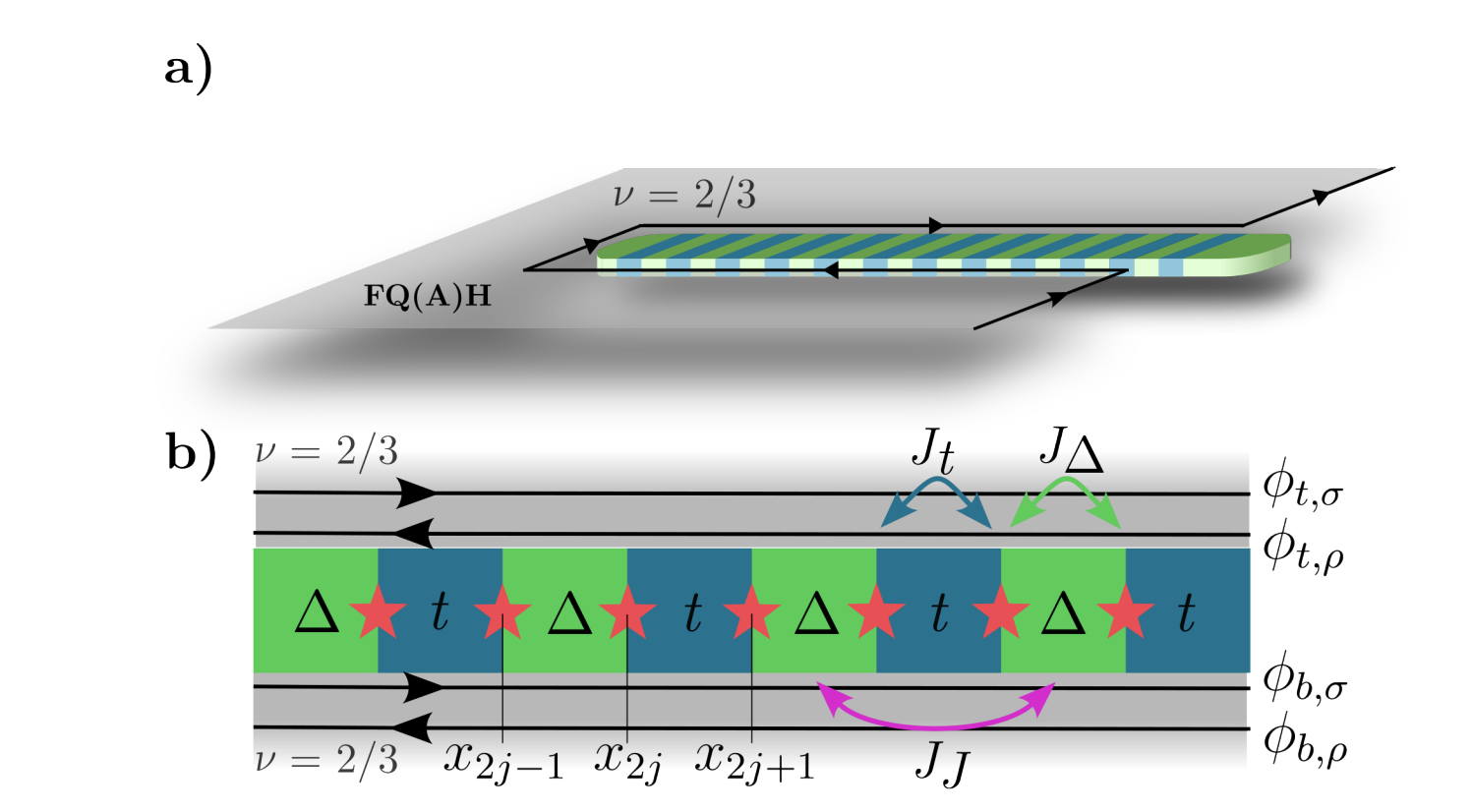
Motivated by recent observations of fractional Chern insulators near superconducting phases, the research investigates heterostructures combining these materials, focusing on systems exhibiting a filling fraction of 2/3 that supports Z3 parafermions. The team developed a theoretical model to predict the phase diagram, exploring how superconductivity and fractional quantum Hall behaviour interact, and mapped the problem onto a topological Josephson junction to examine emergent phenomena at the interface between these distinct quantum phases.
Two-Dimensional Electron System Mott Transition Analysis
This text details the behaviour of electrons in a two-dimensional system undergoing a transition between a Mott insulator and a state exhibiting 2e/3 fractional quantum Hall-like properties. Researchers employed a combination of numerical simulations and analytical calculations, utilising techniques such as Density Matrix Renormalization Group and Conformal Field Theory, to study the transition between a localized Mott insulating state and a fractional quantum liquid state. Conformal Field Theory plays a crucial role in understanding the critical behaviour at the phase transition and identifying the relevant degrees of freedom. The research defines a specific Hamiltonian used in the simulations, including terms for kinetic energy, interactions, and a potential that drives the system towards the fractionalized state, detailing the parameters used to ensure the reliability of the numerical results.
Entanglement entropy was calculated and used to identify the phase transition and estimate the central charge, with finite size scaling techniques used to extrapolate results to the thermodynamic limit. The study justifies the effective Hamiltonian used in the simulations, starting from a more fundamental model and explaining the choices made for specific parameters. Researchers introduce the concept of Z3 parafermions, anyonic excitations crucial to the fractionalized state, and discuss the role of a U(1) order parameter in the system, demonstrating that the U(1) and Z3 theories decouple in the infrared. The Jordan-Wigner transformation was used to map fermionic operators onto spin operators, and the scaling dimension of the operator coupling the U(1) and Z3 theories was calculated, further supporting the idea that the system can be described by a combination of the two theories. The central charge was extrapolated to the thermodynamic limit using finite size scaling, with results consistent with a predicted value of 9/5, providing strong evidence for the emergence of fractionalized excitations with a charge of 2e/3.
Parafermion Phases in Chern Insulator Heterostructures
Scientists have established a detailed phase diagram for heterostructures combining fractional Chern insulators and superconductors, revealing the emergence of exotic quasiparticles known as parafermions. Researchers modelled this complex system as a chain of Josephson junctions, allowing them to map the problem onto a one-dimensional system with lattice parafermions. Experiments revealed two distinct Luttinger liquid phases, characterised by fundamental excitations carrying charges of 2e and e/3, alongside a Mott insulating phase. The team numerically determined transitions between these phases, finding evidence of Berezinskii-Kosterlitz-Thouless transitions and a second-order phase transition with a central charge of 9/5, confirming theoretical predictions based on conformal field theory. The study focused on a fractional Chern insulator with a filling fraction of 2/3, a stable configuration in current materials, inducing a superconducting state by applying a voltage to a gate, creating edge states that encircle the superconducting region. The team demonstrated that these edge states support the formation of Z3 parafermions at the interfaces between the superconducting and insulating regions, establishing a framework for understanding the stability of these parafermionic edge states and paving the way for potential applications in topological quantum computing and novel electronic devices.
Interface Phases, Vortices and Topological Order
This research establishes a detailed phase diagram for heterostructures combining fractional Chern insulators and superconductors, revealing novel electronic behaviour at their interface. The team demonstrates the existence of two distinct Luttinger liquid phases, characterised by unusual charge carriers, alongside Mott insulating phases, confirming theoretical predictions based on conformal field theory. The researchers identify a parameter regime where topology is stabilized, leading to algebraic order, and another where topology breaks down, simultaneously destroying both topological order and algebraic order, noting that the system exhibits a unique sensitivity to the stiffness of the superconducting order parameter. The authors acknowledge that their analysis relies on specific assumptions about the underlying topological properties of the system, and that further investigation is needed to fully understand these heterostructures, suggesting future work could focus on exploring the impact of varying material parameters and device geometries.
🗞 Phases of Quasi-One-Dimensional Fractional Quantum (Anomalous) Hall – Superconductor Heterostructures
🧠 ArXiv: https://arxiv.org/abs/2510.26686