

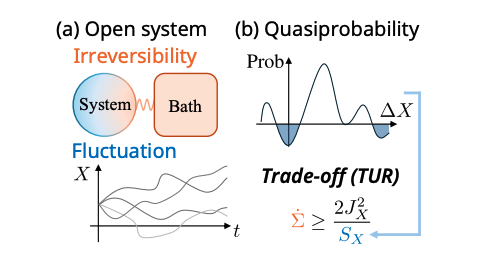
The fundamental limits of thermodynamic efficiency remain a central question in physics, and researchers continually seek ways to minimise energy dissipation. Kohei Yoshimura and Ryusuke Hamazaki, both from the Nonequilibrium Quantum Statistical Mechanics RIKEN Hakubi Research Team at the Pioneering Research Institute, RIKEN, have developed a new uncertainty relation that extends our understanding of these limits. Their work investigates how quantum fluctuations, measured using a concept called quasiprobability, relate to the unavoidable dissipation of energy in physical processes. This research demonstrates that certain ‘anomalous’ quantum behaviours, specifically negativity in these quasiprobabilities, are not merely allowed, but necessary to achieve energy efficiencies that surpass classical expectations, offering a pathway towards designing more efficient technologies and fundamentally redefining the boundaries of thermodynamic possibility.
This newly obtained inequality complements existing quantum thermodynamic uncertainty relations by focusing on changes in observables rather than the exchange of charges through jumps, and importantly, it respects initial coherence. Quasiprobabilities exhibit anomalous behaviours forbidden in classical systems, such as negativity, and the research reveals that these behaviours are necessary to reduce dissipation beyond classical limitations.
Entropy Production and Fluctuation Theorem Analysis
This research investigates stochastic thermodynamics and non-equilibrium fluctuations in a system of interacting quantum bits, centering on entropy production rate and trajectory-dependent dissipation. The primary goal is to develop a theoretical framework for understanding the relationship between trajectory-dependent dissipation, entropy production, and fluctuations. The findings demonstrate a general formula for the entropy production rate, establishing a connection between trajectory-dependent dissipation and entropy production, and validate fluctuation theorems.
Computational results, using a specific qubit model, reveal that entropy production scales differently depending on the initial state of the system, indicating a significant difference in behavior. These simulations confirm the theoretical predictions regarding entropy production and fluctuations. This research is significant because it contributes to a deeper understanding of non-equilibrium systems and advances the field of quantum thermodynamics, potentially impacting quantum information processing by aiding the development of robust quantum devices. This relation is broadly applicable to any quantum state and observable, and complements existing relations by adopting a different approach to measuring fluctuations. The research demonstrates that achieving reduced dissipation beyond classical limits requires non-classical behavior in these quasiprobabilities, proving to be more crucial than simply having quantum coherence. The team discovered that anomalous scaling of fluctuations, which leads to this enhanced dissipation reduction, is directly linked to specific non-classical behaviors within the quasiprobabilities.
They demonstrated this by constructing a model system capable of sustaining a dissipationless heat current, a phenomenon impossible in classical systems, highlighting that coherence alone is insufficient to guarantee reduced dissipation. Further investigation revealed that a quantum state with the same level of coherence as another could fail to support the dissipationless current if it did not satisfy the required quantum conditions for anomalous scaling, demonstrating that these quantum properties are essential for achieving the reduction in dissipation. The findings suggest that quasiprobabilities offer a valuable tool for exploring non-classical features in quantum extensions of thermodynamic principles.
Quasiprobability Negativity Enables Beyond-Classical Dissipation
The research demonstrates that reducing dissipation beyond classical limits requires more than just quantum coherence; it fundamentally depends on the anomalous behaviors of quasiprobabilities. This negativity is not merely a quantum quirk, but a necessary condition for achieving dissipation beyond what classical physics allows, even exceeding the requirements of simple coherence. The team illustrated this principle with a model capable of sustaining a dissipationless heat current, something impossible in classical scenarios, highlighting that coherence alone is insufficient. Specifically, the study found that rapid scaling of short-time fluctuations is essential for reducing entropy production, and this scaling occurs when a system’s properties are highly degenerate. While acknowledging that coherence can contribute to this effect, the authors emphasize that the non-classical behavior of quasiprobabilities is the more fundamental driver.
🗞 Quasiprobability Thermodynamic Uncertainty Relation
🧠 ArXiv: https://arxiv.org/abs/2508.14354


