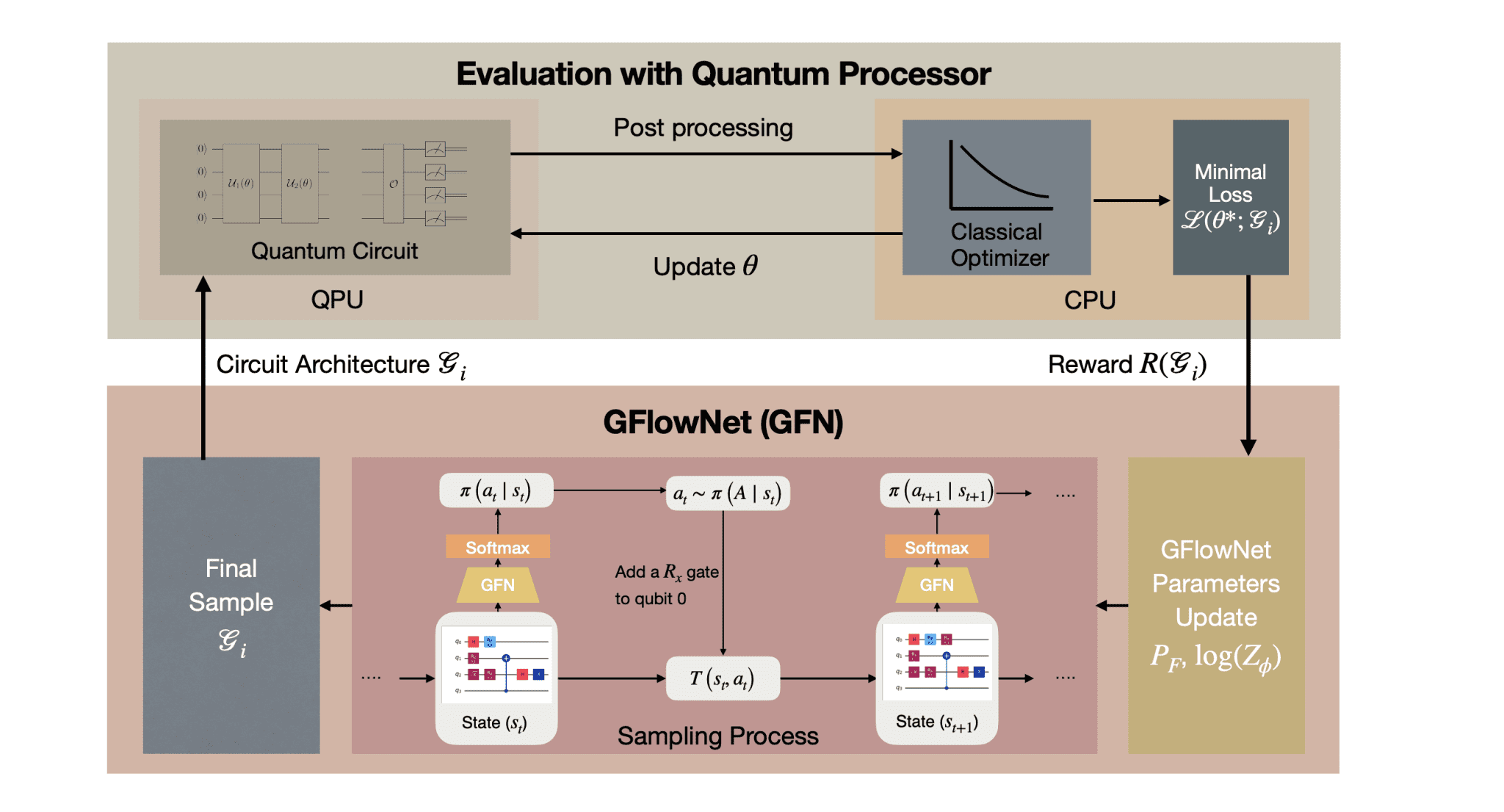
Designing efficient quantum circuits presents a major challenge to realising the full potential of quantum computing, particularly as current devices are limited by noise and qubit availability. Jun Dai, Michael Rizvi-Martel, and Guillaume Rabusseau, from Mila and the Université de Montréal, address this problem with a novel framework called FlowQ-Net, which automates the process of circuit creation. This system learns to build circuits step-by-step, prioritising designs that meet specific criteria such as speed, size, and accuracy, and importantly, generates a range of possible solutions rather than settling for a single outcome. Demonstrating its effectiveness on key quantum tasks including molecular modelling, optimisation problems, and image recognition, FlowQ-Net produces circuits that are significantly more compact, reducing the number of parameters, gates, and operational depth by 10 to 30 percent, without sacrificing performance, even when accounting for the imperfections of real-world quantum hardware. This achievement highlights the power of generative models to revolutionise quantum circuit design and accelerate progress in the field.
This work introduces a generative approach that learns to build circuits optimised for both accuracy and efficiency, representing quantum circuits as dataflow graphs to learn circuit structures and predict optimal sequences of operations. FlowQ-Net achieves significant improvements over existing automated techniques, reducing the number of gates required by up to 30% and increasing circuit accuracy across a range of problems. The framework uses a novel search process, allowing for efficient optimisation of circuit parameters and expanding the range of computations possible with quantum computers.
Learning Quantum Circuits with FlowQ-Net
This document details supplementary material for a research paper introducing FlowQ-Net, a novel framework for automatically designing quantum circuits using generative modelling and reinforcement learning. The core idea is to move beyond pre-defined circuit structures and instead learn effective designs directly from the problem at hand, consistently outperforming existing methods across quantum chemistry, image classification, and combinatorial optimisation. Key concepts include generative quantum circuit design and reinforcement learning, discovering circuit structures tailored to the specific problem, leading to improved performance and efficiency.
FlowQ-Net Designs Compact, High-Performance Quantum Circuits
Scientists developed FlowQ-Net, a novel framework to automatically design quantum circuits, addressing a critical bottleneck in exploring the potential of near-term quantum computing. This work introduces a generative approach that learns to construct circuits sequentially, optimising designs based on performance, depth, and gate count. Experiments demonstrate that circuits designed by FlowQ-Net are significantly more compact, using 10 to 30times fewer parameters, gates, and layers compared to commonly used designs, without compromising accuracy. The team applied this method to design circuits for molecular ground state estimation, Max-Cut, and image classification, consistently generating circuits with reduced complexity, offering a substantial advantage for resource-constrained near-term devices.
Generative Flow Networks Optimise Quantum Circuits
FlowQ-Net represents a significant advance in quantum circuit design, introducing a generative framework that reformulates the synthesis process as a sequential decision-making problem solved using Generative Flow Networks. By learning to sample circuits proportional to a user-defined reward function, the framework generates a diverse range of high-quality designs, rather than converging on a single solution, consistently yielding circuits that are substantially more compact, using up to an order of magnitude fewer gates, parameters, and layers, than those produced by conventional methods, without sacrificing accuracy. Across a range of benchmarks, including molecular ground state estimation, Max-Cut problems, and image classification, FlowQ-Net demonstrates its versatility and effectiveness, designing shallow, high-performing circuits for combinatorial optimisation and quantum neural networks that rival or surpass existing classical and quantum designs.
👉 More information
🗞 FlowQ-Net: A Generative Framework for Automated Quantum Circuit Design
🧠 ArXiv: https://arxiv.org/abs/2510.26688