Reliable communication across noisy channels remains a fundamental challenge in information theory, and recent work by Tamás Havas, Hsuan-Yin Lin, and Eirik Rosnes from Simula UiB, along with Ching-Yi Lai from National Yang Ming Chiao Tung University, addresses this problem for emerging classical-quantum communication systems. The team investigates how to send classical information effectively through quantum channels experiencing amplitude damping errors, a common source of signal degradation. Their research demonstrates that simple, unencoded transmission fails to provide any benefit in practical scenarios with limited data, and instead, advanced coding techniques combining classical error correction with carefully chosen quantum states are essential to achieve reliable communication. This work represents a significant step towards building robust and efficient quantum communication networks capable of transmitting information over imperfect channels.
The central question is whether employing quantum coding techniques, encoding classical information into quantum states and using collective measurements at the receiver, can improve performance compared to sending classical bits directly. The study demonstrates that uncoded transmission is limited, achieving no performance gain even with optimal quantum measurements. However, combining classical coding with quantum encoding and collective measurements can improve performance, particularly when transmitting relatively short messages, a scenario known as the finite blocklength regime.
This work is significant because it bridges quantum and classical communication, focusing on practical scenarios with limited message lengths crucial for building real-world quantum communication systems. It helps to understand the limits of using quantum resources for classical communication and suggests potential for designing new codes that leverage these resources to improve performance. Key to understanding this research are concepts like the quantum channel, the medium through which quantum information travels, and the amplitude-damping channel, which models photon loss. Researchers also utilize qubits, the basic units of quantum information, and collective measurements, which analyze multiple qubits simultaneously to extract more information.
The team proposes potential areas for further exploration, including extending the analysis to larger code sizes and developing hybrid approaches that combine collective measurements with individual measurements to reduce computational complexity. They also suggest analyzing multiple input channels and investigating performance over the quantum symmetric channel, with potential applications for future 6G wireless communication systems. In essence, the research demonstrates that while quantum measurements alone don’t improve classical communication over a noisy quantum channel, combining classical coding with quantum encoding and measurements can enhance performance, especially when dealing with limited message lengths.
Classical Communication Over Noisy Quantum Channels
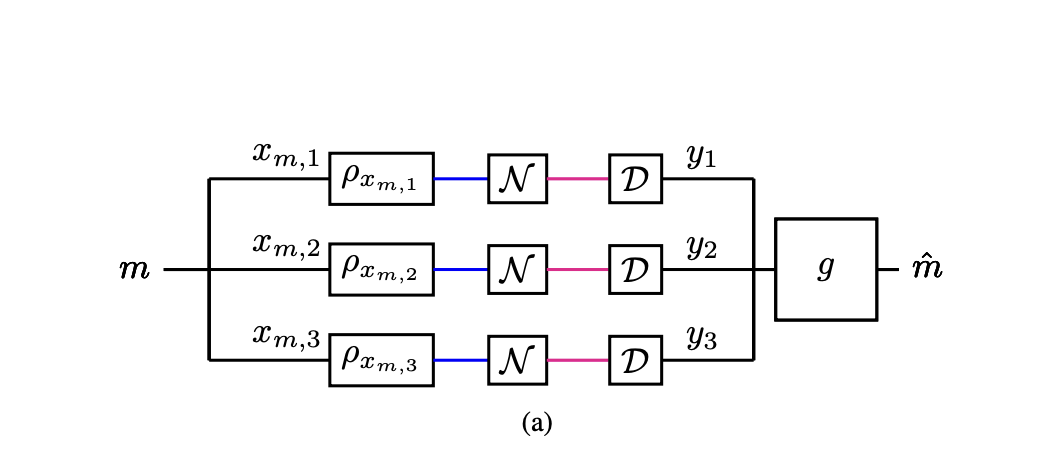
Scientists developed a rigorous methodology for analyzing classical communication over noisy quantum channels, focusing on the amplitude damping channel. The study pioneers a framework for encoding classical information into quantum states, transmitting these states through the noisy channel, and decoding the information at the receiver. Researchers constructed a system where classical messages are transformed into quantum states using a noiseless encoding map, then transmitted through the amplitude damping channel, creating a combined channel representing the entire communication pathway. To evaluate different coding schemes, the team created codewords, sequences of quantum states representing the classical messages, and subjected them to the effects of the noisy channel.
Crucially, the study investigates two distinct measurement strategies at the receiver: individual measurements performed on each output quantum state and collective measurements performed on the entire ensemble. The team meticulously analyzed how these strategies impact the ability to accurately decode the transmitted classical information. Researchers formulated a mathematical definition of an optimal code, the code that maximizes the average success probability of decoding the message, and solved this optimization problem by determining the optimal quantum measurement. Numerical results demonstrate that the collective measurement strategy consistently outperforms the individual measurement strategy, achieving strictly better performance in finite-blocklength scenarios. This improvement highlights the benefits of harnessing quantum correlations in the received signal to enhance communication reliability.
Finite Blocklength Quantum Communication Achieved
This work investigates efficient classical coding strategies for transmitting information reliably through the amplitude damping channel, a model for quantum noise. Researchers demonstrate that simply sending information without encoding offers no benefit when using this channel. Instead, sophisticated encoding techniques, combining classical codes with carefully chosen input quantum states, are crucial for achieving successful communication at finite blocklengths. The team explored two distinct decoding strategies: individual measurements on each quantum bit after it passes through the noisy channel and a more complex approach utilizing collective measurements, analyzing the entire sequence simultaneously.
Results demonstrate that the collective measurement strategy consistently outperforms the individual measurement approach, achieving strictly better performance in all tests. This improvement stems from the ability to consider correlations between the quantum bits, leading to more accurate decoding. Experiments reveal that the performance of these coding schemes is directly linked to the blocklength, the number of quantum bits transmitted together, and the study focuses on optimizing coding strategies for finite blocklengths. Researchers determined that the induced classical channel, representing the equivalent classical communication channel created by the quantum process, is key to understanding performance. Measurements confirm that the Holevo χ-capacity, a theoretical limit on the rate of classical information transmission, provides a lower bound on achievable performance. While the exact classical capacity of the amplitude damping channel remains unknown, this research provides valuable insights into practical coding schemes that approach this limit, advancing the field of quantum communication.
Coding and Collective Measurement Enhance Communication
This research demonstrates that, when transmitting classical information through a noisy quantum channel modeled by amplitude damping errors, simply employing an uncoded approach offers no advantage. The team proved that achieving performance gains at finite blocklengths requires sophisticated encoding techniques, combining classical codes with carefully chosen input states. Importantly, the benefits of collective measurements on the channel outputs become apparent only when these coded transmissions are used, surpassing the performance of individual measurements. The findings highlight a crucial link between coding techniques and measurement strategies for reliable quantum communication.
Numerical results support the theoretical conclusions, confirming that the combination of coding and collective measurements improves performance in this finite-blocklength regime. The authors acknowledge that fully performing collective measurements can be computationally demanding and future work will focus on developing hybrid approaches that combine collective and individual measurements to reduce computational complexity. This includes investigating the potential advantages of applying this hybrid strategy to specific channel configurations and exploring its performance within practical finite-blocklength constraints.
🗞 On Finite-Blocklength Noisy Classical-Quantum Channel Coding With Amplitude Damping Errors
🧠 ArXiv: https://arxiv.org/abs/2509.14852