Researchers from various German universities have developed a Quantum Field Theory (QFT) for multipolar composite bosons with mass defect and relativistic corrections. The study by Tobias Asano, Enno Giese, and Fabio Di Pumpo presents a subspace effective field theory for interacting spin-carrying and possibly charged ensembles of atoms that form composite bosons. The theory includes relativistic corrections to the energy of a single composite boson, light-matter interaction, and the scattering potential between composite bosons. The findings could have significant implications for atomic high-precision measurements and tests of fundamental physics, the Standard Model, and our theory of gravity.
What is Quantum Field Theory for Multipolar Composite Bosons with Mass Defect and Relativistic Corrections?
Quantum Field Theory (QFT) is a powerful tool with applications in various fields, including particle physics, quantum electrodynamics (QED), and non-relativistic ultracold quantum gases. The study by Tobias Asano, Enno Giese, and Fabio Di Pumpo from the Institut für Quantenphysik and Center for Integrated Quantum Science and Technology IQST Universität Ulm, Technische Universität Darmstadt Fachbereich Physik Institut für Angewandte Physik, and Institut für Quantenoptik Leibniz Universität Hannover, focuses on the QFT for multipolar composite bosons with mass defect and relativistic corrections.
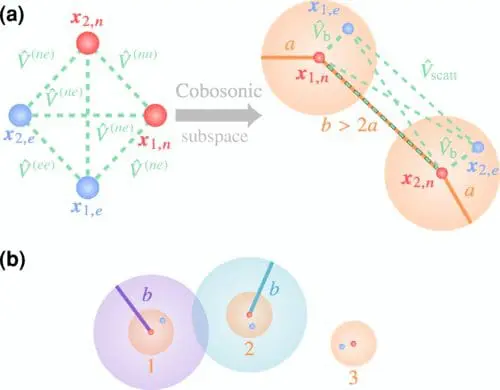
The researchers present a subspace effective field theory for interacting spin-carrying and possibly charged ensembles of atoms composed of nucleus and electron that form composite bosons, also known as cobosons. The interaction with light is included in a multipolar description. Relativistic corrections to the energy of a single coboson, light-matter interaction, and the scattering potential between cobosons arise in a consistent and natural manner.
The study also derives modified bound-state energies, including the motion of ions, modified scattering potentials, a relativistic extension of the Gross-Pitaevskii equation, and the mass defect applicable to atomic clocks or quantum clock interferometry.
How Does Quantum Field Theory Apply to Atomic High-Precision Measurements?
Atomic high-precision measurements have become a competitive and essential technique for tests of fundamental physics, the Standard Model, and our theory of gravity. These measurements require a consistent relativistic description of atoms that originates from quantum field theories like quantum electrodynamics.
Most quantum metrological approaches postulate effective field-theoretical treatments to describe a precision enhancement through techniques like squeezing. However, a consistent derivation of interacting atomic quantum gases from an elementary quantum field theory that includes both the internal structure and the center of mass of atoms has not yet been addressed.
The study by Asano, Giese, and Di Pumpo presents such a subspace effective field theory for interacting spin-carrying and possibly charged ensembles of atoms composed of nucleus and electron that form composite bosons, where the interaction with light is included in a multipolar description.
What is the Role of Relativistic Corrections in Quantum Field Theory?
Relativistic corrections play a crucial role in quantum field theory. They arise in a consistent and natural manner in the energy of a single coboson, light-matter interaction, and the scattering potential between cobosons.
In particular, the researchers obtain a relativistic coupling between the cobosons’ center-of-mass motion and internal structure encoded by the mass defect. These results are used to derive modified bound-state energies, including the motion of ions, modified scattering potentials, a relativistic extension of the Gross-Pitaevskii equation, and the mass defect applicable to atomic clocks or quantum clock interferometry.
How Does Quantum Field Theory Contribute to the Understanding of Composite Particles?
Quantum field theories are powerful tools with applications ranging from the field of particle physics described by the Standard Model, over quantum electrodynamics, to non-relativistic ultracold quantum gases. Because these gases consist of atoms, i.e., composite particles, and not of elementary particles, they have to be described by an effective field theory.
The study by Asano, Giese, and Di Pumpo derives a subspace effective field theory from QED to describe non-relativistic composite particles, including relativistic corrections. As a result, they obtain a field-theoretical description of charged interacting atomic ensembles, including both the coupling of the center of mass motion to the internal atomic structure as well as atom-atom and light-matter interactions with relativistic corrections.
What are the Implications of the Study on Quantum Field Theory for Multipolar Composite Bosons with Mass Defect and Relativistic Corrections?
The study by Asano, Giese, and Di Pumpo on quantum field theory for multipolar composite bosons with mass defect and relativistic corrections has significant implications. It presents a consistent derivation of interacting atomic quantum gases from an elementary quantum field theory that includes both the internal structure and the center of mass of atoms.
The researchers derive a subspace effective field theory from QED to describe non-relativistic composite particles, including relativistic corrections. This contributes to a better understanding of composite particles and their interactions.
Furthermore, the study derives modified bound-state energies, including the motion of ions, modified scattering potentials, a relativistic extension of the Gross-Pitaevskii equation, and the mass defect applicable to atomic clocks or quantum clock interferometry. This could have significant implications for atomic high-precision measurements and tests of fundamental physics, the Standard Model, and our theory of gravity.
Publication Date: 2024-04-26
Authors: Tobias Asano, Enno Giese and Fabio Di Pumpo
Source: PRX Quantum 5, 020322
DOI: https://doi.org/10.1103/PRXQuantum.5.020322