Generating stable and scalable quantum states represents a major challenge in the development of quantum technologies, and researchers are now exploring innovative approaches using quantum metasurfaces. Yehonatan Levin, Uri Israeli, and Rivka Bekenstein, all from Hebrew University of Jerusalem, demonstrate a method for creating cluster states, essential resources for quantum computation and communication, with significantly improved efficiency. Their work overcomes limitations inherent in previous protocols, which suffered from signal loss due to the way quantum bits interact, by utilising the unique properties of a specially designed quantum metasurface operating in free space. The team achieves high-fidelity two-qubit logic gates, exceeding 99% accuracy, and their analysis indicates the potential for substantial speed-up through parallel processing, bringing practical quantum computation a step closer to reality.
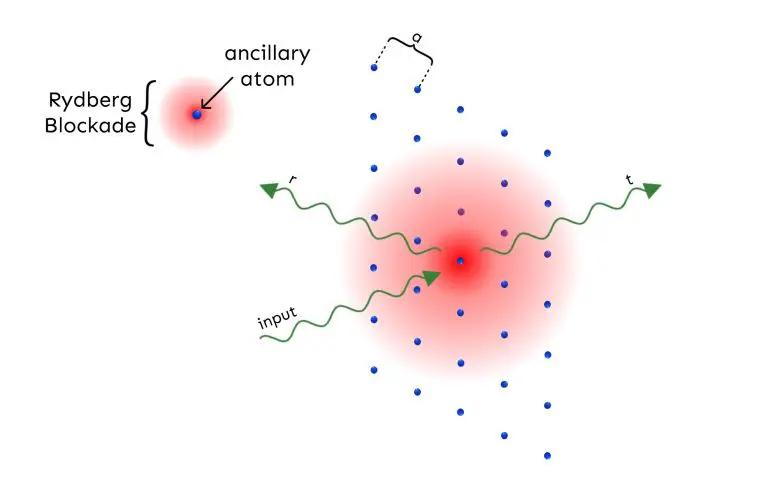
This work investigates generating photonic cluster states, vital for quantum information science, using quantum metasurfaces. These metasurfaces, built from sub-wavelength atomic arrays, control the reflection of light with quantum precision, offering wide-ranging applications in advanced quantum technologies.
Quantum computation and communication protocols have advanced rapidly, but physical implementations often suffer from losses, limiting efficiency and the number of qubits. This research examines a physical implementation of protocols for generating distinct cluster states, including two-dimensional and tree configurations. The approach leverages the unique properties of a quantum metasurface in a free-space setting to implement two-qubit quantum logic gates, CNOT, CZ, and E gates, with practical fidelities exceeding 0. 9, offering potential speed-up.
Rydberg Atom Interactions and Quantum Control
This detailed appendix explores the theoretical underpinnings of a quantum information processing scheme, focusing on Rydberg atoms and their interactions. Rydberg atoms, highly excited atoms with exaggerated properties, are ideal for strong interactions and precise quantum control, enabling the construction of a platform for quantum computation or communication. The research details the theoretical framework, potential sources of error, and how these errors might affect the accuracy of quantum operations. The research centres on understanding how Rydberg atoms interact and how these interactions can be harnessed for quantum control.
Van der Waals forces mediate strong interactions between Rydberg atoms, and the Rydberg blockade effect prevents nearby atoms from being excited to the same state, crucial for creating controlled interactions between qubits. The critical interaction radius defines the strength of this blockade, depending on the decay rates of the excited state and the laser’s intensity. The appendix introduces a quantum medium created by Rydberg atoms, where excited atoms reflect photons. The reflectivity coefficient describes how much light is reflected, but this reflectivity isn’t perfect due to the finite range of the Rydberg blockade.
The research focuses on how this imperfect reflectivity affects the fidelity of quantum operations, detailing how fidelity decays, influenced by decay rates, laser linewidth, and the laser’s strength. The appendix provides equations for calculating reflectivity and modelling fidelity decay, offering a comprehensive theoretical framework. It emphasizes the importance of considering realistic limitations when designing quantum systems and understanding error sources to develop mitigation strategies, ultimately aiming to maximise fidelity and contribute to the advancement of robust quantum technologies.
Metasurface Cluster States Enable Scalable Quantum Logic
This research demonstrates a viable method for generating cluster states, essential resources for quantum computation and communication, using quantum metasurfaces comprised of sub-wavelength atomic arrays. Scientists successfully implemented key quantum logic gates, CNOT, CZ, and E gates, with high fidelity exceeding 0. 9, leveraging the unique properties of these metasurfaces and free-space settings. This achievement enables the creation of both two-dimensional and tree cluster states, offering potential applications in areas such as quantum computation and secure data transmission. The team’s work establishes a scalable framework for generating complex multi-qubit entangled states using sequential photonic qubits and ancilla-mediated interactions.
By constructing a tree cluster state from quantum gates and photons, and outlining a verification method based on stabilizer operator measurements, they provide a robust pathway towards realising practical quantum technologies. The analysis also considered the impact of practical limitations, specifically thermal fluctuations of trapped atoms, on the fidelity of the generated states. Researchers acknowledge that the fidelity of the generated states is sensitive to imperfections in the quantum metasurface, quantified by the reflectance coefficient. While high fidelities were maintained with minimal imperfections, the study details how increasing reflectance coefficient reduces overall performance, suggesting future work will focus on minimising these imperfections and further improving the robustness of the system against environmental noise.
🗞 Cluster States Generation with a Quantum Metasurface
🧠 ArXiv: https://arxiv.org/abs/2511.04297