Quantum state transfer represents a crucial challenge in the development of scalable quantum computers, demanding swift and dependable communication between individual quantum bits. Oscar Michel, Matthias Werner, and Arnau Riera, from Qilimanjaro Quantum Tech and the Universitat de Barcelona, now demonstrate a new protocol for achieving this transfer within linear spin chains. Their work adapts existing techniques, originally designed for more complex systems, to architectures based on the transverse-field Ising model, cleverly encoding information in the boundaries between magnetic domains. This innovative approach significantly broadens the range of platforms suitable for exploring quantum transport, and the team achieves remarkably high transfer fidelities, reaching up to 0. 99 in initial tests, representing a substantial step towards realising practical quantum communication networks.
Spin Chains Enable Quantum State Transfer
Researchers are making significant progress in the field of quantum information transfer, developing methods to reliably move quantum information between qubits, a crucial step towards building powerful quantum computers and communication networks. This work focuses on utilizing spin chains, one-dimensional systems of interacting quantum spins, as a medium for transferring quantum states, the fundamental units of quantum information. A key goal is to achieve perfect state transfer, enabling robust quantum communication and computation. Scientists are exploring various encoding methods, including domain wall encoding, which uses the boundaries between different spin alignments to represent and transmit quantum information.
Several technologies underpin this research. Spin chains provide a platform for encoding and transmitting quantum information via collective excitations. Perfect state transfer aims for 100% fidelity, essential for reliable quantum systems. Researchers employ techniques like the Schrieffer-Wolff transformation and Ising Hamiltonians to model and simplify quantum systems, and are investigating non-stoquastic Hamiltonians for potentially more powerful computations. They are focused on optimizing qubit arrangements, improving transfer fidelity, and creating robust quantum systems resistant to noise.
This research explores various hardware platforms for implementing these technologies, including superconducting qubits, neutral atoms, electromechanical systems, and flux qubits. Scientists are also actively researching materials that can physically realize spin chains with strong magnetic interactions, and combining quantum and classical computing for complex problem-solving. They are pushing the boundaries of computation beyond the capabilities of classical computers.
Domain Wall Encoding for Quantum State Transfer
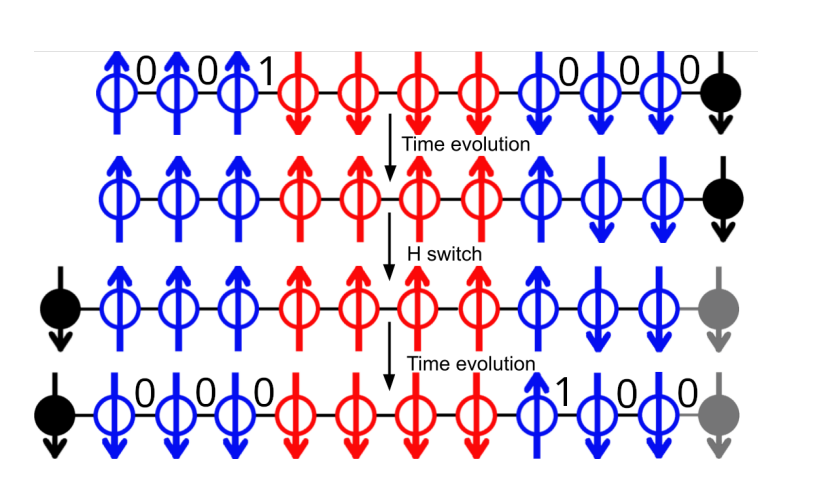
Scientists have developed a new protocol for transferring quantum states along spin chains, a vital step towards building scalable quantum computers. This protocol adapts a previously established method to architectures based on the transverse-field Ising model, a more widely accessible system. The team successfully encoded quantum information within domain walls, creating a system compatible with a broader range of analog quantum simulation platforms. Through simulations, they achieved high transfer fidelities, reaching up to 99%, demonstrating the accuracy and reliability of the method. To visualize the state transfer, researchers employed techniques to calculate fidelity and plot the expectation value of spin components over time, confirming successful transport.
To enable implementation in Ising-like hardware, scientists transitioned from associating each physical spin with a logical spin to a domain wall encoding, placing the logical spin at the interface between two spins. This innovative approach necessitated a modified Hamiltonian containing only ZZ interaction terms. The resulting Hamiltonian, incorporating strong ferromagnetic coupling and local fields, restricts dynamics to domain walls moving along the chain, effectively mimicking energy transfer between sites. The transverse field terms induce spin flips at the domain walls, enabling their movement and facilitating the transfer of excitation.
High-Fidelity Quantum Transfer in Spin Chains
Scientists have achieved high-fidelity quantum state transfer along one-dimensional chains of qubits, a crucial step towards building scalable quantum computers and advanced quantum communication networks. This research focuses on transferring quantum information between distant spins, a fundamental requirement for powerful quantum processors. Experiments successfully transferred quantum states with fidelities reaching 0. 99, showcasing the potential for reliable communication between qubits. This breakthrough utilizes a novel approach, encoding information in domain walls within the spin chain, enabling quantum transport experiments on a variety of analog quantum simulation platforms.
The team developed a protocol tailored for linear spin chains implementing the transverse-field Ising model, overcoming limitations of previous methods. By encoding information in domain walls, the researchers were able to simulate interactions beyond the typical ZZ term, expanding the range of compatible hardware platforms. Tests consistently achieved high transfer fidelities, validating the effectiveness of the domain wall encoding strategy. This work demonstrates a practical method for transferring quantum states with minimal loss of information, paving the way for the development of more complex quantum algorithms and communication protocols. The ability to achieve near-perfect single-qubit and multi-qubit state transfer opens possibilities for building larger, more powerful quantum processors and exploring long-range quantum communication. This protocol serves as a benchmark test for small devices, allowing researchers to measure the accuracy of quantum simulations.
Domain Wall Transfer Achieves High Fidelity
This research demonstrates a successful protocol for quantum state transfer along linear spin chains, adapting a scheme originally designed for systems governed by a Heisenberg Hamiltonian to architectures based on the transverse-field Ising model. The team encoded quantum information in domain walls within the spin chain, enabling a potentially more accessible approach to quantum transport experiments using existing analog quantum simulation platforms. Through simulations, they achieved high transfer fidelities, reaching up to 0. 99, indicating a robust and accurate method for transmitting quantum states.
The significance of this work lies in its potential to simplify the implementation of quantum state transfer, a crucial requirement for scalable quantum computation. By utilizing domain walls, the protocol offers a pathway to realizing quantum communication between distant spins in systems that are more readily available for experimental investigation. Further research could focus on refining the domain wall approximation or exploring alternative encoding methods to enhance the fidelity and scalability of the protocol.
🗞 A quantum state transfer protocol with Ising Hamiltonians
🧠 ArXiv: https://arxiv.org/abs/2510.07481