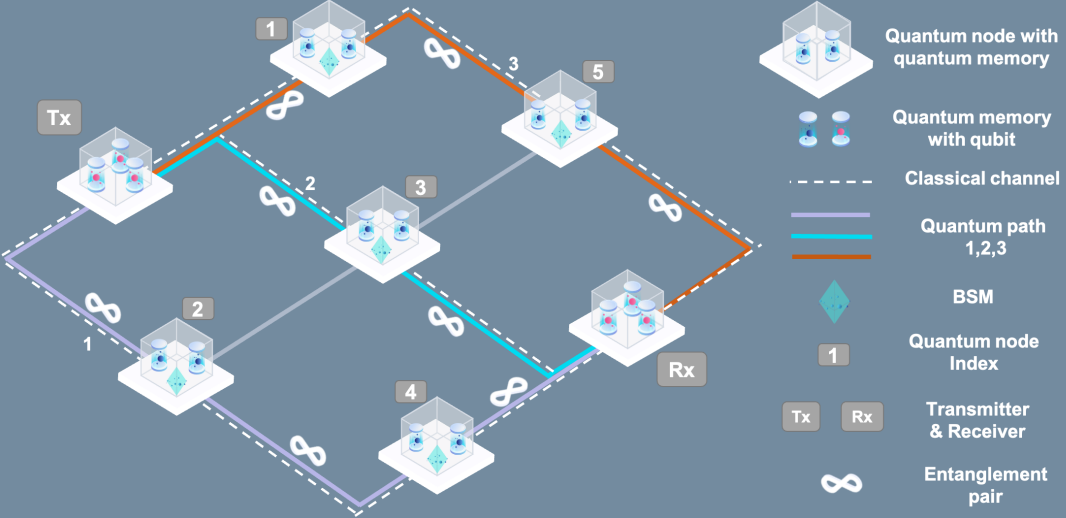
Long-distance quantum communication relies on repeaters to overcome signal loss, but these devices face a fundamental challenge: balancing storage capacity with transmission speed. Karl C. Linne from the University of Chicago, Yuanyuan Li, and Debashri Roy from the University of Texas at Arlington, alongside Kaushik Chowdhury, present Q-REACH, a novel approach that tackles this issue by employing caching networks and repetition. The team demonstrates how encoding and broadcasting qubits through multiple paths, combined with careful analysis of storage time within repeaters, significantly improves fidelity, a measure of quantum information accuracy. This research establishes a framework for optimising qubit transmission rates and correcting errors, representing a crucial step towards building practical, long-range quantum networks.
Optimizing Quantum Networks for Reliable Communication
Scientists have developed Q-REACH, a new approach to quantum communication that tackles the challenges of maintaining qubit fidelity over long distances using quantum repeaters. The research pioneers a method of repetition, encoding a single logical qubit with multiple physical qubits and broadcasting them through diverse quantum paths, each comprising multiple repeaters equipped with quantum memory units. This technique minimizes signal loss and combats quantum decoherence, the degradation of qubit state during transmission. Researchers analytically estimate the time spent by these emitted qubits within the network, considering the number of paths, repeaters, and memory units, to precisely model network performance.
The core of Q-REACH lies in applying queuing theory, traditionally used in classical caching networks, to tune qubit transmission rates while considering fidelity as a critical cost metric. By modeling the quantum repeater network as a caching network, scientists can analyze end-to-end performance and optimize qubit injection rates at the source. This innovative application of queuing theory allows for a detailed assessment of queuing delays within repeater memory, a previously unaddressed factor in quantum network design. The team formulated an optimization problem that utilizes this timing analysis to correct the transmitted logic qubit and select the optimum repetition rate, balancing the benefits of increased redundancy with the detrimental effects of queuing delay.
Furthermore, the study addresses limitations in existing approaches that fail to jointly consider the number of memory units within a repeater and the resulting end-to-end queuing delay. Prior work often focused on maximizing qubit transmission rates or estimating arrival times, but Q-REACH uniquely integrates these considerations into a comprehensive error correction framework. By accurately estimating the time spent by qubits in the network, the system enables error correction at the destination, ensuring resilient end-to-end transmission despite the inherent fragility of quantum states. This method achieves a balance between increasing redundancy for error recovery and minimizing the average waiting time in repeater queues, ultimately improving the fidelity of transmitted qubits.
Simulation results demonstrate a correlation between the logical qubit transmission rate and the corresponding decoding accuracy, a crucial finding that shows it’s possible to trade off between speed and reliability in the network. Specifically, the team found that with 7 physical qubits and 9 quantum memory units, combined with a lookup table decoding method, they could achieve a transmission rate exceeding 35kHz with decoding accuracy greater than 85%. This work has the potential to significantly advance the development of practical quantum networks and the team suggests that future research could focus on implementing Q-REACH on a real quantum repeater network, paving the way for a functional quantum internet.
Optimizing Qubit Transmission and Fidelity Through Queuing
This work presents Q-REACH, a novel queuing theory-based approach designed to enhance logical qubit transmission and correction within quantum caching networks. Researchers addressed the trade-off between qubit transmission rate and fidelity in long-distance quantum communication by leveraging queuing principles to tune transmission rates while considering fidelity as a key cost metric. The team developed a method of repetition, encoding and broadcasting qubits through multiple paths, and analytically estimated the time these qubits spend within the network, factoring in the number of paths, repeaters, and memory units. Through this analysis, scientists formulated an optimization problem to correct transmitted logic qubits and select the optimum repetition rate at the transmitter, ultimately establishing a correlation between logical qubit transmission rate and decoding accuracy. Simulation results validate Q-REACH, providing a benchmark for evaluating and constructing robust quantum communication networks. The authors acknowledge that future research could focus on implementing Q-REACH on real quantum repeater networks with actual quantum memory, further testing and refining the approach in practical scenarios.
🗞 Q-REACH: Quantum information Repetition, Error Analysis and Correction using Caching Network
🧠 ArXiv: https://arxiv.org/abs/2509.24407