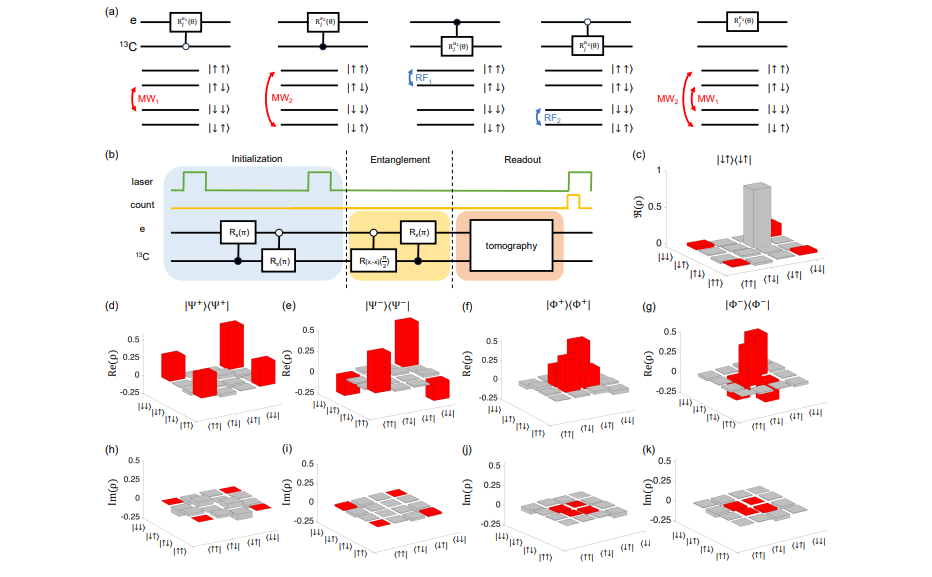
Quantum entanglement, a cornerstone of modern physics and emerging technologies, has taken a significant step forward thanks to research led by Xingyu Gao, Zhun Ge, and Saakshi Dikshit from Purdue University, alongside colleagues including Sumukh Vaidya, Peng Ju, and Tongcang Li. This team successfully demonstrates room-temperature entanglement between an electron spin and a nuclear spin within hexagonal boron nitride, a two-dimensional material with remarkable properties. Achieving entanglement at room temperature, and extending electron spin coherence to 38 seconds, overcomes a major hurdle in developing practical quantum technologies. The researchers create highly accurate entangled states, known as Bell states, with a fidelity approaching 0. 89, and utilise the nuclear spin as a stable memory, paving the way for advanced sensing and quantum information processing based on these versatile two-dimensional materials.
HBN Defects for Quantum Sensing Applications
Hexagonal boron nitride (hBN) is rapidly becoming a central material for quantum sensing research. Scientists are investigating defects within hBN’s layered structure, particularly boron vacancies, to create highly sensitive quantum sensors. A key focus involves controlling and utilizing nuclear spins, such as carbon-13, to enhance coherence times and improve sensing capabilities. Researchers are employing techniques like dynamic nuclear polarization and isotope engineering to manipulate the nuclear spin environment and optimize performance. Optical addressing and control methods allow for precise initialization and readout of spin states within hBN.
These sensors hold promise for a wide range of applications, including highly sensitive magnetic, electric, temperature, and pressure measurements, as well as chemical sensing and high-resolution imaging. Beyond sensing, these defects are also being explored as potential qubits for quantum computing and communication. Numerous studies focus on understanding and characterizing these defects. Researchers are developing methods to create and control boron vacancies, while also investigating the role of isotopic composition in manipulating nuclear spin properties. Studies demonstrate the power of isotope engineering, specifically enriching hBN with carbon-13, to improve coherence times and sensing sensitivity.
Theoretical modeling plays a vital role in understanding decoherence mechanisms and optimizing defect properties. This research is driving progress towards practical quantum sensors and exploring the potential of hBN defects as building blocks for future quantum technologies. Recent advancements include demonstrating robust nuclear spin polarization via ground-state level anti-crossing of boron vacancy defects. Researchers are also integrating hBN-based sensors with photonic waveguides to create compact and efficient devices. Studies demonstrate the ability to sense spin wave excitations and proximity-induced exchange interactions using these spin defects.
While hBN offers significant advantages, challenges remain in terms of defect density, coherence times, and scalability. Addressing these challenges and integrating hBN-based sensors with other technologies are crucial steps towards realizing practical quantum devices. This rapidly evolving field promises significant advances in quantum sensing and quantum technologies in the coming years.
Room-Temperature Entanglement in Hexagonal Boron Nitride
Scientists have achieved a significant breakthrough by demonstrating room-temperature quantum entanglement between an electron spin and a carbon-13 nuclear spin within a hexagonal boron nitride (hBN) material. This achievement establishes a robust platform for advanced quantum technologies based on two-dimensional materials, overcoming a long-standing challenge in realizing entanglement within these systems. The team created carbon-related spin defects in hBN through a carefully controlled process of ion implantation and thermal annealing, identifying isolated emitters suitable for detailed study. Experiments revealed a strong interaction between the electron spin and the carbon-13 nuclear spin, forming a well-defined two-qubit system.
Utilizing this interaction, the team extended the electron spin coherence time to 38 microseconds with a technique called dynamical decoupling, representing a substantial improvement over previously measured coherence times in hBN at room temperature. This extended coherence is crucial for maintaining quantum information and performing complex operations. The team successfully generated maximally entangled states between the electron and nuclear spins, achieving a high fidelity of up to 0. 89, demonstrating the quality of the entanglement and its potential for use in quantum information processing.
Furthermore, by leveraging the long-lived carbon-13 nuclear spin as a quantum memory, scientists enhanced AC magnetic field sensing via correlation spectroscopy, extending the duration of signal detection and improving frequency resolution. These results establish entangled spin qubits in hBN as a viable platform for hybrid quantum devices and open new avenues for quantum sensing and information processing in two-dimensional materials. Researchers acknowledge that further improvements in material purity and device fabrication are needed to overcome current limitations in coherence times. Future research directions include exploring the potential of these 2D quantum sensors for investigating phenomena such as two-dimensional magnetism and many-body entanglement in emerging quantum materials.
🗞 Room-temperature quantum entanglement in a van der Waals material
🧠 ArXiv: https://arxiv.org/abs/2509.23170