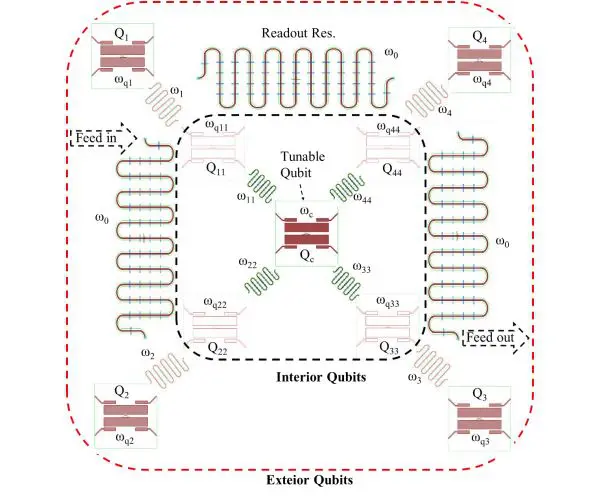
The pursuit of stable and reliable quantum computation faces a fundamental challenge, balancing the need for strong entanglement with accurate readout of quantum information. Ahmad Salmanogli from Ankara Yildirim Beyazit University and Hesam Zandi from the Iranian Quantum Technologies Research Center, along with their colleagues, now present a novel quantum chip architecture that simultaneously preserves both entanglement and readout fidelity. Their design employs a unique arrangement of superconducting qubits, strategically dividing them into interconnected groups to minimise signal interference and maintain coherence. Simulations demonstrate that this innovative approach sustains strong entanglement while achieving a measurement fidelity of approximately 0. 995, even under realistic conditions with inherent noise, representing a significant step towards building practical and scalable quantum processors.
Tunable Qubit Coupling Enhances Quantum Gate Fidelity
This research details a new superconducting qubit architecture designed to improve fidelity and scalability in quantum computing. The team focused on a tunable coupling scheme, allowing dynamic control over qubit interactions to enhance gate fidelity and reduce unwanted crosstalk. This design overcomes limitations of fixed-coupling architectures and improves modularity, offering significant benefits for building more powerful quantum processors. The architecture utilizes a method to dynamically adjust the strength of interaction between qubits, crucial for implementing complex quantum algorithms and optimizing gate operations.
This dynamic control, combined with careful design choices, achieves high-fidelity two-qubit gates, a critical requirement for practical quantum computation. The research also emphasizes fast and accurate qubit readout, crucial for extracting information from quantum computations. The team validated the architecture’s performance through detailed simulations and modeling, building upon existing research in superconducting qubits, tunable coupling schemes, and quantum error correction. This research contributes to the advancement of superconducting quantum computing by providing a promising architecture for building more powerful and reliable quantum processors. Future work will focus on fabricating and testing the proposed architecture, optimizing control techniques, investigating scalability to larger qubit numbers, integrating with quantum algorithms, and exploring quantum machine learning applications.
Entanglement and Readout via Tunable Qubit Architecture
The research team engineered a novel quantum chip architecture comprising nine transmon qubits, strategically organized into interior and exterior groups to simultaneously preserve entanglement and enhance readout fidelity. This design addresses a key challenge in scaling quantum hardware, where strong qubit coupling often leads to unwanted crosstalk and reduced measurement accuracy. The interior qubits form an entanglement core, interconnected and tunable to maximize quantum correlations, while the exterior qubits operate in a dispersive regime, largely isolated and detuned, to facilitate high-fidelity readout. To dynamically control entanglement, the team precisely adjusted the coupling strength between a central tunable qubit and the interior qubits, allowing for reconfiguration of the quantum system.
They characterized the complete system dynamics by numerically solving the full Hamiltonian, which incorporates all significant coupling contributions between interior and exterior qubits, as well as their interactions through interface resonators. This detailed modeling, alongside the Lindblad master equation, enabled comprehensive evaluation of both spectroscopic features and separation fidelity. Advanced simulation techniques demonstrated that the proposed architecture maintains strong entanglement while achieving a measurement fidelity of 0. 995, even under realistic noise conditions. This co-optimization of entanglement strength and readout fidelity establishes a viable pathway toward building high-performance and scalable quantum processors.
Entanglement Control and High-Fidelity Readout Demonstrated
Researchers developed a novel quantum chip architecture designed to simultaneously preserve entanglement and maximize readout fidelity, addressing a critical challenge in building scalable quantum hardware. The team designed a nine-qubit system with an innovative configuration integrating interior and exterior qubit groups. The interior qubits form an entanglement core, while the exterior qubits operate in a dispersive regime, enabling high-fidelity readout. By dynamically adjusting the coupling between a central tunable qubit and the interior qubits, the degree of entanglement can be precisely controlled.
The team numerically solved the complete Hamiltonian of the system, alongside the Lindblad master equation, to characterize its dynamic behavior and evaluate both spectroscopic features and separation fidelity. Simulation results demonstrate the proposed design maintains strong entanglement while sustaining measurement fidelity around 0. 995 under realistic noise conditions. These findings confirm that entanglement strength and readout fidelity can be co-optimized within a single, reconfigurable architecture, establishing a viable route toward high-performance and scalable superconducting quantum processors. Furthermore, researchers expressed a mapping Hamiltonian in terms of Pauli operators, enabling a computationally tractable framework for artificial intelligence-driven optimization and benchmarking of the architecture. This study demonstrates a significant advancement in quantum chip design, overcoming the traditional trade-off between entanglement and fidelity and paving the way for more powerful and reliable quantum computing systems.
Entanglement Preservation and High Fidelity Readout
This research introduces a novel superconducting quantum chip architecture that simultaneously preserves entanglement and maintains high readout fidelity, addressing a critical challenge in developing scalable quantum processors. The team designed a nine-qubit system with an innovative configuration integrating a tunable coupler and a multilayer layout, enabling dynamic control over qubit interactions while minimizing unwanted crosstalk and measurement-induced errors. Theoretical modeling and numerical simulations, incorporating the full system Hamiltonian and the Lindblad master equation, demonstrate the architecture’s ability to support both strong entanglement and separation fidelity exceeding 0. 99 even under realistic noise conditions.
The findings confirm that entanglement strength and readout fidelity can be co-optimized within a single, reconfigurable architecture, establishing a promising pathway towards high-performance quantum computing. Spectroscopic simulations validate the chip’s tunability, revealing clear avoided crossings indicative of coherent hybridization between qubits. Importantly, the design effectively suppresses next-nearest-neighbor crosstalk, a major source of quantum error, without compromising coupling efficiency. The researchers also developed a mapping Hamiltonian framework, bridging analog and gate-level circuit representations, which facilitates implementation on gate-based simulators and opens possibilities for AI-assisted optimization using differentiable quantum machine learning. This work represents a significant advance in quantum chip design, offering a viable route towards building more robust and scalable quantum processors.
🗞 Quantum Chip Co-Design for Fidelity and Entanglement Preservation
🧠 ArXiv: https://arxiv.org/abs/2511.04194