Quantum error detection represents a crucial step towards building practical, large-scale quantum computers, yet remains a significant challenge for silicon-based qubits. Chunhui Zhang, Chunhui Li, and Zhen Tian, along with colleagues at their institutions, now demonstrate successful quantum error detection within a silicon processor containing four nuclear spin qubits and one electron spin qubit. The team validates the system’s entanglement capabilities by creating highly accurate four-qubit Greenberger-Horne-Zeilinger states, and then executes a detection circuit that identifies arbitrary single-qubit errors. This achievement not only recovers encoded information but also reveals the nature of noise affecting the system, marking a substantial advance towards fault-tolerant quantum computation in silicon spin qubits.
Quantum error detection is essential in realising large-scale universal quantum computation, especially for quantum error correction. However, key elements for fault-tolerant quantum computation have yet to be realised in silicon qubits. Here, scientists demonstrate quantum error detection on a donor-based silicon quantum processor comprising four nuclear spin qubits and one electron spin as an auxiliary qubit. Experiments validated the system’s entanglement capability by establishing two-qubit Bell state entanglement between the nuclear spins and generating a four-qubit Greenberger-Horne-Zeilinger (GHZ) state.
Silicon Qubit Control and Readout Techniques
Research in silicon-based quantum computing focuses on using electron spins confined in quantum dots or the spins of donor atoms embedded in silicon as qubits. Silicon is attractive due to its long coherence times, compatibility with existing semiconductor manufacturing, and potential for scalability. A significant portion of this research concentrates on achieving high-fidelity control and readout of these qubits, including techniques for single-shot measurement and precise control pulse optimisation. A major challenge is scaling up the number of qubits while maintaining high fidelity. Researchers explore using the exchange interaction between qubits to create entanglement, employing mediated coupling to connect distant qubits, and developing different architectures for scalability. Quantum error correction is also crucial, with scientists adapting existing codes to the specific characteristics of silicon qubits and designing codes robust to common silicon-based errors. Understanding and mitigating noise sources is critical, including controlling the nuclear spin environment, minimising charge fluctuations, and mapping spatial noise correlations.
Silicon Qubits Detect Single-Qubit Errors
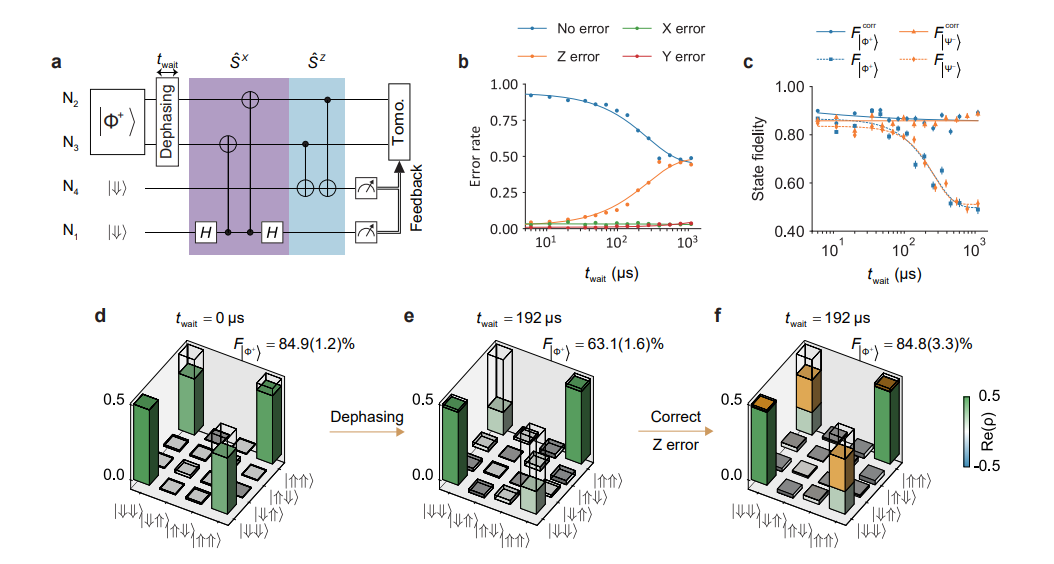
Scientists have achieved a significant breakthrough in fault-tolerant quantum computing by demonstrating error detection within a silicon-based quantum processor. The research team successfully implemented a four-qubit error detection circuit using a donor-based silicon processor containing four nuclear spin qubits and one electron spin qubit functioning as an auxiliary qubit. Experiments validated the system’s entanglement capability by establishing two-qubit Bell state entanglement between the nuclear spins and generating a four-qubit Greenberger-Horne-Zeilinger (GHZ) state, achieving a GHZ state fidelity of 88. 5%.
This achievement lies in the successful detection of arbitrary single-qubit errors using a specific code, employing stabilizers to identify errors without directly measuring the encoded quantum information. By executing the four-qubit error detection circuit, the team independently detected both phase and bit-flip errors simultaneously. The encoded Bell state entanglement information was then recovered through a post-processing step. Detailed analysis revealed strongly biased noise characteristics within the silicon system, providing valuable insights for future optimisation. This work represents a crucial step toward realising practical fault-tolerant quantum computation in silicon spin qubits.
Silicon Qubit Error Detection and Recovery
This research demonstrates a significant advance in fault-tolerant quantum computing using silicon spin qubits. Scientists successfully implemented quantum error detection on a four-qubit processor fabricated from donor-based silicon, incorporating both nuclear and electron spins. Through this system, they generated and verified a four-qubit Greenberger-Horne-Zeilinger state with a fidelity of 88. 5%, and importantly, demonstrated the ability to detect arbitrary single-qubit errors using a stabilizer circuit. Post-processing of the detected errors allowed for recovery of entangled information, effectively mitigating the effects of system decoherence and achieving improved Bell state fidelities.
These findings represent a crucial step towards building practical, fault-tolerant quantum computers based on silicon, a platform distinct from superconducting qubits in its error characteristics. The team identified strongly biased noise within their system, highlighting the need for tailored error correction codes specifically designed for silicon donor spins. While acknowledging limitations related to initial state preparation and the scope of demonstrated operations, the researchers plan to extend this work by incorporating logic state initialization, repeated error detection cycles, and ultimately, implementing fault-tolerant operations across larger, distributed qubit arrays.
🗞 Demonstration of quantum error detection in a silicon quantum processor
🧠 ArXiv: https://arxiv.org/abs/2509.24766