The development of efficient quantum memories represents a critical challenge in realising practical quantum technologies, and recent work by Markus Teller, Susana Plascencia, Samuele Grandi, and Hugues de Riedmatten at ICFO, The Barcelona Institute of Science and Technology, alongside ICREA, demonstrates a significant step forward in this field. The team successfully stores and retrieves qubits, the fundamental units of quantum information, within an array of ten independently controllable solid-state quantum memories. This achievement moves the technology closer to creating random-access quantum memory, a crucial component for future quantum repeaters and processors, by enabling qubits to be stored in, and read from, any cell within the array on demand. The researchers report high storage fidelities that surpass classical limits for both path and time-bin encoded qubits, and they demonstrate the ability to store multiple qubits simultaneously, paving the way for more complex quantum operations and scalable quantum networks.
Scalable Quantum Memory with Controlled Solid-State Qubits
Scientists are developing scalable quantum memory using a solid-state system, a crucial step towards building more powerful quantum technologies. They have created an array of independently controllable quantum memories based on crystals doped with rare-earth ions, allowing for the simultaneous storage of multiple qubits and potentially qudits, which can encode more information per qubit. This innovation enables multiplexing, increasing storage capacity and paving the way for complex quantum information processing. The research utilizes solid-state materials, offering advantages in scalability and integration with existing technologies compared to other quantum memory approaches.
Each memory cell within the array can be individually addressed and controlled, a key feature for storing and retrieving information from multiple qubits simultaneously. Information is stored by manipulating the timing of light pulses, a technique known as temporal multiplexing, achieved using tools like atomic frequency combs. The system demonstrates the potential for long storage times and high fidelity, meaning information is preserved accurately.
Praseodymium Crystal Array for Quantum Memory Access
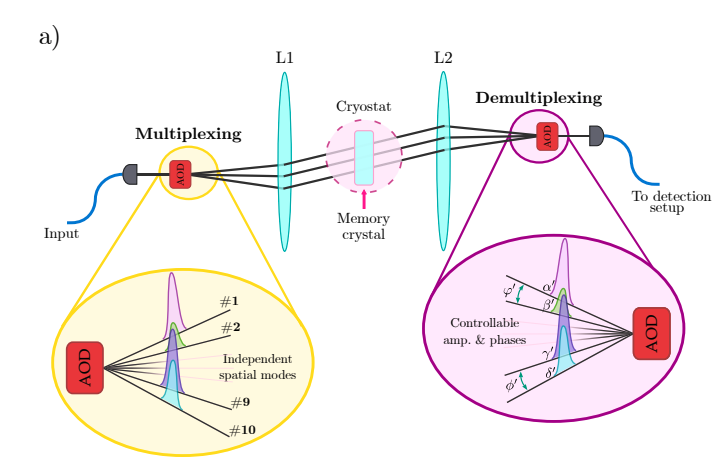
Researchers engineered a solid-state quantum memory array to advance random-access quantum memory technology, a vital component for future quantum networks and processors. They fabricated a ten-cell array from a praseodymium-doped crystal cooled to extremely low temperatures, enabling the storage and retrieval of qubits using weak light signals. Precise control over individual memory cells is achieved using optical components, allowing for spatial multiplexing with a small separation between cells. This system employs an atomic frequency comb to store information in the timing of light pulses without requiring complex conversions.
Ten-Cell Quantum Memory Demonstrates High Fidelity Storage
Scientists have achieved a significant breakthrough in solid-state quantum memory, demonstrating a functional array of ten independently controllable memory cells with precise timing control. This work advances the development of random-access quantum memory, essential for future quantum networks and processors. The team successfully stored and retrieved qubits using both path and time-bin encoding schemes, achieving high-fidelity storage through temporal multiplexing. Experiments revealed high fidelities for both encoding methods across all ten memory cells, exceeding the limits achievable with classical systems.
Researchers further demonstrated the ability to store qubits in two separate memory cells simultaneously, performing a collective readout and confirming coherence between the stored quantum states. Detailed analysis of the stored qubits revealed consistently high fidelities, representing a substantial advance towards practical random-access quantum memory. The team investigated how the measurement window affects fidelity, averaging results across all qubit states to ensure consistent performance. While acknowledging limitations related to signal quality, the researchers identify clear paths for improvement, including enhanced filtering techniques and optimization of memory preparation. Future work will focus on scaling the number of memory cells to hundreds, further enhancing the capabilities of this promising quantum memory architecture and bringing practical quantum repeaters and processors closer to reality.
🗞 Quantum Storage of Qubits in an Array of Independently Controllable Solid-State Quantum Memories
🧠 ArXiv: https://arxiv.org/abs/2509.11910