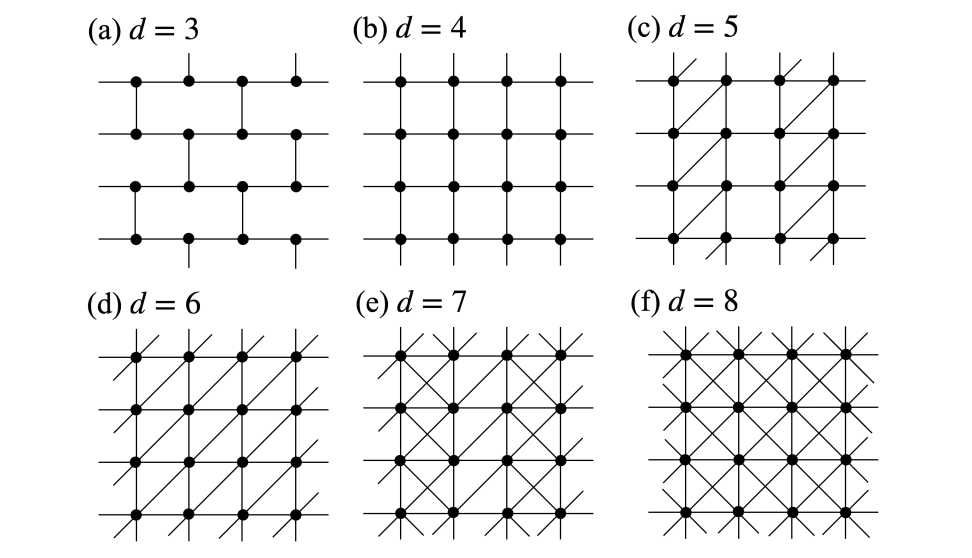
Entangled states known as graph states form the foundation for advanced quantum information processing, and assessing their resilience to noise is paramount as researchers build larger and more complex systems. Tatsuya Numajiri, Shion Yamashika, and Tomonori Tanizawa from Chuo University, alongside Ryosuke Yoshii, Yuki Takeuchi, and Shunji Tsuchiya, have developed a new method to efficiently calculate the fidelity of these states, even as they grow in size and complexity. Their work demonstrates that the fidelity between an ideal graph state and its noisy counterpart can be understood through the lens of classical statistical mechanics, allowing researchers to use established computational techniques to model and predict robustness. This approach reveals a critical relationship between a graph state’s connectivity, its spatial dimensionality, and its susceptibility to noise, showing that lower-degree and lower-dimensional states exhibit greater resilience, while highly connected states can surprisingly restore robustness, offering vital insights for designing noise-tolerant quantum systems.
The study focuses on understanding how these states transition between different phases and how susceptible they are to noise, a major obstacle in building practical quantum computers. They demonstrate that the transition between ordered and disordered phases resembles a classical percolation transition, with a universal critical exponent of 0. 88 ±0. 02.
The research employs numerical simulations based on the tensor network method to analyse the entanglement structure and stability of the graph states. This approach allows for efficient calculation of relevant physical quantities, even for relatively large system sizes. By systematically increasing the level of noise, researchers map out the region of stability for different graph states and identify the types of noise that are most detrimental to their performance. The team also investigates the effect of local depolarizing and bit-flip noise on the entanglement structure and fidelity of the graph states.
Certain graph states exhibit remarkable robustness against noise, maintaining a significant level of entanglement even in the presence of substantial noise. This robustness is attributed to the specific connectivity pattern of the graph, which allows for efficient distribution of entanglement and protects it from local perturbations. The 3-regular graph state, in particular, exhibits a high degree of resilience, making it a promising candidate for fault-tolerant quantum computation.
Graph states are entangled states essential for quantum information processing, including measurement-based quantum computation. As experimental advances enable the realization of large-scale graph states, efficient fidelity estimation methods are crucial for assessing their robustness against noise. Researchers are developing methods to estimate fidelity without needing to calculate the exact value, focusing on scalable approaches that can handle larger systems. These methods typically involve characterising the generated state using a limited number of measurements and then extrapolating to estimate the overall fidelity, offering a practical solution for assessing the performance of quantum devices.
Graph State Quality and Computation Verification
This research focuses on verifying the correctness of quantum computations, particularly those performed using measurement-based quantum computation with graph states. It explores methods to ensure that a quantum computer produces the correct results, even in the presence of noise and errors. A significant portion of the work addresses how to certify the quality of graph states themselves, which are the fundamental resource for measurement-based quantum computation. Researchers are developing methods to verify the fidelity of graph states, crucial because the quality of the graph state directly impacts the reliability of the quantum computation.
The research explores passive verification protocols, which do not require active manipulation of the quantum state, advantageous for reducing errors. There is a focus on efficient verification, aiming to minimize the resources needed to achieve a certain level of confidence in the graph state. The research indicates an interest in verifiable fault tolerance, meaning the ability to not only correct errors but also prove that the error correction process is working correctly. Researchers employ statistical tools for analysing the reliability of verification protocols and consider verification in the presence of malicious adversaries.
They also map quantum verification problems onto classical statistical mechanics problems, potentially allowing the use of classical tools to analyse quantum systems. The research investigates the relationship between topological order and the ability to maintain quantum memory. Researchers are exploring how to diagnose topological order and understand how it breaks down. A recurring theme is the need for verification protocols that can scale to large numbers of qubits and require minimal resources.
Noise Tolerance in Graph State Fidelity
This work demonstrates a new method for calculating the fidelity of graph states, essential for quantum information processing, even when noise is present. Researchers successfully mapped the problem of calculating fidelity to a classical statistical mechanics problem, allowing for efficient computation using established techniques. The analysis reveals that the robustness of graph states against noise depends critically on both their connectivity and their spatial dimensionality. Specifically, the team discovered that graph states exhibit a distinct transition in behaviour as noise increases, changing from a stable state to one dominated by errors.
This transition occurs more readily in lower-dimensional and less connected graph states, which demonstrate greater resilience to noise and exhibit a smooth change in fidelity. Conversely, higher-dimensional and highly connected states are more susceptible to errors, though extreme connectivity can restore robustness. While the study focused on a specific type of noise, the authors acknowledge that extending the analysis to other noise models and exploring the relationship between noise robustness and computational power represent important avenues for future research. Determining the maximum degree of connectivity at which a phase transition can occur remains an open question.
🗞 Phase Transitions and Noise Robustness of Quantum Graph States
🧠 ArXiv: https://arxiv.org/abs/2510.00548