Entangled photon sources underpin the development of secure communication networks, and a team led by Vasile-Laurentiu Dosan, Alek Lagarrigue, and Alessandro Zannotti, from Quantum Optics Jena GmbH and Friedrich Schiller University Jena, now presents a significant advance in this field. They have engineered a highly stable source of entangled photons that generates pairs at wavelengths of 680nm and 1550nm, a combination previously unachieved. This innovative design simultaneously optimises photon detection efficiency and leverages the low-loss transmission properties of standard optical fibres, offering a compelling balance between performance and cost for quantum key distribution. The resulting entangled state exhibits high visibilities and fidelity, establishing this wavelength-hybrid platform as a practical solution for future long-distance, fibre-based quantum communication networks.
Dual Wavelength Entangled Photons for Quantum Networks
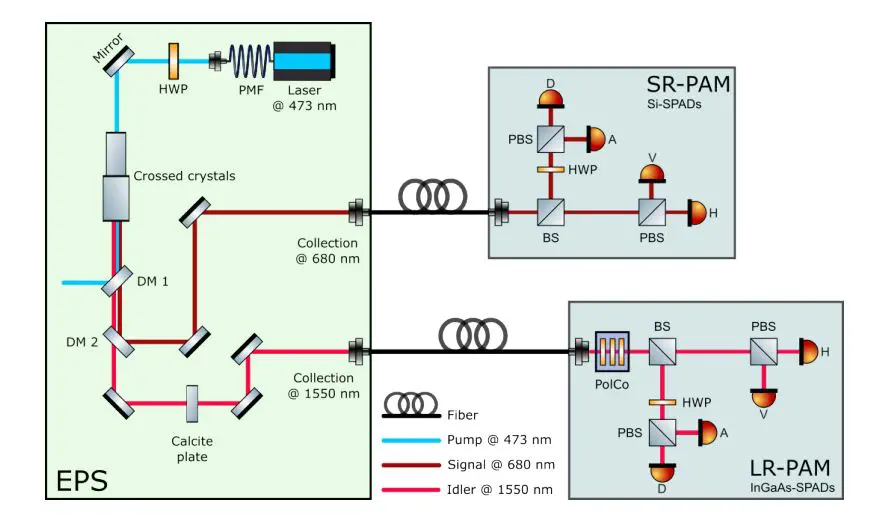
Scientists have engineered a novel entangled photon source for quantum key distribution and long-haul network architectures, generating highly nondegenerate photon pairs at 680nm and 1550nm when pumped by a 473nm laser. This wavelength combination optimizes detection efficiency for silicon single-photon avalanche diodes in the visible/near-infrared range and minimizes transmission loss using standard telecom fibers. The study pioneered a crossed-crystal configuration utilizing periodically poled potassium titanyl phosphate crystals with orthogonal optical axes, enabling polarization entanglement through a process called spontaneous parametric down-conversion. This configuration generates a maximally entangled state, a superposition of horizontally and vertically polarized photons at the two wavelengths.
The experimental setup incorporates a fiber-coupled, diode-pumped solid-state laser emitting at 473nm, ensuring stable operation crucial for efficient photon pair generation. Researchers carefully selected crystals to optimize nonlinear interaction and photon pair generation efficiency. The team achieved a measured spectral bandwidth of 300GHz, corresponding to a high spectral brightness and reduced dispersion for long-distance fiber transmission. The study demonstrated heralding efficiencies reaching 18% for the signal photon and 34% for the idler photon, utilizing both silicon single-photon detectors and superconducting nanowire detectors. Entangled states achieved high visibilities in both horizontal/vertical and diagonal/anti-diagonal bases, yielding a fidelity exceeding 96%, establishing the EPS as a practical platform for fiber-based QKD.
High-Fidelity Entangled Photons at Key Wavelengths
This research demonstrates a stable and highly nondegenerate entangled photon source, generating photon pairs at 680nm and 1550nm when pumped by a 473nm laser. The source utilizes a crossed-crystal configuration for spontaneous parametric down-conversion, achieving a spectral bandwidth of 301GHz, which aligns closely with theoretical predictions. Measurements reveal heralding efficiencies of 18% for the signal photon and 34% for the idler photon, alongside visibilities exceeding 94% in both horizontal/vertical and diagonal/anti-diagonal bases, corresponding to a fidelity greater than 96%. The significance of this work lies in the practical advantages offered by the chosen wavelengths, simultaneously benefiting from the peak detection efficiency of silicon single-photon detectors around 680nm and the low signal loss associated with fiber optic transmission at 1550nm. This combination establishes the source as a promising building block for future fiber-based quantum key distribution links and emerging quantum network architectures.
👉 More information
🗞 Highly Nondegenerate Entangled Photon Source for Fiber-Based Quantum Key Distribution
🧠 ArXiv: https://arxiv.org/abs/2512.11630