The interplay between light, magnetism and material structure governs the behaviour of two-dimensional semiconductors, and recent research focuses on understanding these complex relationships in materials like Fe2P2S6. Nasaru Khan from the Indian Institute of Technology Mandi, alongside Yuliia Shemerliuk, Sebastian Selter, and colleagues at the Leibniz-Institute for Solid-state and Materials Research, investigate the fundamental optical properties of this layered antiferromagnetic material. Their work reveals detailed information about how light creates excitons, quasiparticles that influence material properties, and how these excitons interact with both internal magnetic transitions and the material’s crystal structure. The team observes a unique interference effect, known as Fano resonance, between these excitons and transitions within the iron atoms, offering new insight into the excitation pathways within Fe2P2S6 and paving the way for potential applications in novel optoelectronic devices.
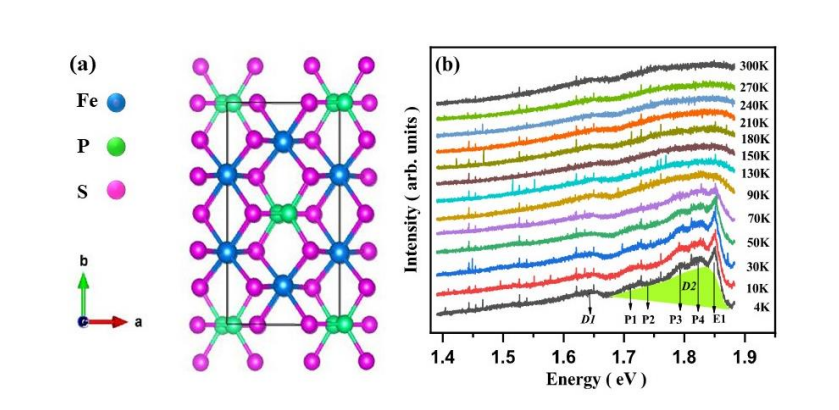
Scientists employed photoluminescence spectroscopy to examine how the material’s electronic and vibrational properties change with temperature, aiming to understand the origin of observed photoluminescence features, including excitonic peaks, phonon sidebands, and transitions within the iron ions. The investigation revealed several key features in the photoluminescence spectra. Phonon sidebands, labelled P1 through P4, indicate interactions between electrons and the material’s vibrations.
A prominent excitonic peak, E1, arises from the formation of electron-hole pairs. Additionally, two broad emission bands, D1 and D2, are attributed to transitions within the iron ions. The observation of a spin-forbidden transition, D2, suggests the presence of structural distortions or defects that alter the material’s electronic structure. Temperature-dependent measurements reveal how these features evolve. The energy of the excitonic peak shifts with temperature, consistent with interactions between electrons and phonons, and can be accurately modelled using established relationships.
The width of the excitonic peak increases with temperature, indicating enhanced interactions and scattering. The intensity of the excitonic emission decreases as temperature rises, suggesting a reduction in the number of electron-hole pairs due to thermal effects. The intensity of the spin-allowed transition, D1, also decreases with temperature, while the spin-forbidden transition, D2, remains relatively constant, indicating its resilience to temperature changes. Scientists utilized established theoretical models, including the Varshni and O’Donnell-Chen relations, to describe the temperature dependence of the excitonic peak energy.
Crystal field theory explains how the arrangement of atoms around the iron ions influences their electronic structure. These models provide a comprehensive understanding of the observed photoluminescence behaviour. This study highlights the significant role of electron-phonon interactions in determining the optical properties of Fe2P2S6. The observation of the spin-forbidden transition suggests the presence of structural distortions or defects that influence the material’s electronic structure. Photoluminescence spectroscopy provides valuable insights into the material’s electronic structure, vibrational properties, and defect chemistry, paving the way for optimizing its performance in potential applications such as spintronics and optoelectronics.
Low Temperature Raman Spectroscopy of Fe2P2S6
This research details a comprehensive investigation into the photoluminescence properties of Fe2P2S6, a layered antiferromagnetic semiconductor, to understand exciton dynamics and their interplay with atomic transitions. Scientists used a micro-Raman spectrometer to excite samples with a laser and collect the resulting inelastically scattered light, carefully controlling laser power to minimize sample heating. A sophisticated detection system enabled precise analysis of the emitted light. Precise temperature control, crucial for observing dynamic effects, was achieved using a closed-cycle refrigerator, maintaining stability from 4 to 300 Kelvin.
The study revealed seven distinct peaks in the photoluminescence spectra of bulk Fe2P2S6 crystals at 4 Kelvin, labelled P1-P4, D1-D2, and E1. Researchers systematically varied the temperature to observe how these peaks changed in intensity, discovering that peaks P1-P4 and E1 disappeared around 70 Kelvin, well below the material’s Néel temperature of 120 Kelvin. Broader peaks D1 and D2, however, persisted up to room temperature. The low-energy peaks P1-P4 were attributed to vibrations associated with exciton emission, while the dominant feature, E1, at 1. 853 electron volts, was identified as an exciton emission exhibiting an asymmetric line shape.
To analyze the temperature dependence of these emissions, scientists fitted the spectra using mathematical functions, with the excitonic peak E1 requiring a more complex function to accurately model its shape. Analysis of the data revealed a shift in the excitonic peak energy with increasing temperature, a characteristic behaviour observed in conventional semiconductors. This temperature-induced variation in energy was further modelled using established relationships, yielding excellent agreement between the models and experimental data. These findings provide detailed insight into the complex interplay between excitons, vibrations, and magnetic ordering within Fe2P2S6.
Fe2P2S6 Exciton Dynamics and Temperature Dependence
This research details a comprehensive investigation into the photoluminescence properties of Fe2P2S6, a layered antiferromagnetic semiconductor, revealing crucial insights into its exciton dynamics and electronic structure. Scientists meticulously examined the material’s response to varying temperatures, identifying seven distinct peaks in the low-temperature photoluminescence spectra, labelled P1-P4, D1-D2, and E1. These peaks progressively diminish in intensity as temperature increases, with peaks P1-P4 and E1 disappearing at approximately 70 Kelvin, well below the material’s Néel temperature of 120 Kelvin. The broader peaks, D1 and D2, however, persist up to room temperature.
The dominant emission feature, labelled E1, appears as an asymmetric peak centred at 1. 853 electron volts and is identified as an exciton emission. Detailed analysis reveals this asymmetry arises from a quantum interference effect between the discrete excitonic state and a continuum induced by the D2 transition. Temperature-dependent measurements demonstrate a shift in the excitonic peak energy with increasing temperature, a characteristic behaviour observed in conventional semiconductors. Fitting this data using the Varshni relation yields a bandgap energy at 0 Kelvin of 1.
853 electron volts, an exciton-phonon coupling strength of 4. 058×10^-5 electron volt Kelvin^-1, and a Debye temperature of 176. 8 Kelvin. Further analysis using the O’Donnell-Chen model provides alternative fitting parameters, including an exciton peak energy of 1. 853 electron volts, a Huang-Rhys factor of 0.
09541, and an average phonon energy of 2. 96 milli-electron volts. Measurements of the integrated PL intensity for the excitonic peak E1 reveal a marked decline with increasing temperature, indicating thermal quenching of the excitonic emission. The temperature dependence of the linewidth of the excitonic peak E1 demonstrates pronounced broadening with increasing temperature, highlighting the significant role of exciton-phonon coupling in the material’s behaviour.
Fano Resonance and Iron d-d Transitions
This research presents a detailed photoluminescence study of the layered antiferromagnetic semiconductor Fe2P2S6, investigating the interplay between Fano resonance and iron d-d transitions. Scientists observed a distinct asymmetric line shape in the excitonic emission, attributed to a quantum interference effect between the discrete excitonic state and a.
🗞 Exciton dynamics, Fano quantum interference and d-d excitation in the single crystal of two-dimensional antiferromagnetic Fe2P2S6
🧠 ArXiv: https://arxiv.org/abs/2511.02640