
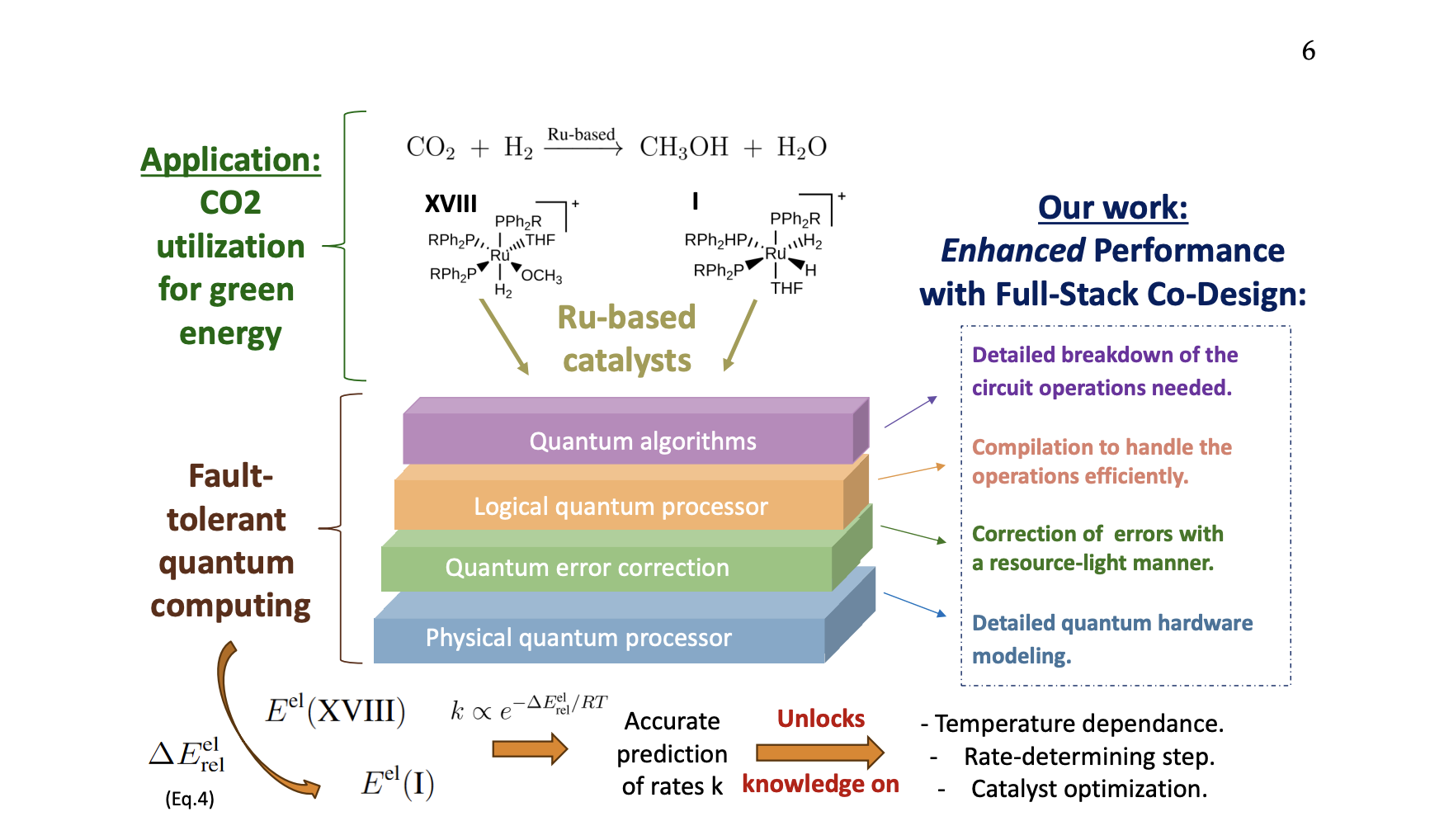
Quantum computing holds the potential to transform fields from materials science to medicine, but realising this promise requires overcoming significant hurdles in computational speed. Katerina Gratsea and Matthew Otten, both from the University of Wisconsin, Madison, alongside their colleagues, demonstrate a pathway towards practical, utility-scale quantum computation by meticulously co-designing all layers of a fault-tolerant quantum computer. Their work tackles a challenging problem in carbon dioxide utilisation for green energy production, reducing the computational runtime from an impractical 22 years to just 1 day —a remarkable 7,900-fold improvement over previous estimates. This achievement not only makes the computation feasible but also establishes a predicted runtime advantage over existing classical methods and provides compelling evidence that a holistic approach, considering every layer of the quantum computing stack, is crucial for achieving real-world impact.
Full Stack Co-Design For Fault Tolerance
Quantum computing promises revolutionary advances in modelling materials and molecules, but current estimates for running utility-scale applications on some quantum hardware reach years, rendering computations impractical. This research incorporates innovations across all layers of the quantum computing stack, from algorithms and quantum error correction to hardware architecture and control, to address this challenge. The team presents a full stack co-design methodology, focusing on minimising the resources needed for fault tolerant quantum computation and optimising the performance of near-term algorithms. This approach allows detailed exploration of the trade-offs between different design choices, leading to significant reductions in runtime for key applications like materials discovery and drug design. The research demonstrates that careful co-design dramatically improves the feasibility of quantum computation for practical problems, paving the way for future utility-scale quantum computers. This achievement stems from a combination of novel algorithmic techniques, improved quantum error correction codes, and hardware-aware compilation strategies, resulting in substantial performance gains compared to existing approaches.
The research demonstrates how quantum computers could realistically tackle CO2 utilization for green energy production, reducing the quantum computation runtime from 22 years to just one day, achieving a nearly 8,000-fold reduction. This reduction makes the computation feasible and predicts a run-time quantum advantage over classical methods. The work rigorously analyses how innovations across the stack combine to provide such reductions, offering strong evidence that all layers of fault-tolerant quantum computing are crucial in the quest for quantum advantage.
Quantum Computing Advances Chemistry and Materials Science
This research explores the application of quantum computing to solve complex problems in chemistry and materials science, problems that are intractable for classical computers. Specific areas of focus include determining the electronic structure of molecules and materials, understanding and designing better catalysts, discovering new materials with desired properties, and developing materials and processes for converting CO2 into useful fuels and chemicals. The team also investigates binding affinity calculations to understand how strongly molecules bind to each other. The research employs several quantum computing algorithms and methods, including Heat-Bath Configuration Interaction, Density Matrix Renormalization Group, and Variational Quantum Eigensolver, alongside techniques for quantum ground state preparation and magic state distillation.
The team investigates several quantum computing hardware platforms, including trapped ions and neutral atoms, focusing on scalability, modular architectures, and high-fidelity entanglement. Key challenges addressed include scaling up quantum computers, improving qubit fidelity, maintaining qubit coherence, developing error correction techniques, and efficiently compiling algorithms onto quantum hardware. Specific research directions include investigating materials for CO2 conversion into methanol, designing corrosion-resistant materials, and calculating the binding affinity of molecules. The team develops modular architectures for trapped ions and neutral atoms to improve scalability and achieves high-fidelity entanglement of qubits for improved quantum computations.
They also explore techniques for compiling quantum algorithms into graph states and use the ZX-calculus for quantum circuit simplification and optimization, with the ultimate goal of building elementary quantum networks for distributed quantum computing. This work leverages hybrid quantum-classical algorithms, quantum error mitigation techniques, and efficient quantum compilation strategies. Resource estimation plays a crucial role in determining the qubits, gates, and time required to run quantum algorithms. The research emphasizes co-design, integrating quantum hardware and software to optimise performance. This represents a comprehensive overview of ongoing research efforts to harness the power of quantum computing for solving complex problems in chemistry and materials science, highlighting the challenges, opportunities, and key advancements in this rapidly evolving field.
Quantum Speedup for Carbon Dioxide Utilization
This research demonstrates a substantial advancement in the feasibility of applying quantum computing to real-world problems, specifically carbon dioxide utilization for green energy production. Researchers achieved a significant reduction in computational runtime, decreasing estimates from 22 years to just one day, representing a nearly 8,000-fold improvement over previous approaches. This breakthrough stems from a comprehensive, full-stack co-design approach, integrating innovations across the algorithmic layer, logical processing, and quantum error correction. The team’s methodology connects quantum algorithms directly to applications with tangible real-world impact, providing compelling evidence of achievable quantum advantage.
By meticulously analysing how improvements in each layer of the computational stack combine, they highlight the crucial role of holistic optimisation in realising the potential of fault-tolerant quantum computing. The researchers acknowledge that their analysis focuses on a specific quantum hardware system, chosen for its initially poorer performance, to demonstrate the impact of parallel improvements across all computational layers. Future work will likely extend this methodology to other hardware platforms and explore the scalability of these techniques as quantum systems continue to grow in complexity.
🗞 Achieving Utility-Scale Applications through Full Stack Co-Design of Fault Tolerant Quantum Computers
🧠 ArXiv: https://arxiv.org/abs/2510.26547