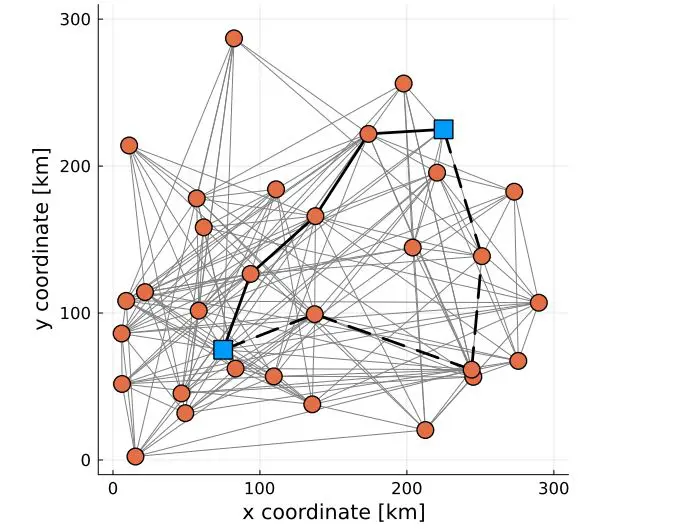
Finding efficient routes for quantum information across complex networks presents a significant challenge, and researchers are now tackling the problem in scenarios where traditional pathfinding methods fail. Maxwell Tang, Garrett Hinkley, and Kenneth Goodenough, alongside Stefan Krastanov, Guus Avis, and colleagues, demonstrate that current routing algorithms struggle when networks exhibit non-isotonic behaviour, a common occurrence when considering both the speed and quality of entanglement generation. Their work introduces novel algorithms that overcome these limitations, offering substantial improvements over exhaustive search methods. Specifically, the team develops both provably optimal and heuristic best-first-search approaches, alongside metaheuristic algorithms like simulated annealing and genetic algorithms, allowing for a flexible balance between path quality and computational cost. These advances promise to accelerate the development of practical quantum communication networks, and are applicable to a variety of repeater designs beyond the specific swap-ASAP scheme investigated.
Optimizing Secret Key Rate in Repeaters
Evaluating Performance in Quantum Repeater Networks
This research focuses on optimizing the performance of quantum repeater networks, essential for long-distance quantum communication, which are limited by signal loss and decoherence. The primary metric for evaluating performance is the Secret Key Rate, representing how quickly a secure key can be established between two parties. Finding the best network configuration to maximize this rate presents a complex optimization challenge, and the study investigates a range of algorithms to address this problem. Exact algorithms, such as Breadth-First Search and Dijkstra’s algorithm, provide optimal solutions but become computationally expensive as network size increases.
Near-exact algorithms, like a heuristic-guided Breadth-First Search, improve efficiency by strategically pruning the search space, often achieving near-optimal results with reduced runtime. Metaheuristic algorithms, including simulated annealing and genetic algorithms, offer alternative approaches inspired by natural processes. The research demonstrates that the heuristic-guided Breadth-First Search algorithm consistently balances accuracy and computational efficiency. A key bottleneck for this algorithm in large networks is the cost of performing dominance checks, which determine if one path is superior to another.
While simulated annealing and genetic algorithms can achieve reasonable performance, they require careful parameter tuning and can be less predictable. Understanding the bottlenecks in these algorithms is crucial for improving their performance, and careful parameter tuning and error analysis are essential for obtaining reliable results. The team also proposes a method to remove unnecessary edges from the network using biconnected components, further improving performance. This work has potential applications in the development of quantum communication networks and a future quantum internet, and further research could focus on optimizing the dominance check procedure or exploring other heuristic algorithms.
Novel Algorithmic Solutions for Quantum Routing
Prefix Bounding Optimizes Quantum Repeater Routing
This study addresses the challenge of optimal routing in quantum repeater networks, where traditional pathfinding algorithms struggle with non-isotonic utility functions. Researchers developed improved algorithms to overcome this limitation, focusing on both best-first search and metaheuristic approaches. To accelerate best-first search, scientists engineered a technique called prefix bounding, which leverages relationships between path prefixes and their potential merit, allowing the algorithm to discard unlikely paths early in the search process. The team implemented this by pairing a priority queue with a partially ordered set, enabling efficient domination checks to identify and eliminate suboptimal prefixes.
Experiments demonstrated that prefix bounding reduces the query count, significantly speeding up the search process. Beyond best-first search, the team explored metaheuristic algorithms, simulated annealing and genetic algorithms, to provide flexibility for diverse quantum repeater models. Simulated annealing mimics thermodynamic processes, starting with a random path and iteratively mutating it based on utility and a decreasing temperature. Each step involves randomly altering the current path by either adding or removing a repeater node, then accepting or rejecting the change based on a probability determined by the utility difference and current temperature. The genetic algorithm, similarly, employs mutation and selection to evolve better paths, utilizing mutation operations including adding/removing repeaters and crossing/uncrossing edges. These metaheuristic methods offer a tunable tradeoff between path quality and computational cost, allowing researchers to control overhead even in large networks by accepting a degree of suboptimality.
Best-First Search for High-Efficiency Pathfinding
Optimal Quantum Routing With Best-First Search
Solving Complex Non-Isotonic Routing Challenges
Scientists have developed new algorithms to optimize routing in quantum repeater networks, addressing a critical challenge in long-distance quantum communication. These networks require identifying the best path for establishing entanglement between distant nodes, a task complicated by the non-isotonic nature of realistic utility functions. Previous pathfinding methods often resorted to exhaustive searches of all possible paths. The research team introduced two best-first-search algorithms designed for faster convergence. One algorithm provably identifies the optimal path, while the other utilizes heuristics to achieve a query count that scales sublinearly with network size, consistently finding near-optimal solutions in practice.
Additionally, the team implemented metaheuristic algorithms, including simulated annealing and a genetic algorithm, allowing for a tunable trade-off between path quality and computational overhead. Experiments focused on swap-ASAP quantum repeaters, modeling entanglement generation with specific parameters, including an initial state fidelity and coherence time. The team modeled the success probability of entanglement generation over a fiber of a certain length, and accounted for depolarizing noise affecting qubit coherence. Measurements demonstrate that the utility function is not always isotonic, necessitating the development of these new algorithms to efficiently navigate the complex pathfinding landscape in quantum networks.
Quantum Routing Algorithms Boost Repeater Networks
This research presents new algorithms to address the complex problem of optimal routing in quantum repeater networks, a critical component for establishing long-distance quantum communication. The team demonstrates that conventional pathfinding methods struggle with the non-isotonic utility functions inherent in realistic quantum networks, where both the rate and quality of entanglement generation must be considered. The researchers developed two best-first-search algorithms that utilise destination-aware merit functions, significantly accelerating the pathfinding process. One algorithm guarantees identification of the best possible path, while the other employs heuristics to achieve effectively sublinear scaling in query count with network size, consistently finding near-optimal solutions. Furthermore, they implemented metaheuristic algorithms, specifically simulated annealing and a genetic algorithm, allowing for a tunable balance between path quality and computational overhead.
🗞 Routing in Non-Isotonic Quantum Networks
🧠 ArXiv: https://arxiv.org/abs/2511.20628