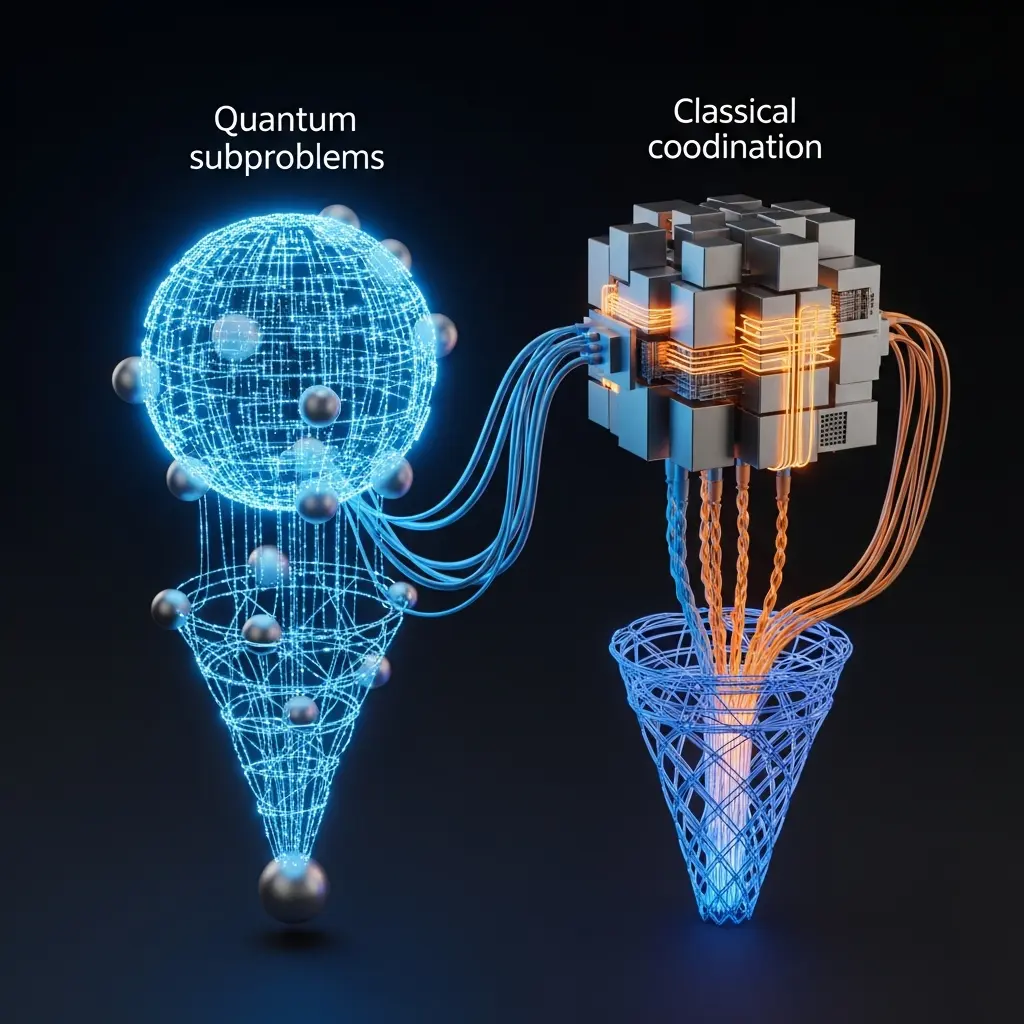
Scientists are tackling the computational limits of mixed-integer linear programming , a cornerstone of industrial optimisation , by exploring a powerful hybrid quantum-classical approach. Sergio López-Baños (German Aerospace Center DLR & Hamburg University of Technology), Elisabeth Lobe (German Aerospace Center DLR), Ontje Lünsdorf (German Aerospace Center DLR) and Oriol Raventós (German Aerospace Center DLR) et al., present a performance-enhanced Benders decomposition algorithm designed to leverage the strengths of both quantum annealers and classical computing. This research is significant because it addresses the scalability issues currently hindering quantum speedups, offering a novel method to utilise existing quantum hardware for larger, more complex problems. By combining a reformulated master problem solved on a quantum annealer with a classically solved linear subproblem, and incorporating key enhancements to embedding and constraint handling, the team demonstrates a promising pathway towards practical quantum-assisted optimisation solutions.
Hybrid Quantum-Classical Algorithm for MILP Solving
Developing Hybrid Quantum-Classical Optimization Solvers
Scientists have demonstrated a novel hybrid quantum-classical algorithm designed to accelerate the solution of complex mixed-integer linear programming (MILP) problems. Researchers tackled the limitations of both classical solvers and current quantum annealers by developing a hardware-agnostic Benders’ decomposition algorithm enhanced for quantum computing. The core of this work lies in decomposing a large MILP into a master problem, reformulated as a quadratic unconstrained binary optimization (QUBO) problem and solved using a quantum annealer, alongside a classical solution of a linear subproblem. This innovative approach aims to leverage the strengths of both computational paradigms, enabling the tackling of larger, more intricate optimization tasks than previously possible.
The team achieved significant performance enhancements through a series of carefully designed improvements to the Benders’ decomposition framework. These enhancements include novel embedding processes that dramatically reduce the pre-processing time required to map problems onto the quantum annealer without sacrificing solution quality. Furthermore, a conservative handling of cut constraints was implemented, alongside a refined stopping criterion that acknowledges the inherent limitations and heuristic nature of current quantum hardware. These modifications collectively optimise the algorithm’s efficiency and robustness, paving the way for practical applications in challenging optimisation scenarios.
This study unveils a practical application of the algorithm by benchmarking it against classical approaches using a D-Wave quantum annealer for a scalable family of transmission network expansion planning problems. Experiments show that the proposed quantum-classical hybrid approach offers a promising pathway towards solving large-scale MILP problems that are intractable for classical solvers within reasonable timeframes. The research establishes a new benchmark for hybrid quantum-classical algorithms in the context of industrial optimisation, specifically addressing the computational challenges encountered in critical infrastructure planning. The work opens exciting possibilities for addressing complex energy system optimisation problems, such as decarbonisation pathways and the integration of renewable energy sources.
As grid infrastructure struggles to keep pace with evolving energy demands, expansion-planning models become increasingly crucial, but also computationally demanding. By accelerating the solution of these large MILP formulations, this research contributes to more efficient and sustainable energy system planning, potentially unlocking the full potential of renewable energy and enabling a more resilient and adaptable grid. The algorithm’s hardware-agnostic design ensures its adaptability to future advancements in quantum annealing technology, promising continued improvements in performance and scalability.
Integrating Benders’ Decomposition with Quantum Annealing
Quantum Benders’ Decomposition with QUBO Formulation
Scientists developed a novel Benders’ decomposition algorithm, enhanced for quantum computation, to tackle large-scale mixed-integer linear programming problems. The research team addressed limitations of classical solvers by integrating a quantum annealer into the decomposition process, aiming to accelerate solutions for complex optimization tasks. This work pioneers a hardware-agnostic approach, allowing the algorithm to function independently of specific quantum hardware characteristics, thereby increasing its versatility and potential for future implementation on improved quantum systems. The core of the methodology involves decomposing the original problem into a master problem, formulated as a quadratic unconstrained binary optimization (QUBO) problem, and a linear subproblem.
Researchers reformulated the integer variable master problem into a QUBO instance suitable for execution on a D-Wave quantum annealer, while the classical solver efficiently handled the linear subproblem. A key innovation lies in the embedding processes, which substantially reduce pre-processing time, critical for quantum annealers, without compromising the quality of the final solution. The team engineered these embedding techniques to minimize the computational burden associated with mapping problem variables onto the limited qubits of the quantum hardware. Furthermore, the study implemented a conservative handling of cut constraints, ensuring the robustness of the decomposition process and preventing premature convergence to suboptimal solutions.
Refinements: Constraint Management and Stopping Criteria
This involved carefully managing the constraints transferred between the master and subproblems to maintain solution accuracy throughout the iterative process. A novel stopping criterion was also developed, accounting for the inherent limitations and heuristic nature of current quantum annealers, preventing unnecessary computation and optimizing resource allocation. Experiments employed a D-Wave quantum annealer to benchmark the proposed algorithm against classical approaches using a scalable family of transmission network expansion planning problems. The algorithm’s performance was rigorously evaluated on these transmission network problems, demonstrating its potential to address computationally intensive challenges in energy systems. This benchmark allowed scientists to quantify the speedup achieved by the quantum-classical hybrid approach compared to traditional classical methods, validating the effectiveness of the methodological innovations. The research highlights the potential of combining the strengths of both quantum and classical computing paradigms to solve previously intractable optimization problems, paving the way for advancements in areas such as power systems and sustainable energy planning.
Quantum Annealing Speeds Complex Problem Solving by exploring
Advanced Solution Capabilities Through Hybrid Systems
Scientists have developed a novel Benders’ decomposition algorithm enhanced for quantum annealing, achieving significant improvements in solving complex mixed-integer linear programming problems. The research team successfully integrated a hardware-agnostic approach with several key enhancements, targeting optimal quantum utilization and scalability for large-scale optimization tasks. Experiments revealed that precomputed embeddings minimized preprocessing time by 3, effectively circumventing the need for repeated embedding calculations in each iteration of the algorithm. This optimization substantially reduces computational overhead and accelerates the overall solution process.
The core of the breakthrough lies in the algorithm’s ability to decompose a mixed-integer linear programming problem into a master problem, reformulated as a quadratic unconstrained binary optimization problem, and a linear subproblem solved classically. Measurements confirm that this decomposition, coupled with conservative handling of cut constraints and a refined stopping criterion, allows for efficient utilization of current quantum annealers despite their limitations. Tests prove the algorithm’s efficacy using a 4-quantum annealer benchmarked against classical approaches on a scalable family of transmission network expansion planning problems. Data shows the implementation of precomputed embeddings dramatically reduces the time required for problem setup, a historically significant bottleneck in quantum-classical hybrid algorithms.
The team meticulously analyzed scalability, performance, convergence, and time complexity, demonstrating the algorithm’s robustness under various parameter configurations and embedding strategies. Specifically, the study generated a scalable set of mixed-integer linear programming instances representing transmission network expansion planning, providing a comprehensive dataset for evaluating performance. Furthermore, the research delivers a fully automated and hardware-agnostic Benders’ decomposition-quantum annealing algorithm implemented in Python, offering a general framework for future development. Scientists recorded that this approach allows for more precise adaptation to annealer constraints, while remaining compatible with any quadratic unconstrained binary optimization solver. The algorithm’s ability to minimize the number of qubits required in each iteration represents a crucial step towards tackling increasingly complex optimization challenges with limited quantum resources. This work establishes a foundation for leveraging quantum resources to accelerate multi-cut Benders’ decomposition, circumventing scalability issues associated with directly evaluating the master problem on a quantum annealer.
Quantum Benders’ Decomposition via QUBO Formulation
Scientists have developed a novel Benders’ decomposition algorithm, enhanced for use with quantum annealers, to tackle complex mixed-integer linear programming problems. This research presents a hardware-agnostic approach, meticulously detailing each step rather than treating the quantum annealer as a simple black-box solver, offering a general framework for quantum-assisted Benders’ decomposition (BD-QA) algorithms. The algorithm combines a master problem, reformulated as a quadratic unconstrained binary optimization (QUBO) problem and solved using a quantum annealer, with a classical solution of a linear subproblem. Key contributions include an automated, general-purpose BD-QA algorithm implemented in Python, incorporating improvements to fully utilise quantum device capabilities and enhance performance.
Precomputed embeddings minimise preprocessing time, avoiding repeated embedding calculations in each iteration, and a detailed scalability, performance, and time complexity analysis was conducted using a quantum annealer for solving the master problem. Furthermore, the researchers generated a scalable set of mixed-integer linear programming instances based on a transmission network expansion planning problem, providing all necessary data for investment and operational planning. The authors acknowledge that current quantum annealers have limited scale, which restricts the size of problems that can be practically solved. While the algorithm is hardware-agnostic, its performance is naturally constrained by the capabilities of the chosen QUBO solver. Future research directions involve exploring more advanced embedding techniques and investigating the potential of hybrid quantum-classical algorithms to further improve scalability and solution quality. This work demonstrates a promising step towards leveraging quantum computing for solving real-world optimisation problems in energy systems planning, though practical speedups remain dependent on advancements in quantum hardware.
🗞 Performance enhancing of hybrid quantum-classical Benders approach for MILP optimization
🧠 ArXiv: https://arxiv.org/abs/2601.14024