

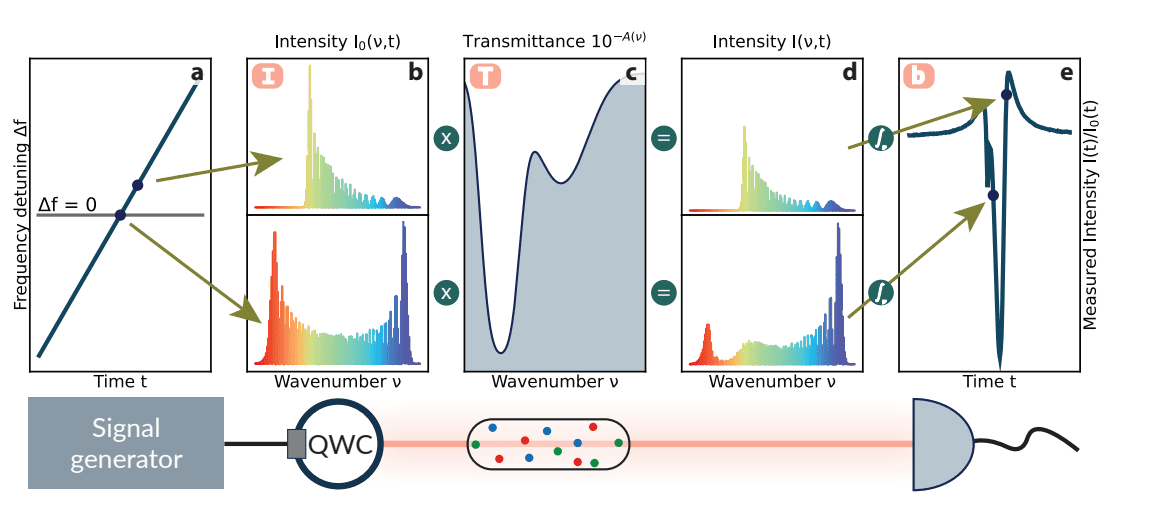
Frequency combs revolutionise chemical analysis by enabling rapid and compact multi-component measurements, but current dual-comb spectrometers require complex paired systems. Ina Heckelmann, Davide Pinto, and colleagues at ETH Zürich now demonstrate a significantly simplified approach, building a fast and compact spectroscopic analyser using a single ‘quantum walk comb’ laser. The team exploits the unique tunability and speed of this laser to create a device that requires no moving parts, achieving a time resolution of just 10 microseconds and a wide dynamic range. This breakthrough paves the way for real-time analysis of chemical processes and offers a powerful new tool for studying chemical kinetics and identifying a broad range of organic vapours.
Quantum Walk Combs Detect Molecular Motion
This research details a novel spectroscopic technique called Quantum Walk Comb Spectroscopy (QWCS), leveraging the unique properties of Quantum Walk Comb (QWC) lasers for rapid and sensitive detection of molecular kinetics. QWC lasers generate a frequency comb, a spectrum consisting of evenly spaced frequencies, through a process analogous to a quantum walk, and are characterised by fast gain dynamics and the ability to be rapidly modulated. This allows for precise control over the comb’s spectral shape and temporal characteristics, enabling broadband infrared spectroscopy with potentially sub-nanosecond resolution, particularly well-suited for studying fast molecular processes and transient species. The technique offers high time resolution, broadband coverage, and high sensitivity, and semiconductor-based QWC lasers are amenable to integration into compact, portable devices. Experiments demonstrate the feasibility of QWCS by accurately identifying and quantifying the concentration of different molecules in simple gas mixtures, highlighting its potential for studying complex chemical reactions and biological processes. This research presents a promising new spectroscopic technique that combines the advantages of frequency comb spectroscopy with the unique properties of Quantum Walk Comb lasers, potentially revolutionising the study of fast molecular kinetics and opening up new avenues for research in chemistry, biology, and materials science.
Rapid Broadband Spectroscopy With Laser Combs
Scientists developed a rapid spectroscopic analyser that operates without moving components, leveraging a single walk comb laser for broadband mid-infrared measurements. This system achieves a time resolution as small as 10 microseconds and a high dynamic range reaching three orders of magnitude in concentration, suitable for real-time analysis of chemical kinetics. The experimental setup involved flowing a gas sample through a gas cell while simultaneously acquiring spectral data. Researchers employed two reconstruction methods, a targeted approach requiring prior knowledge of gas species, and an untargeted approach assuming no prior knowledge.
The targeted approach directly determined acetone concentration, while the untargeted approach solved for spectral transmittance using mathematical techniques and physical constraints. Both methods captured overall trends in spectral transmittance, with the targeted approach exhibiting higher precision and accuracy. This innovative system achieves a level of precision comparable to that of Fourier-transform infrared spectroscopy, offering a fast and compact alternative for real-time chemical analysis.
Tunable Comb Spectroscopy Achieves Microsecond Resolution
This work demonstrates a new approach to rapid, compact spectroscopic analysis, achieving high-resolution measurements without moving mechanical parts. Scientists implemented a system utilising a single, tunable quantum cascade laser comb operating within the mid-infrared spectrum, a region critical for identifying molecular fingerprints. Experiments revealed a time resolution as small as 10 microseconds, coupled with a dynamic range spanning three orders of magnitude in concentration, enabling real-time analysis of chemical kinetics. By fitting the data to established reference spectra, scientists accurately determined the concentrations of gases.
Measurements of acetone and 2-butanone showed excellent agreement between the comb-based system and a traditional Fourier-transform infrared (FTIR) instrument. Further experiments involved rapidly flushing the gas cell with acetone, allowing scientists to monitor the dynamic changes in transmittance, a capability not achievable with conventional FTIR instruments. These results demonstrate a significant advancement in spectroscopic techniques, offering a pathway to compact, fast, and sensitive chemical analysis.
Rapid Spectroscopy With Tunable Walk Combs
This research demonstrates a new approach to compact spectroscopic analysis, achieving rapid measurements without the need for moving mechanical parts or paired frequency combs. By employing a single, tunable ‘walk comb’ laser in the mid-infrared spectrum, scientists have developed a system capable of analysing organic solvent vapours with a time resolution of just 10 microseconds and a wide dynamic range. The method allows for both targeted identification of known compounds and untargeted analysis, providing flexibility for diverse applications in chemical kinetics. Researchers successfully demonstrated the accurate identification of acetone, and the system’s ability to track changing concentrations of gases in real-time. While acknowledging that further improvements to system robustness are possible, the team highlights the potential for on-chip integration to create even more compact and reliable devices.
👉 More information
🗞 Fast and compact time-resolved spectroscopy enabled by Quantum Walk Combs
🧠 ArXiv: https://arxiv.org/abs/2509.20112


