Quantum networks represent a vital step towards powerful distributed computing, yet these systems consistently suffer from the effects of noise travelling through the channels that connect them. Yue-Yang Fei, Zhenhuan Liu, and Rui Zhang, along with colleagues at their institutions, now demonstrate a method for actively purifying these quantum channels, suppressing noise without the need for complicated encoding or decoding. The team achieves this purification by carefully manipulating the spatial and polarization properties of photons, utilising two Fredkin gates to create interference between independent noise channels. This innovative approach effectively reduces noise across a broad spectrum of conditions and, crucially, preserves entanglement, a key resource for quantum communication, to a significantly greater extent than existing purification techniques.
Entanglement Purification and Depolarizing Noise Channels
This research investigates entanglement purification and its effectiveness when entangled states are affected by depolarizing noise. The study demonstrates how a purification protocol improves the quality of these states, essential for quantum technologies. Scientists characterized the noise affecting entangled states and presented density matrices representing the quantum states after noise exposure, purification, and a theoretical purification step, precisely measuring entanglement quality and purification effectiveness. The initial channel matrices define the noise introduced to entangled states, with a depolarizing channel randomly altering a quantum state with a certain probability.
Density matrices describe the quantum states, with diagonal elements representing state probability and off-diagonal elements indicating quantum superposition. Entanglement quality is assessed from the density matrix, with higher off-diagonal elements and specific patterns indicating stronger entanglement. A virtually purified channel serves as a benchmark to evaluate the purification protocol’s performance. By comparing density matrices before and after purification, scientists quantify the improvement in entanglement quality. Increased diagonal elements indicate a more well-defined state, while larger off-diagonal elements signify stronger coherence and entanglement.
A purer state exhibits reduced mixedness, a measure of quantum uncertainty. The purification process performs better with less initial noise, as demonstrated by data with different noise levels. This research is crucial for building practical quantum communication systems, as quantum entanglement is a key resource but is fragile and susceptible to noise. Entanglement purification protocols are essential for overcoming this limitation and enabling long-distance quantum communication.
Spatial Fredkin Gates Suppress Quantum Noise
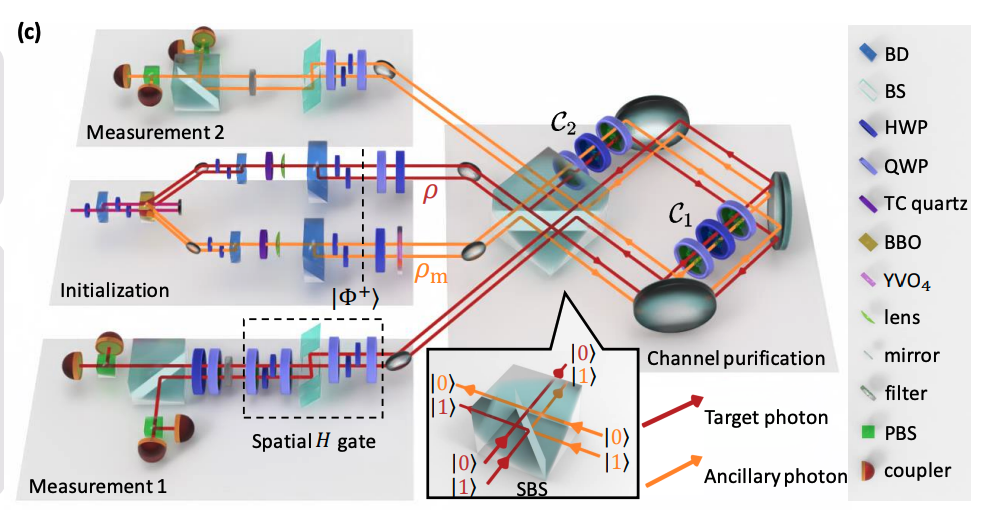
Scientists have developed an innovative experimental setup to address noise accumulation in quantum networks, focusing on channel purification as a means of improving remote quantum information transmission. The study pioneers a method that efficiently suppresses noise without relying on complex encoding and decoding operations, a significant advantage for optical systems. Researchers engineered a configuration leveraging the spatial and polarization properties of photons to implement multiple Fredkin gates within a single circuit, a computationally powerful tool for quantum error mitigation and simulation. This design enables coherent interference between independent noise channels, achieving effective noise suppression across a wide range of noise levels and types.
The core of the work involves a channel purification protocol that consumes several noisy channels to obtain a less noisy one, specifically targeting the noisiest channel. The team constructed a circuit comprising three registers: a main register initialized with the input state, an ancillary register in a maximally mixed state, and a control register in a specific quantum state. Following initialization, scientists sequentially performed Fredkin gates and applied the noise channels, departing from traditional quantum error correction, which often requires complex encoding, decoding, and numerous ancillary qubits. To validate the effectiveness of this approach, researchers employed process tomography and average fidelity estimation, confirming a significant reduction in noise rates and demonstrating the protocol’s universality. The study further showcases the practical benefits of channel purification by applying it to an entanglement distribution task, where it surpasses conventional entanglement purification in preserving distributed entanglement. This advancement offers a simpler, more practical approach for linear optical quantum computing platforms by relaxing the stringent requirements of traditional error correction methods and focusing on targeted noise suppression.
Spatial and Polarization Purification of Qubits
Scientists have developed a novel channel purification protocol for quantum networks, achieving significant noise suppression without complex encoding or decoding. This work introduces an experimental setup that leverages the spatial and polarization properties of photons to effectively mitigate noise in quantum channels, crucial for reliable remote quantum information transmission. The core of the technique involves two Fredkin gates designed to create coherent interference between independent noise channels, demonstrating effective noise suppression across a wide range of noise levels and types. The team implemented a new architecture utilizing distinct colors to encode four qubits with polarization and spatial degrees of freedom.
A key component is the spatial beam splitter (SBS), designed to transmit top-layer photons and reflect bottom-layer photons, functionally mimicking a polarization beam splitter in spatial degrees of freedom. Experiments demonstrate that when both photons are in the top layer, they transmit through the SBS, directing one photon through noise channel C1 and the other through C2, while the bottom layer configuration exchanges these trajectories. This SBS functionality achieves the effect of a Fredkin gate by exchanging target states based on the control state, creating a specific quantum state. To evaluate performance, researchers performed process tomography measurements on the initial noise channels and the resulting purified channels.
The team achieved high interference visibility when applying specific quantum rotations, ensuring efficient protocol implementation. Measurements confirm that the purified channel consistently resides closer to the target channel than the initial channels. Furthermore, the protocol functions effectively even when the two input channels are not equivalent, requiring only that their principal components align with the noiseless channel.
Entanglement Preservation Via Photon Purification
This research demonstrates a new method for improving the reliability of quantum communication channels, known as channel purification. Scientists successfully built an experimental setup that effectively suppresses noise within these channels, utilizing the spatial and polarization properties of photons to achieve coherent interference and noise reduction across a range of conditions. The team’s approach differs from traditional entanglement purification, as it can preserve entanglement even when initial states are separable, a significant advantage for practical applications. The successful implementation of channel purification was demonstrated through improved entanglement distribution, achieving a high fidelity, which highlights the potential for long-distance quantum communication. While acknowledging that the current protocol’s performance relies on the characteristics of the noise channel itself, the researchers suggest this work provides valuable insight into the fundamental principles of channel purification and informs the design of future protocols. Future research will focus on adapting this architecture to handle more complex scenarios involving multiple channels and levels of purification, as well as exploring alternative protocols to further enhance performance and reduce implementation costs.
🗞 Experimental Quantum Channel Purification
🧠 ArXiv: https://arxiv.org/abs/2510.27534