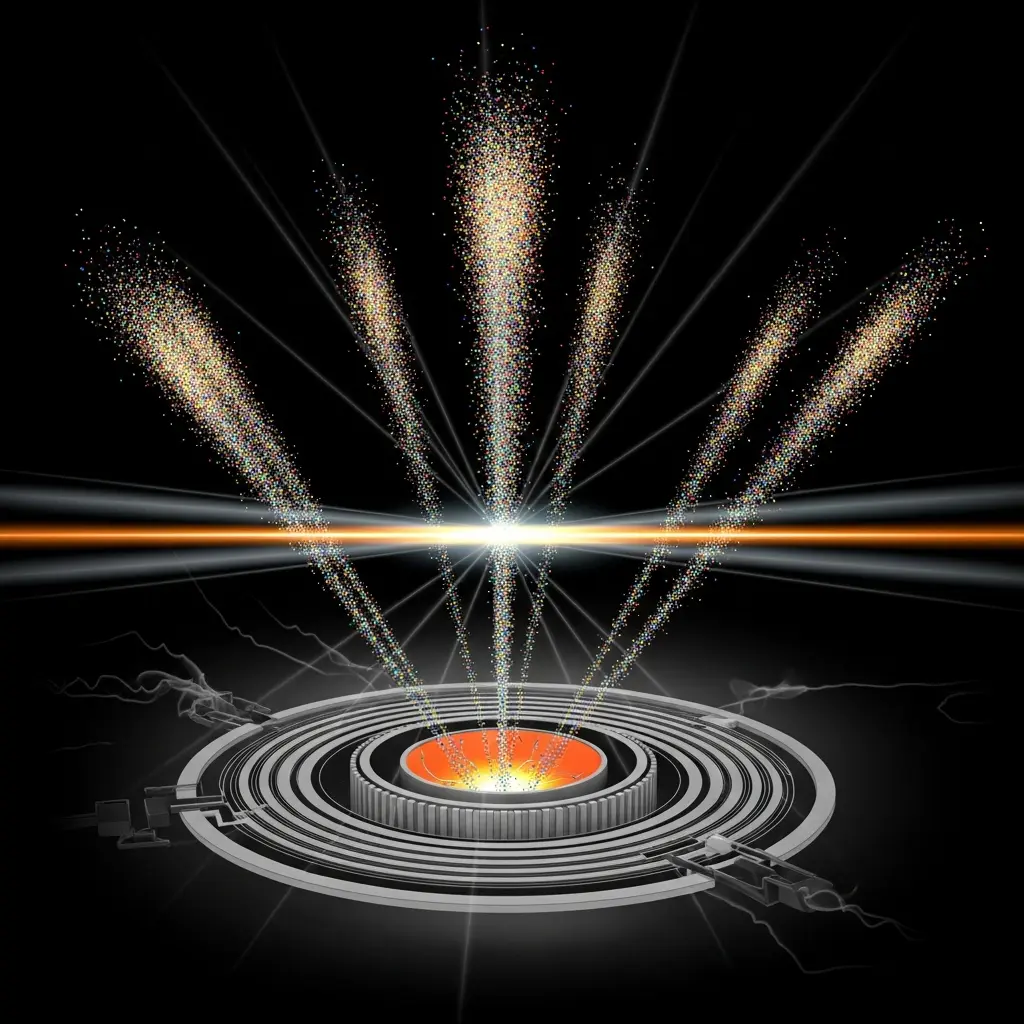
The production of high-energy jets in collisions offers a powerful probe of the fundamental structure of matter, and understanding the dynamics of gluons within atomic nuclei remains a central challenge in nuclear physics. E. Iancu, D. N. Triantafyllopoulos, S. Y. Wei, and F. Yuan investigate the quantum evolution of these gluons, specifically focusing on how their distribution changes with energy and momentum transfer. Their work demonstrates a method for predicting the behaviour of these gluons from first principles, bypassing the need for assumptions about unobservable, non-perturbative effects, and provides a crucial step towards a complete theoretical description of diffractive jet production in high-energy collisions. By examining the evolution of the gluon distribution in both momentum and coordinate space, the team reveals a self-consistent picture of gluon saturation, offering new insights into the strong force that binds quarks and gluons together within atomic nuclei.
Using the Colour Glass Condensate description of electron-nucleus collisions at high energy, this work studies the diffractive production of a pair of jets with transverse momenta much larger than the nuclear saturation momentum. At leading order in the QCD coupling, the di-jet cross-section exhibits transverse-momentum dependent (TMD) factorisation, with a gluon diffractive TMD distribution. The research investigates how the nuclear environment modifies the gluon distribution and affects the production of high-energy jets, providing insights into the underlying structure of nuclear matter. This approach allows for a detailed examination of gluon dynamics at small momentum fractions, crucial for understanding the Colour Glass Condensate phenomenon and the behaviour of matter under extreme conditions.
Color Glass Condensate and Gluon Saturation Theory
This body of work explores high-energy quantum chromodynamics, saturation physics, and related topics at colliders. Key theoretical foundations include the Color Glass Condensate framework, which describes how to compute gluon distributions in large nuclei at small energy scales. Recent advances include resumming double logarithms in QCD evolution and developing non-linear evolution equations beyond leading order.
Experimental studies focus on measurements at colliders, including the Large Hadron Collider, where ultra-peripheral heavy-ion collisions provide a unique probe of gluon saturation. Measurements of photonuclear interactions and dijet production in these collisions are crucial for testing theoretical predictions. The upcoming Electron-Ion Collider promises to provide even more detailed insights into saturation physics, with experiments designed to probe the gluon distribution at small energy scales. The research demonstrates that the transverse momentum distribution of these jets is governed by a diffractive gluon distribution, a key component describing gluon behaviour within the “Pomeron”, the colourless exchange between colliding particles. Measurements confirm that this gluon distribution exhibits a characteristic flat shape at low transverse momenta, up to a saturation scale, indicating a high density of gluons within the Pomeron, and then rapidly decreases at higher momenta. The team demonstrated that the emergence of this distribution can be derived from first principles, without relying on assumptions about non-perturbative physics.
Calculations reveal that the gluon distribution is strongly influenced by gluon saturation, a phenomenon where the density of gluons becomes so high that their interactions significantly alter the overall dynamics. These findings provide a comprehensive understanding of the underlying physics governing diffractive di-jet production and pave the way for further investigations into the strong interaction at high energies.
Gluon Saturation From First Principles
This research advances understanding of gluon saturation, a phenomenon predicted to occur in dense gluonic systems like those found within atomic nuclei at very high energies. Scientists have investigated diffractive production of jets to probe the behaviour of gluons and the saturation scale, which represents the density limit of gluons within a nucleus. The team successfully demonstrates that the boundary conditions and solutions for describing the evolution of gluon distributions can be determined entirely from first principles, without relying on assumptions about non-perturbative physics. The work focuses on the Collins-Soper-Sterman (CSS) evolution equation, which describes how gluon distributions change with energy scale.
Researchers explored different mathematical representations of this equation, finding good agreement between them despite inherent differences in their underlying assumptions and boundary conditions. Importantly, the study incorporates the effects of both the BK/JIMWLK and DGLAP evolutions, providing a more complete picture of gluon dynamics. Future research directions include refining the CSS equation and applying these results to predict the outcomes of experiments at the upcoming Electron-Ion Collider, where direct observation of gluon saturation is anticipated. These findings represent a significant step towards a comprehensive understanding of gluon saturation and its role in the behaviour of matter at extreme densities.
🗞 The quantum evolutions of the diffractive transverse-momentum dependent gluon distribution
🧠 ArXiv: https://arxiv.org/abs/2512.11730