Researchers demonstrate a technique, termed ‘whitening’, to improve the detection of weak signals at unknown frequencies, surpassing the limitations of conventional measurement approaches. This covariant measurement enhances sensitivity in experiments such as gravitational wave detection and dark matter searches, even with limited prior information about the signal parameter.
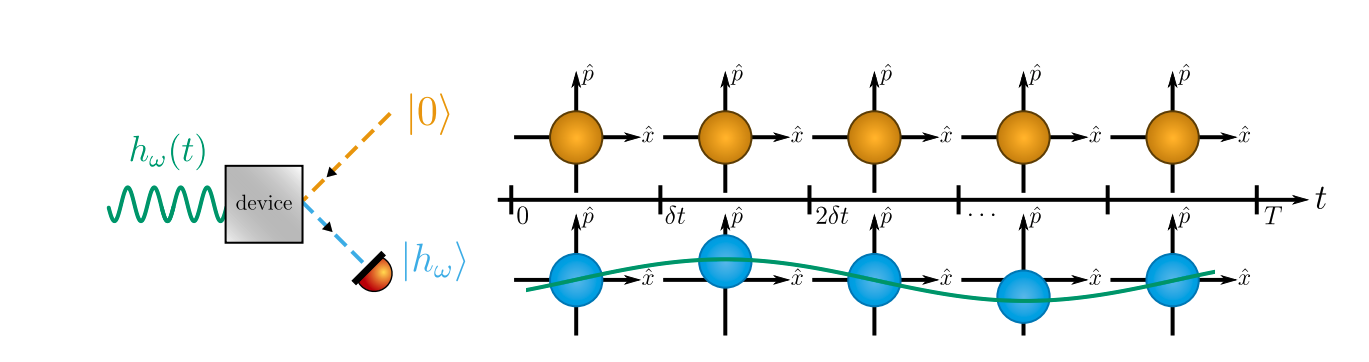
The accurate determination of signal frequency is crucial in diverse areas of physics, ranging from the detection of gravitational waves to the search for elusive dark matter candidates. Conventional methods of frequency estimation encounter limitations when signals are weak, struggling to pinpoint their location within the noise. New research, detailed in ‘Bayesian frequency estimation at the fundamental quantum limit’, demonstrates a technique that surpasses these classical boundaries, utilising a coherent measurement protocol known as ‘whitening’ to improve signal detection. James W. Gardner from OzGrav-ANU, Tuvia Gefen from the Racah Institute of Physics, and colleagues, present a theoretical and numerical analysis showing that this approach can enhance the precision of frequency estimation, even when approaching the fundamental quantum limits imposed by uncertainty. The study offers potential benefits for optimising the performance of advanced sensors and broadening the scope of experiments probing fundamental physics.
Quantum metrology represents a developing field poised to enhance the precision of measurement beyond classical limits. Researchers investigate methods to circumvent the constraints inherent in traditional techniques, leveraging principles established in quantum mechanics to achieve improved sensitivity. This pursuit builds upon foundational work, notably the Holevo bound, which defines the ultimate limit to precision in estimating an unknown parameter from a quantum state, and utilises tools like the Cramér-Rao bound, a statistical figure of merit determining the minimum variance of any estimator.
A central challenge lies in developing measurement strategies resilient to environmental noise and limitations in available information. Real-world applications demand robustness, requiring techniques that maintain enhanced precision despite imperfections. Current research concentrates significantly on waveform estimation, a process of reconstructing a signal from noisy data, and translating theoretical advantages into tangible improvements for practical measurements. Waveform estimation is crucial in areas like gravitational wave detection and medical imaging, where accurate signal recovery is paramount.
The potential impact of these advancements extends across diverse scientific disciplines. Improved metrological capabilities promise to refine fundamental constants, enhance sensor technologies, and facilitate new discoveries in fields ranging from materials science to astrophysics. The development of quantum-enhanced sensors, for example, could revolutionise medical diagnostics by enabling earlier and more accurate disease detection. Furthermore, precise measurements are vital for validating theoretical models and pushing the boundaries of scientific understanding.
👉 More information
🗞 Bayesian frequency estimation at the fundamental quantum limit
🧠 DOI: https://doi.org/10.48550/arXiv.2507.02811