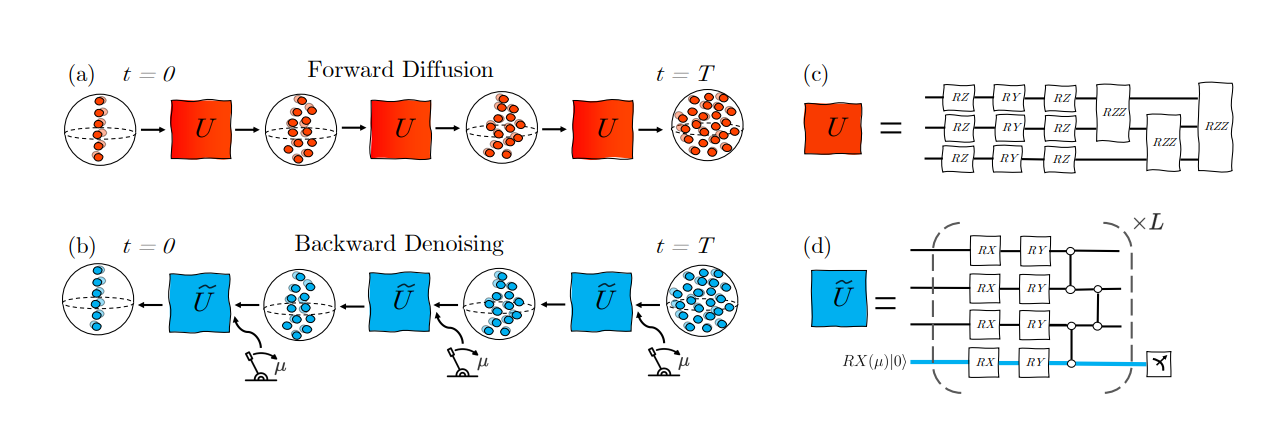
Denoising diffusion models represent a rapidly advancing technique for generative tasks in quantum physics, and a team led by Daniel Quinn from Queen’s University Belfast and Lorenzo Buffoni from the University of Florence now expands the capabilities of these models through a novel conditioning mechanism. This approach allows the generation of multiple, distinct quantum states within a single framework, avoiding the need for separate training for each desired state. Researchers, including Stefano Gherardini from the Istituto Nazionale di Ottica del Consiglio Nazionale delle Ricerche (CNR-INO) and Gabriele De Chiara from Queen’s University Belfast, demonstrate the effectiveness of this method across a range of simulations, from single-qubit generation to complex many-body systems. The results show a significant reduction in error, often by as much as an order of magnitude, marking a substantial advance in the precision and efficiency of quantum state preparation.
Quantum denoising diffusion models have recently emerged as a powerful framework for generative quantum machine learning. Researchers have now extended these models, introducing a conditioning mechanism that enables the generation of quantum states drawn from multiple target distributions. This innovative approach avoids the need to train separate models for each distribution, streamlining the generation process and offering a significant advantage over traditional methods.
Experimental Setup and Performance Evaluation
This research project provides comprehensive documentation of the experimental setup, performance metrics, and related work for quantum generative diffusion models. The level of detail ensures reproducibility, allowing other researchers to verify the results and build upon the work. The inclusion of a comprehensive bibliography demonstrates a strong understanding of the relevant literature. The research team used both Maximum Mean Discrepancy and Wasserstein distance to evaluate the quality of the generated samples, a good practice as different metrics capture different aspects of the distribution.
The document specifies the noise schedules used in the diffusion process, which is important because these schedules can significantly affect model performance. The extensive bibliography demonstrates a thorough understanding of generative modeling, quantum machine learning, and statistical distance measures. The strengths of this work include its reproducibility, comprehensive documentation, clear organization, strong theoretical foundation, and commitment to open science practices. Detailed hyperparameter tuning allows for a better understanding of the model’s sensitivity to different settings. Potential areas for improvement include expanding on the motivation behind each generative task and conducting ablation studies to understand the relative importance of different model components.
Overall, this is an exceptionally well-documented research project. The level of detail and commitment to open science are commendable. The potential areas for improvement are relatively minor and would further enhance the quality and impact of the work. This document provides a solid foundation for future research in the exciting field of quantum generative modeling.
Multiple Quantum State Generation via Diffusion Models
Scientists have achieved a breakthrough in generative modeling by extending denoising diffusion models to generate quantum states drawn from multiple target distributions simultaneously. This innovative approach avoids the need for separate models for each distribution, significantly streamlining the generation process. The research team validated their method through numerical simulations encompassing single-qubit generation, entangled state preparation, and many-body ground state generation, demonstrating its versatility across diverse quantum systems. Experiments revealed a substantial reduction in error for targeted state generation, with improvements reaching up to an order of magnitude compared to existing methods.
The team quantified performance using the Wasserstein distance, obtaining a comparable final loss of approximately 4. 3% across all tested distributions. Visualizations of the generated quantum states on the Bloch sphere confirmed the model’s ability to produce the desired ring structure for each distribution, rather than converging to a single outcome. Further investigations focused on generating polar points, a class of single-qubit states aligned with the Cartesian axes. By adding Gaussian noise to these eigenstates, the researchers created clusters around specific directions, effectively expanding the number of target classes beyond the limitations of previous methods.
Measurements confirmed that the model accurately generated states corresponding to each cardinal direction, with the lowest spread observed for the +Z and −Y classes. Detailed analysis revealed percentage overlaps, demonstrating the model’s precision in aligning generated states with their intended targets. The team also explored the generation of entangled states using two qubits, focusing on Bell states with a relative phase. After training, the model achieved a final test error of approximately 2%, demonstrating its ability to learn entanglement and switch between distinct Hilbert space subspaces.
The average Meyer-Wallach measure, a key indicator of entanglement, reached 0. 97, closely approaching the theoretical maximum value of 1. These results demonstrate a significant advancement in quantum state generation, paving the way for more efficient and versatile quantum technologies.
Conditional Quantum State Generation with CQDD
This work presents a novel quantum machine learning model, termed CQDD, which extends denoising diffusion models by incorporating a conditioning mechanism enabling the generation of multiple distinct quantum states with a single set of parameters. Validating the approach across diverse tasks, including single-qubit state generation, entangled state preparation, and many-body ground state generation, demonstrates the model’s versatility and generalisation capabilities. Results consistently show significant reductions in error, up to an order of magnitude, when generating targeted states compared to unconditioned models. The team also conducted a detailed ablation study, quantifying the impact of key hyperparameters on performance and revealing how the structure of target states influences model accuracy under fixed computational resources. While the model demonstrates strong performance, the authors acknowledge limitations regarding generalisation to unseen classes. Future research directions include investigating end-to-end learning of the conditioning mechanism and assessing the model’s robustness under realistic noise conditions, crucial steps towards practical implementation on near-term quantum hardware.
🗞 Conditioning in Generative Quantum Denoising Diffusion Models
🧠 ArXiv: https://arxiv.org/abs/2509.17569