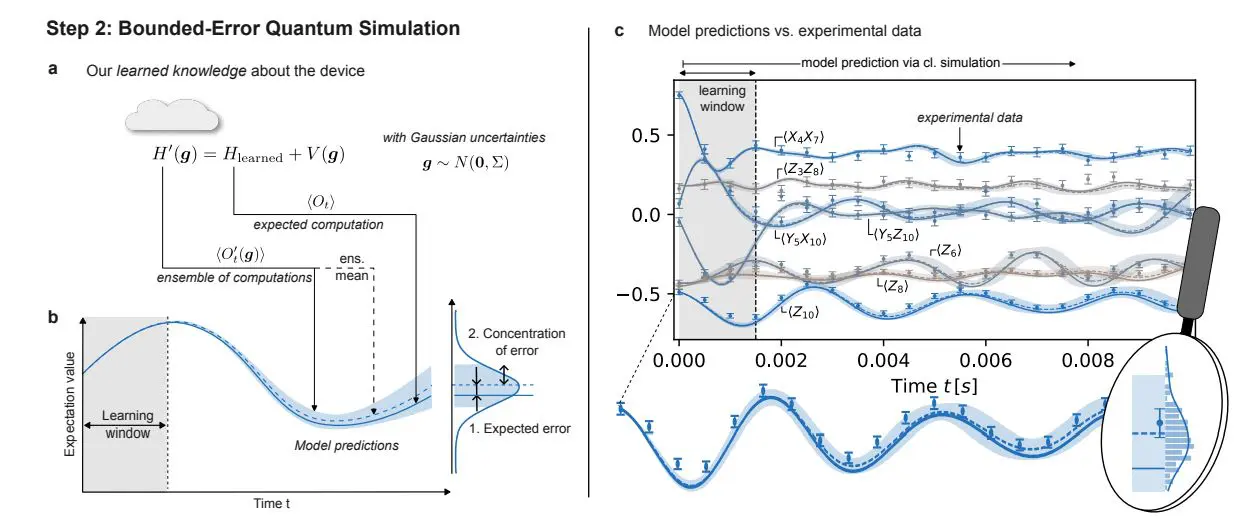
Exploring the complex behaviour of many-body systems remains a significant challenge in physics, and researchers continually seek ways to move beyond the limitations of classical computation. Tristan Kraft, Manoj K. Joshi, and William Lam, along with colleagues at institutions including the Technical University of Munich and the University of Innsbruck, present a new framework for achieving bounded-error simulation using analog quantum systems. This work introduces a method that combines Hamiltonian and Lindbladian learning to rigorously estimate uncertainties in predictions made by these simulators, effectively transforming them from qualitative tools into platforms capable of quantitative scientific discovery. By propagating uncertainties derived directly from experimental data, the team demonstrates the ability to predict many-body observables with quantifiable confidence bounds, validating the approach on trapped-ion simulators with up to 51 ions and establishing a scalable foundation for trusted analog simulation that extends to digital approaches.
Learning Quantum Dynamics With Noise Mitigation
Researchers are developing methods for bounded-error quantum simulation, a crucial step towards utilising near-term quantum devices. They address the challenge of accurately simulating open quantum systems, which interact with their environment and experience dissipation and decoherence. This novel approach combines Hamiltonian and Lindbladian learning techniques to achieve robust and verifiable simulation, allowing the quantum device to learn the dynamics of the target system directly from experimental data and mitigate the effects of imperfections and noise. The method involves constructing a learning loop where the quantum simulator iteratively refines its representation of the target system’s energy and interactions with its surroundings.
The team employs a feedback mechanism, utilising measurement outcomes from the quantum simulator to update learned parameters. This iterative process minimises the discrepancy between the simulator’s behaviour and the desired dynamics of the target system, ensuring accuracy even with noise and imperfections. Researchers demonstrate the effectiveness of their method by simulating the dynamics of a driven transverse-field Ising model, achieving high fidelity despite significant noise. The results show the learned simulator accurately reproduces the target system’s behaviour, demonstrating the potential for simulating complex quantum systems. Furthermore, the team establishes bounds on the simulation error, providing a quantifiable measure of accuracy and reliability.
Trapped Ion Quantum Simulation, Error Mitigation Achieved
This research focuses on quantum simulation using trapped ions, with a strong emphasis on characterising and mitigating errors to achieve accurate results. The team aims to build a reliable platform for simulating quantum many-body systems, intractable for classical computers, by identifying and minimising errors in the experimental setup and simulation process. They are also developing methods to verify the quantum simulator’s accuracy, a crucial step towards demonstrating quantum advantage and creating a robust framework applicable to other platforms. Experiments are conducted using a system of trapped ions, where ions serve as quantum bits.
Researchers use a mathematical model, a master equation, to describe the noise affecting the system, allowing them to understand error types and their impact. They employ machine learning techniques to learn the true energy, interactions, and noise characteristics by measuring the system’s behaviour and refining the model. Techniques like randomised benchmarking and optimal overlapping tomography characterise quantum operation fidelity and reconstruct the quantum state. Sophisticated statistical methods, such as Jackknife resampling and concentration inequalities, analyse data and quantify uncertainties, while tensor networks validate experimental results with efficient numerical simulations.
The team identified and characterised various error sources, including fluctuations in lasers and magnetic fields, and imperfections in quantum operations. They demonstrated accurate learning of energy, noise characteristics, and mitigation of noise effects by correcting simulation results. They developed a robust framework for verifying the quantum simulator’s accuracy, designed to be scalable to larger systems. The emphasis on rigorous statistical analysis ensures the reliability of their conclusions. This research represents a significant step forward in quantum simulation. By developing methods for accurate error characterisation, mitigation, and verification, they are paving the way for demonstrating quantum advantage and improving quantum hardware design. The methods are applicable to other platforms, such as superconducting qubits and neutral atoms.
Certified Quantum Simulation with Experimental Bounds
This research introduces a framework for bounded-error quantum simulation, equipping quantum simulators with the ability to produce quantitatively certified predictions for many-body observables. By combining Hamiltonian and Lindbladian learning with careful propagation of statistical uncertainties, the team achieves prediction intervals directly derived from experimental data, moving beyond qualitative demonstrations towards quantitative scientific tools. The method was successfully demonstrated on trapped-ion simulators implementing long-range interactions with up to 51 ions, and validated through comparison with classical simulations where possible. Crucially, the team established error bounds directly from experimental measurements, independent of classical computation, opening a path towards regimes where quantum simulation can offer a distinct advantage.
While the current work assumes a simplified model of noise, the researchers outline clear extensions to accommodate more complex scenarios or slow experimental drifts, envisioning a framework capable of inferring probability distributions over fluctuating parameters. Future work could also incorporate characterisation of more complex noise environments and address systematic calibration errors, further refining the accuracy and reliability of the simulations. The framework extends naturally to digital quantum simulation, offering physically transparent diagnostics of errors in circuits and a direct characterisation of circuit noise through learned models.
🗞 Bounded-Error Quantum Simulation via Hamiltonian and Lindbladian Learning
🧠 ArXiv: https://arxiv.org/abs/2511.23392