

Researchers are detailing a novel implementation of a three-dimensional fermionic toric code utilising Floquet techniques, offering a potentially more efficient pathway to quantum error correction. Yoshito Watanabe, Bianca Bannenberg, and Simon Trebst, all from the Institute for Theoretical Physics at the University of Cologne, demonstrate a method for dynamically generating stabilizer structures using only two-body Pauli measurements within this three-dimensional system. This work is significant because it extends the principles of Floquet codes to higher spatial dimensions, previously limited in scope, and crucially maintains access to the full logical qubit space throughout the measurement process. The team identified a unique three-dimensional lattice geometry, building upon the Kekulé lattice of the two-dimensional Hastings-Haah code, which avoids the loss of logical information often encountered in similar systems, and further establishes a connection between lattice geometry, dynamically created entangled phases, and the preservation of logical information in time-ordered Floquet protocols.
Scientists have engineered a three-dimensional quantum error-correcting code that preserves logical information throughout its operation, representing a step towards robust quantum computing. This work introduces a novel Floquet code, a dynamically generated code using periodic measurements, that realizes a three-dimensional fermionic toric code, a sophisticated structure for protecting quantum states.
Unlike previous attempts at extending Floquet codes to higher dimensions, this research successfully maintains all three encoded qubits during the entire measurement sequence, a critical requirement for practical quantum computation. The achievement hinges on a specially designed three-dimensional lattice geometry that generalizes the principles of the two-dimensional Hastings-Haah code.
This lattice possesses a unique property; removing any single type of bond results in a network of short, closed loops rather than extended chains. This “loop property” is crucial for preventing the collapse of encoded quantum information during the measurement process, a common issue in many three-dimensional lattice designs. While a straightforward measurement cycle does not fully reveal all potential errors, researchers demonstrate the ability to append an additional measurement sequence to extract the complete error syndrome without compromising the logical qubits.
Beyond the code itself, this lattice geometry defines a new family of three-dimensional monitored Kitaev models. These models exhibit dynamically created entangled phases with nontrivial topology when subjected to random measurements, offering insights into the fundamental physics of quantum systems. The preservation of logical information within these time-ordered Floquet protocols also suggests connections to critical points within the underlying phase diagrams, potentially unlocking new avenues for understanding and controlling quantum entanglement.
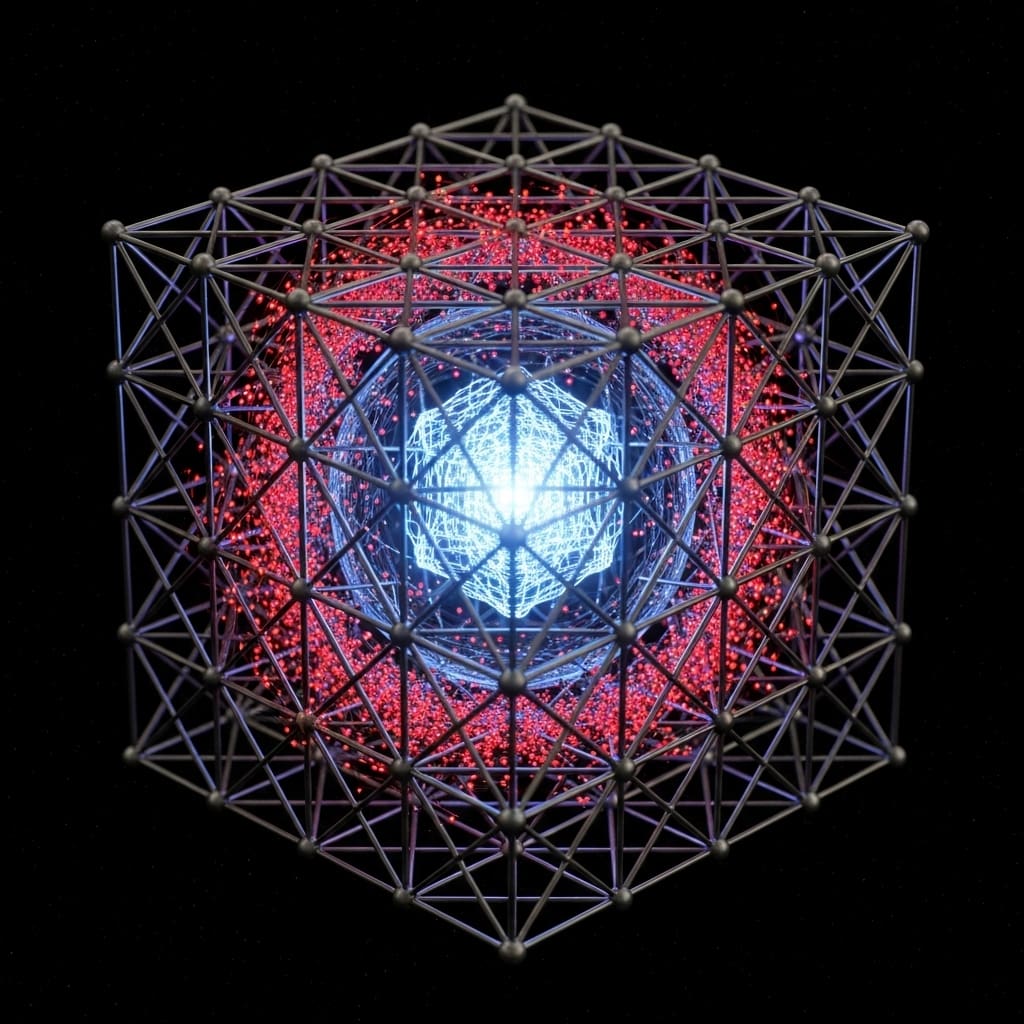
A tricoordinated lattice geometry underpins this work, enabling the extension of two-body parity-check sequences, a hallmark of two-dimensional Floquet codes, into a genuinely error-correcting three-dimensional setting. The lattice, constructed from stacked square-octagon layers interconnected by vertical bonds, forms a three-dimensional network with each vertex connected to three edges.
This specific geometry was chosen because deleting any single edge colour results in a two-colour subgraph composed of short, closed loops rather than extended chains, crucial for preventing the collapse of logical information. To establish the instantaneous stabilizer group equivalent to a three-dimensional fermionic toric code, a periodic sequence of two-qubit measurements is implemented, utilising three types of parity checks, XX, YY, and ZZ, applied sequentially to the lattice edges, analogous to the Hastings-Haah code.
While a simple three-round cycle measuring these parity checks does not fully reveal the error syndrome, an appended measurement sequence extracts the missing information without disrupting the logical qubit subspace, ensuring complete syndrome extraction for robust error correction. Measurements within the newly developed three-dimensional Floquet code reveal the preservation of all three logical qubits throughout the entire measurement sequence, achieved through a carefully constructed lattice geometry and measurement protocol.
Central to this success is a 3d lattice geometry generalizing the Kekulé lattice, where the removal of any single edge colour results in short, closed loops rather than extended chains, preventing the collapse of logical information. The research establishes that the combination of the 3d Kekulé-Kitaev lattice, a specific relaxation process, and a ten-round measurement cycle creates a 3d Floquet code with inherent redundancy, potentially mitigating errors arising from syndrome extraction.
Beyond code design, the study reveals that these 3d tricoordinated lattice geometries define a family of monitored Kitaev models, where random measurements of non-commuting parity checks give rise to dynamically created entangled phases exhibiting nontrivial topology. Analysis of these phases reveals the existence of critical points, further supporting the preservation of logical information within the time-ordered Floquet protocols.
Examining the 2d monitored Kitaev honeycomb model, researchers found that near corners of the measurement probability simplex, representing dominance of a single bond colour, the dynamics realizes an extended area-law phase. In this regime, the probability of measuring a nonlocal logical operator is exponentially suppressed with increasing system size L, indicating robust quantum information encoding.
Moving away from these corners, increased frustration between measurement types generates long-range entanglement, leading to an extended critical regime where half-system entanglement entropy scales as S(L/2) ∼ L ln L, suggestive of a fermionic system with low-energy modes. The persistent challenge of building a fault-tolerant quantum computer has long hinged on the delicate balance between encoding information in a robust manner and being able to manipulate it without introducing errors.
This work offers a significant advance by demonstrating a three-dimensional generalisation of Floquet error-correcting codes, effectively creating a more resilient framework for protecting quantum states. What distinguishes this development is not simply the extension to three dimensions, but the preservation of the full logical qubit space throughout the dynamic measurement sequence, crucial for performing complex quantum computations.
The researchers achieve this by designing a lattice where removing any single connection doesn’t disrupt the overall topological structure, preventing the fragmentation of encoded information, opening the door to exploring dynamically created entangled phases. However, the current demonstration relies on a specific measurement schedule and doesn’t fully expose the complete error syndrome, meaning the code’s full error-correcting potential remains unrealised and more sophisticated decoding strategies will be needed. Furthermore, scaling these three-dimensional structures to the size required for practical quantum computation presents a formidable engineering challenge.
👉 More information
🗞 Floquet implementation of a 3d fermionic toric code with full logical code space
🧠 ArXiv: https://arxiv.org/abs/2602.12685

