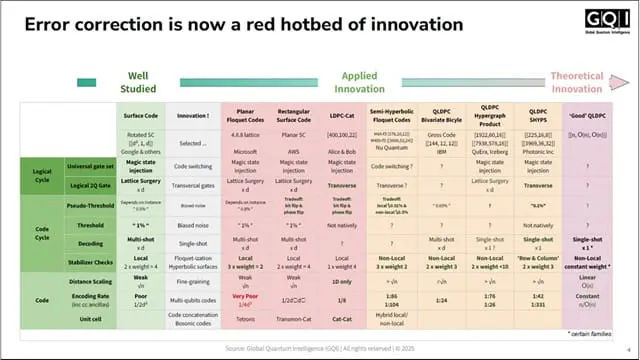
GQI has released a comprehensive 21-page document detailing the current state of quantum error correction (QEC) research. The report examines key themes, including the surface code’s role as the Standard Model for large-scale fault-tolerant quantum computing, recent demonstrations and innovations in QEC, challenges posed by high overheads, emerging alternative codes such as QLDPC and SHYPS, and fundamental concepts like error rates and decoder algorithms.
The surface code stands as the cornerstone of the standard model for large-scale fault-tolerant quantum computing (FTQC). Renowned for its robustness, this topological error-correcting code offers a high error threshold and efficient decoding algorithms, making it a preferred choice in quantum architectures. Its ability to detect and correct errors without requiring complex operations has solidified its role as the foundation for many quantum computing initiatives.
Recent advancements have demonstrated the practical implementation of the surface code, particularly in achieving logical qubits with reduced overheads. These milestones highlight the progress toward scalable quantum systems, where maintaining low error rates is crucial for fault tolerance. Such demonstrations underscore the potential of the surface code to bridge theoretical models with real-world applications.
Despite its strengths, the surface code presents challenges, notably the high resource requirements for achieving fault-tolerance. This limitation has spurred research into alternative codes, such as QLDPC and semi-hyperbolic Floquet codes, which aim to enhance performance or reduce overheads. These emerging approaches offer promising avenues for overcoming current barriers, potentially paving the way for more efficient quantum computing architectures.
Challenges and Innovations in Quantum Error Correction
The high resource overheads of the surface code represent a significant challenge for practical fault-tolerant quantum computing. Achieving fault tolerance requires an extensive lattice of physical qubits to encode each logical qubit, imposing stringent demands on hardware scalability and error rates. This limitation has driven researchers to explore alternative quantum error-correcting codes that could reduce overheads or offer improved performance characteristics.
Emerging approaches such as QLDPC (Quantum Low-Density Parity-Check) codes, SHYPS codes, and semi-hyperbolic Floquet codes are being investigated for their potential advantages. These codes aim to address the surface code’s limitations by offering lower resource requirements, higher error thresholds, or more efficient decoding algorithms. For instance, QLDPC codes leverage sparse parity-check structures to reduce overheads while maintaining robust error correction capabilities potentially.
Fundamental challenges in QEC remain, particularly in achieving sufficiently low physical error rates and implementing practical decoder algorithms. The relationship between physical and logical error rates is critical, as even small improvements in physical error suppression can significantly enhance fault-tolerant performance. Additionally, the development of efficient decoders that can handle large-scale systems remains an active area of research, with implications for both code design and hardware implementation.
Pursuing innovative quantum error-correcting codes offers exciting possibilities for enhancing fault tolerance and scalability. Continued research and development in this area are crucial for driving advancements in FTQC and paving the way for practical, large-scale quantum computing solutions.
More information
External Link: Click Here For More