

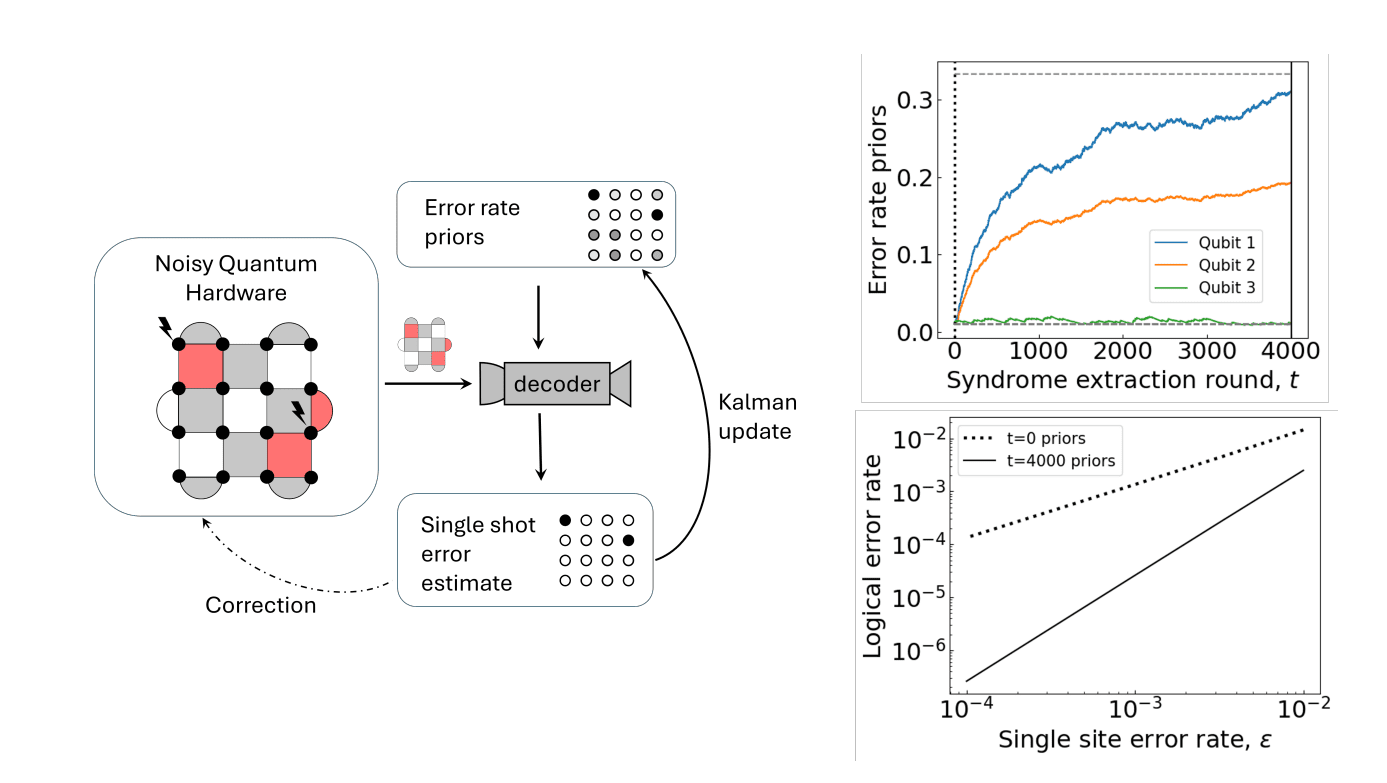
Quantum error correction represents a vital step towards realising practical quantum computers, yet maintaining the integrity of quantum information demands increasingly sophisticated techniques. Jonathan Kunjummen and Jacob M. Taylor, from the University of Maryland-NIST and the Joint Quantum Institute, alongside their colleagues, demonstrate a significant advance in this field by developing a method for real-time calibration of quantum operations during error correction. Their approach leverages the information gained from monitoring errors and applying Bayesian updates to refine estimates of qubit behaviour, even in particularly noisy systems. This allows the use of error correction codes previously considered less effective, and crucially, enables the system to learn and improve its performance over time, ultimately paving the way for more robust and efficient quantum computation. The team’s simulations show this method not only enhances error correction rates, but also facilitates the in-situ calibration of quantum gates with minimal overhead, representing a substantial step towards building fault-tolerant quantum computers.
The research focuses on identifying and correcting errors while safeguarding encoded quantum bits. It investigates how prior information and Bayesian updates can significantly enhance the performance of quantum error correction, particularly when dealing with a highly noisy qubit. This allows the utilisation of even distance codes, which are generally considered less effective in quantum error correction, to manage the noisy qubit and alter the power-law scaling between the logical error rate and the underlying physical error rate. A key element of this approach involves updating the initial prior beliefs by incorporating real-time feedback from the decoder outputs into an approximate Kalman filter, effectively providing a bootstrap mechanism for determining accurate error rates. The team demonstrates this capability through simulations of the complete closed-loop system.
Tailoring Quantum Codes to Hardware Constraints
This is a comprehensive overview of recent advancements in quantum error correction (QEC), focusing on tailoring codes to specific hardware constraints and exploring novel approaches like erasure codes. The field is moving beyond universal codes towards designs suited to the characteristics of different quantum platforms. A significant focus lies on adapting codes to handle defects in hardware, such as accommodating defects with surface codes or using locally unbiased codes robust against qubit loss. This hardware-aware code construction leverages the strengths of a particular platform while mitigating its weaknesses, as demonstrated by the XZZX surface code.
Erasure codes represent a fundamentally different approach to QEC, addressing the loss of information rather than bit or phase flips. They offer natural robustness against qubit loss, a significant source of error in many platforms, and potentially simpler decoding with higher error thresholds. The concept of erasure qubits, which can be lost without immediately destroying encoded information, is being explored for neutral atom platforms, superconducting qubits, and trapped ion systems. Researchers are also investigating hybrid approaches that combine the benefits of both erasure and traditional codes.
Degenerate quantum LDPC codes offer potential advantages in performance and decoding complexity. The key takeaway is that hardware-aware QEC is crucial for future progress. Erasure codes offer a promising new approach, particularly for platforms susceptible to qubit loss, and hybrid approaches are likely to be the most effective. Continued research is essential to develop and optimize QEC techniques for real-world quantum computers.
Bayesian Updates Boost Noisy Qubit Correction
Scientists have demonstrated a novel approach to quantum error correction that leverages prior information and Bayesian updates to significantly improve performance, even with noisy qubits. The work centers on adapting decoding algorithms to estimate both the location and type of errors while simultaneously protecting encoded bits, achieving a breakthrough in handling particularly noisy quantum systems. Researchers found that by incorporating Bayesian updates and an approximate Kalman filter, they could bootstrap the system to accurately determine error rates, enabling even distance codes to effectively manage noisy qubits and alter the scaling of logical rate with physical rate. Experiments revealed that starting with uniform prior knowledge, the update procedure gradually learns site-specific error rates, allowing the decoder to outperform fixed-prior baselines.
This adaptive decoding system was then used to implement a new protocol involving controlled rotations with slight over- or under-estimation, allowing for in situ calibration of unitary operations with moderate overhead, even in scenarios with low noise qubits. The team demonstrated that the theoretically predicted outcomes for known and unknown error locations corresponded precisely with observed numerical results, confirming that even-distance codes can correct one introduced error of known location compared to odd-distance codes of one unit smaller. Further analysis proved a key theoretical insight: even-distance codes can outperform odd-distance codes when correcting errors in a mixture of arbitrary and preferred locations. Specifically, the team proved that given a code of distance d and knowledge of errors on n1 sites, the code can correct up to n2 additional errors of unknown location if *n1 + 2n2 The researchers practically realized this benefit by adapting the decoder to the task, demonstrating that high-weight corrections can be allowed only if their additional support is on the known error locations. This work establishes a foundation for scalable calibration and error correction in solid-state quantum computing paradigms where qubits drift out of calibration.
Bayesian Updates Boost Noisy Qubit Correction
This research demonstrates a novel approach to quantum error correction, leveraging prior information and Bayesian updates to enhance performance, particularly when dealing with noisy qubits. The team showed that even codes traditionally considered less valuable can effectively manage noisy qubits, altering the expected scaling of logical error rates with physical error rates. A key innovation is the use of an approximate Kalman filter, updated in real time with decoder outputs, to bootstrap accurate error rate estimations. Simulations confirm that this iterative process learns site-specific error rates, allowing the decoder to surpass the performance of systems relying on fixed prior assumptions.
Furthermore, this method enables in situ calibration of quantum operations through the incorporation of gate set tomography, achieved with only moderate overhead in scenarios with low-noise qubits. The work establishes a theoretical framework for correcting errors with a mixture of known and unknown locations, revealing that odd-distance codes possess unique advantages. Specifically, the research proves that codes can correct errors up to their distance limit when the error location is known, a capability not fully realized in traditional quantum error correction strategies.
👉 More information
🗞 In situ calibration of unitary operations during quantum error correction
🧠 ArXiv: https://arxiv.org/abs/2511.01080


