

Achieving precise measurements of multiple parameters simultaneously presents a significant challenge in metrology, often diminishing the accuracy gained from using entangled quantum probes. Mauricio Gutiérrez from the University of Costa Rica, Chiranjib Mukhopadhyay from the University of Electronic Sciences and Technology of China, Victor Montenegro from Khalifa University, and Abolfazl Bayat et al. now demonstrate a method for overcoming this limitation, employing quantum error correction to dramatically improve multiparameter precision. The team reveals that by treating unknown parameters as noise and applying a carefully designed error correction protocol, they restore the optimal precision achievable with single-parameter measurements, maintaining fixed and separable measurement strategies. This breakthrough allows researchers to extract the best possible precision from quantum probes of any size, recovering the sought-after Heisenberg scaling through the use of multiple complementary probes and opening new avenues for high-precision sensing and parameter estimation.
GHZ States and Bayesian Magnetic Field Sensing
This research details a sophisticated quantum sensing protocol utilizing entangled GHZ states to measure magnetic fields with unprecedented precision. The technique employs quantum error correction to protect the sensitive probe from environmental noise and decoherence, significantly enhancing measurement accuracy. A key innovation lies in the use of a specialized error correction code that allows for more reliable detection of magnetic field components. The protocol leverages Bayesian analysis, a powerful statistical method, to combine prior knowledge with observed data from stabilizer measurements and the final corrected state.
This combination refines the estimation of magnetic field components, achieving a level of precision that scales optimally with the number of qubits used in the GHZ state, aiming to reach the Heisenberg limit where uncertainty decreases inversely with qubit number. The team generalized the protocol to measure all three components of a magnetic field, demonstrating that the Heisenberg limit can be achieved in three dimensions. The use of specific types of error-correcting probes is crucial for this optimal performance, and the Bayesian analysis systematically combines information from different sources, providing a robust framework for refining the magnetic field estimate. This research offers a significant improvement in sensitivity compared to classical magnetic field sensors, with potential applications in biomedical imaging, materials science, navigation, and fundamental physics.
GHZ Probes and Ancilla-Assisted Error Correction
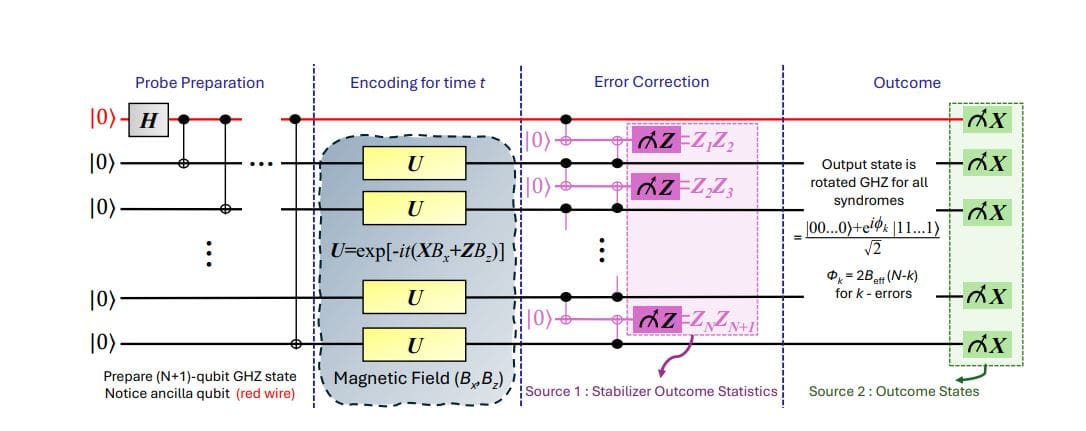
Scientists have developed a new sensing protocol using Greenberger-Horne-Zeilinger (GHZ) probes to achieve enhanced precision in estimating multiple parameters simultaneously. Recognizing that single GHZ probes struggle with complex scenarios, the team implemented an error correction technique, effectively treating unknown parameters as noise that can be systematically corrected, restoring the inherent advantage of single-parameter GHZ sensing and allowing for optimal precision across all unknown parameter values with straightforward measurements. The protocol employs one ancilla qubit per GHZ probe to extract the highest possible precision for any probe size. Simulations, using a Bayesian inference approach, demonstrated that the precision scales with the number of probes, achieving Heisenberg scaling. Further analysis revealed that each probe effectively reduces uncertainty in its designated magnetic field component, and combining two probes allows for the rejection of inconsistent estimates and reinforcement of overlapping values, effectively narrowing the range of plausible values and improving overall estimation precision.
Optimal Precision with GHZ Quantum Sensors
Scientists have achieved optimal precision in multiparameter quantum sensing using Greenberger-Horne-Zeilinger (GHZ) probes, overcoming limitations found in previous approaches. The research demonstrates a method for extracting optimal precision for any probe size by treating unwanted parameters as noise and correcting for their effects, restoring the advantages of single-parameter GHZ-based sensing and allowing for optimally enhanced precision across the full range of unknown parameter values with fixed, separable measurements. The team implemented a protocol utilizing one shielded ancilla qubit per GHZ probe, enabling the extraction of optimal possible precision. Experiments revealed that a single GHZ probe achieves shot-noise limited precision, but the use of multiple complementary GHZ probes recovers Heisenberg scaling, a significant improvement in sensitivity.
The post-error-correction quantum state is proportional to a superposition of states, with coefficients dependent on the number of errors and the magnetic field. The team measured a specific operator to assess the precision, finding that the corresponding classical Fisher information is singular without combining it with stabilizer measurements. The overall achievable precision is bounded by the trace of the inverse of the combined information, demonstrating that the protocol can achieve Heisenberg scaling for large numbers of qubits. This research delivers a breakthrough in quantum sensing, paving the way for more sensitive and accurate measurements in diverse fields, including magnetic field detection and precision metrology.
GHZ Sensing Restored with Error Correction
Scientists have developed a new approach to multiparameter quantum sensing using Greenberger-Horne-Zeilinger (GHZ) probes, overcoming limitations found in previous methods. While single-parameter sensing with GHZ probes already achieves optimal precision using straightforward measurements, extending this to multiple parameters typically results in decreased performance and complex measurement strategies. This research introduces a protocol that leverages error correction techniques, effectively treating unwanted parameters as noise that can be corrected, thereby restoring the optimal precision characteristic of single-parameter sensing. The team demonstrates that by incorporating a single shielded ancilla qubit into the GHZ probe, the system can achieve the ultimate obtainable precision, even in multiparameter scenarios.
Importantly, the use of multiple complementary GHZ probes allows the recovery of Heisenberg scaling, a significant enhancement in precision that improves with increasing probe size. Simulations using Bayesian estimation confirm the effectiveness of this protocol and demonstrate its potential for achieving quantum advantage with a limited number of measurements. The authors acknowledge that the ultimate precision achieved with a single GHZ probe is fundamentally shot-noise limited in multiparameter sensing, but their error correction protocol overcomes this limitation. This research provides a promising pathway for enhancing multiparameter quantum metrology and unlocking new possibilities for precision measurement.
👉 More information
🗞 Quantum error correction for multiparameter metrology
🧠 ArXiv: https://arxiv.org/abs/2511.04018


