

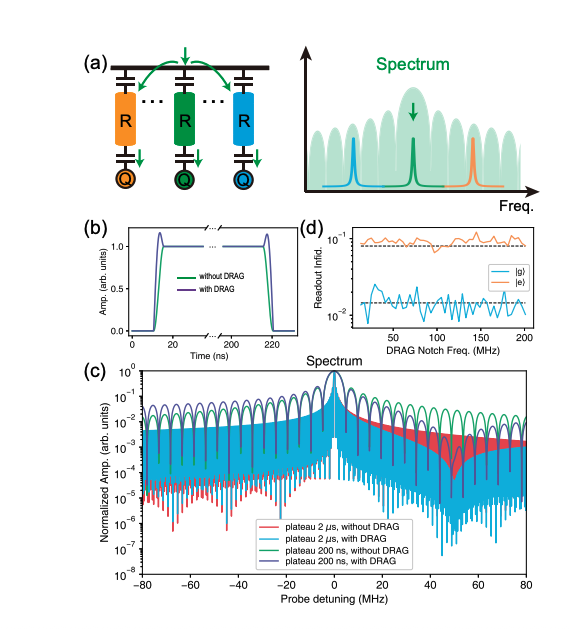
Rapid and repeated measurements are essential for quantum error correction, but increasing the speed of these measurements introduces a significant problem: crosstalk between neighbouring quantum systems. Yang Gao, Feiyu Li, and Yang Liu, along with colleagues at their institutions, now demonstrate a technique to mitigate this interference, paving the way for more reliable quantum computations. The team achieves this by carefully shaping the probe pulses used for measurement, creating a spectral notch that suppresses signals leaking into adjacent resonators. This innovative pulse shaping method, inspired by established techniques in quantum control, integrates easily with existing quantum architectures and allows for fast, accurate measurements without requiring additional hardware, representing a crucial step towards building scalable and fault-tolerant quantum computers.
Quantum error correction protocols require rapid and repeated qubit measurements. Multiplexed readout in superconducting quantum systems improves efficiency, but fast probe pulses introduce spectral broadening, leading to signal leakage into neighboring readout resonators. This crosstalk results in qubit dephasing and degraded readout fidelity. This research introduces a pulse shaping technique inspired by the derivative removal by adiabatic gate (DRAG) protocol to suppress measurement crosstalk during fast readout. The method involves engineering a spectral notch at neighboring resonator frequencies to minimise unwanted interactions and improve the accuracy of qubit state determination.
Dynamic Readout Pulse Shaping for Qubit Fidelity
This research details a method to improve the fidelity of superconducting qubit readout by dynamically shaping the readout pulse to suppress spurious transitions and minimize errors. The core challenge lies in achieving accurate qubit measurements while maintaining the speed necessary for complex computations. Traditional dispersive readout, a standard technique for determining qubit states, can suffer from leakage errors due to unwanted transitions during the readout process, limiting the accuracy of state determination. These errors become particularly problematic with fast readout schemes. The researchers developed a technique called dynamic control of the dispersive shift using specifically shaped readout pulses.
This involves optimizing the pulse shape to minimize excitation of unwanted qubit states during readout and suppressing spurious transitions by carefully controlling the frequency and amplitude of the readout pulse. They employed a spectrally balanced pulse to minimize the excitation of unwanted states, effectively refining the measurement process. Experiments demonstrate significant improvement in readout fidelity, with the optimized pulse shapes demonstrably reducing readout errors and bringing the fidelity closer to the threshold required for quantum error correction. The technique effectively minimized the excitation of unwanted qubit states, leading to cleaner readout signals and enhanced performance even in the presence of noise and imperfections.
This method is potentially scalable to larger qubit arrays, offering a pathway towards more complex quantum processors. This research represents a significant step towards building more reliable and accurate superconducting quantum computers. By improving readout fidelity, it paves the way for more complex quantum algorithms, larger qubit arrays, and ultimately, fault-tolerant quantum computing.
Spectral Notching Suppresses Qubit Measurement Crosstalk
Scientists have developed a novel pulse shaping technique to dramatically suppress measurement crosstalk in quantum systems, a critical step towards building scalable quantum computers. This breakthrough addresses a fundamental challenge: fast, multiplexed readout, essential for efficient quantum processing, introduces unwanted signal interference that degrades qubit performance. The team’s method, inspired by the derivative removal by adiabatic gate (DRAG) protocol, effectively mitigates this crosstalk by carefully engineering the spectral content of readout pulses. Experiments demonstrate that applying DRAG introduces no measurable degradation in qubit readout fidelity across a broad range of notch frequencies, spanning from 13 to 201 MHz.
By creating a spectral notch at frequencies neighboring the target resonator, the technique minimizes spurious signal interference, preserving qubit coherence. Ramsey experiments revealed that implementing DRAG extends qubit coherence times to 1. 41 μs, a substantial improvement over systems without this spectral shaping. This enhancement is achieved by suppressing a pronounced beating pattern observed in standard Ramsey oscillations, indicating a significant reduction in qubit dephasing. Further measurements of readout-induced qubit dephasing confirm the effectiveness of the DRAG technique.
The team observed a substantial suppression of additional errors induced by stray readout pulses, with theoretical calculations exhibiting excellent agreement with experimental data. Specifically, the technique minimizes the impact of the pseudo-readout pulse on qubit coherence, allowing for more accurate and reliable quantum measurements. This advancement paves the way for denser and more complex quantum circuits, bringing scalable quantum computing closer to reality. The method seamlessly integrates with existing readout architectures without requiring additional hardware, making it a practical and readily implementable solution for improving quantum system performance.
Spectral Notching Suppresses Qubit Measurement Crosstalk
This research addresses a key challenge in scaling up quantum computers: efficiently reading out the state of multiple qubits. The team demonstrates that fast measurement pulses, while improving readout speed, introduce unwanted interference, crosstalk, between qubits due to spectral broadening. This crosstalk degrades the accuracy of the measurements. To overcome this, they developed a pulse-shaping technique, inspired by established methods in quantum control, that suppresses this interference by carefully engineering the frequency spectrum of the measurement pulses. The method effectively creates a “notch” in the pulse spectrum, minimizing signal leakage into neighboring qubits’ resonators.
Importantly, this technique integrates seamlessly with existing quantum computing hardware, requiring no additional components. The results show a significant reduction in crosstalk, paving the way for faster and more reliable multiplexed qubit readout. While acknowledging that the technique is most effective when qubits are not identically spaced, the authors suggest potential extensions, including combining it with existing filtering architectures and exploring balanced pulse shaping for systems with both positively and negatively detuned neighbors. Future work could also integrate this pulse shaping with other techniques designed to further enhance readout fidelity and speed.
🗞 Mitigating Measurement Crosstalk via Pulse Shaping
🧠 ArXiv: https://arxiv.org/abs/2509.05437


