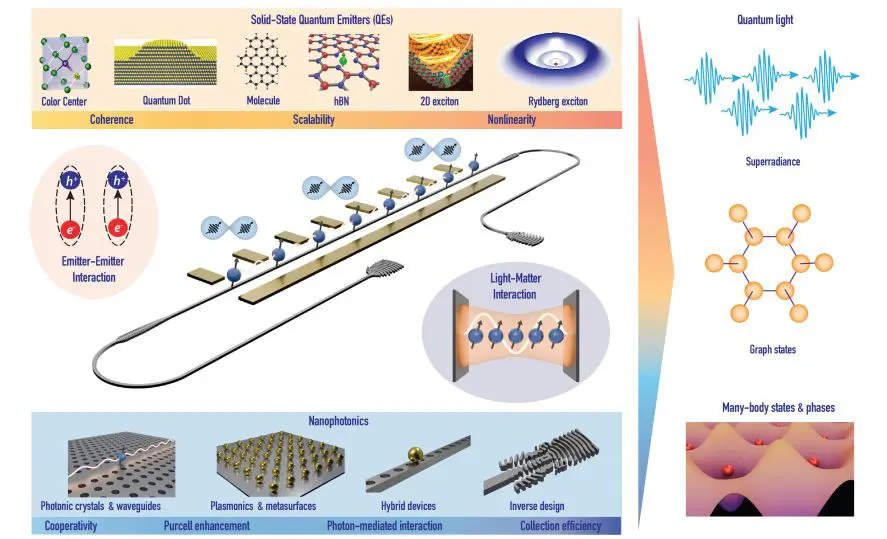
The creation and control of quantum states underpin advances in information science, and researchers are increasingly turning to solid-state emitters as promising platforms for scalable quantum technologies. Emma Daggett from Purdue University, Christian M. Lange, Bennet Windt, and colleagues demonstrate significant progress in engineering interactions between these solid-state emitters and photons, achieving robust coherence and controllable many-body entanglement. This work explores how these entangled states, including complex photonic graphs and superradiant emission, hold potential for breakthroughs in computation, sensing, and simulation. By addressing the challenges posed by imperfections and decoherence in solid-state materials, the team paves the way for realising more complex and stable quantum systems with practical applications.
Deterministic Entanglement From Solid-State Emitters
Scientists are making significant strides in building the foundations for a quantum internet by developing deterministic sources of entanglement using solid-state emitters. The primary goal is to move beyond probabilistic methods and create systems that reliably generate entangled states on demand. Researchers are successfully integrating these emitters with photonic nanostructures and cavities to enhance light collection and control, paving the way for practical quantum repeaters. Studies demonstrate high-fidelity generation of multiphoton entangled states and all-silicon quantum light sources, crucial components for long-distance quantum communication.
By utilizing artificial atoms within silicon and enhancing their emission, scientists are creating robust and efficient quantum light sources. These efforts extend to manipulating the structure of entanglement itself, focusing on graph states and cluster states, which are fundamental to measurement-based quantum computation. Researchers are exploring techniques to fuse these states, improving error correction thresholds and enhancing the capabilities of quantum computers. By combining encoded qubits with fusion techniques, scientists are achieving higher thresholds for reliable quantum computation.
Alongside these advancements in entanglement generation and manipulation, researchers are developing comprehensive methods for verifying entanglement and characterizing its quality. Quantum state tomography remains a valuable tool, while scientists are increasingly employing randomized measurement techniques, creating classical shadows that efficiently evaluate entanglement entropies and quantum fidelities. Photon correlation measurements, specifically analyzing the second-order correlation function, are used to detect inter-emitter correlations, with anti-dips at zero delay time indicating entanglement. Hong-Ou-Mandel interference and Ramsey interference experiments further confirm coherence between distinct emitters.
These techniques are crucial for debugging and optimizing quantum systems, ensuring the reliable operation of quantum networks. Beyond quantum repeaters, these advancements have implications for quantum metrology and sensing, potentially improving the precision of measurements. Fundamental physics and materials science play a crucial role, with researchers exploring materials with the right properties and refining techniques to improve measurement precision. This work builds upon decades of research, establishing a clear pathway toward realizing a quantum internet and unlocking the full potential of quantum technologies.
Entangled Emitter Interactions and Bright-Dark State Splitting
Scientists are achieving unprecedented control over light and matter by studying the interactions between solid-state quantum emitters and photons. This work demonstrates the ability to engineer many-body interactions, paving the way for advanced technologies in computation and simulation. Researchers have successfully observed the splitting of optical resonance peaks, a signature of entangled states between pairs of emitters. This splitting arises from the creation of “bright” and “dark” states, where the bright state exhibits enhanced emission and the dark state shows suppressed decay. Experiments reveal that the bright state displays a broadened, more intense spectral line, while the dark state appears as a narrower, weaker peak, confirming their distinct characteristics.
Multidimensional ultrafast spectroscopy directly probes multi-exciton collective states, detecting oscillations in the interaction signal as a function of pulse area, providing clear evidence of coherent exchange dynamics among silicon-vacancy centers in diamond. Furthermore, time-resolved emission dynamics directly measure modified decay rates of collective single-excitation states, confirming the observation of these collective effects. Achieving these results requires bringing emitters into near-resonance, a challenge overcome through techniques like electrostatic Stark tuning and all-optical tuning. Researchers utilize nanoscale electrodes to finely adjust transition energies and employ intense laser illumination to induce local charge rearrangement. Beyond pairs, scientists are exploring clusters of three or more individually addressable emitters, observing the emergence of a Dicke manifold of collective states with multiple excitations delocalized across the ensemble. This work establishes a clear pathway toward realizing fully entangled states of N=3 solid-state quantum emitters, combining precision tuning with strong common coupling and coherent pulse sequences to navigate multi-excitation state spaces.
Robust Many-Body Coherence in Solid-State Systems
Recent advances demonstrate significant progress in harnessing the interactions between solid-state quantum emitters and photons to create complex entangled states, paving the way for advancements in quantum technologies. Researchers have focused on mitigating the challenges posed by imperfections and decoherence within solid-state systems, successfully engineering robust many-body coherence necessary for generating states like photonic graphs and clusters, and observing superradiant emission. These achievements are crucial for developing new approaches to quantum computation, sensing, and simulation, offering potential advantages over existing methods. The work detailed represents a substantial step towards realizing practical quantum devices, with investigations into optimal methods for verifying entanglement and exploring novel quantum error-correcting codes.
Specifically, researchers have explored fusion-based techniques and encoded-fusion approaches to enhance the thresholds for reliable quantum computation, alongside the development of one-way quantum repeaters based on near-deterministic photon-emitter interfaces. While acknowledging the inherent difficulties in achieving perfect coherence within solid-state materials, the authors highlight ongoing efforts to improve material quality and refine control mechanisms. Future research directions include further exploration of advanced error correction strategies and the development of more efficient quantum repeater architectures to extend the range of quantum communication.
🗞 Many-Body Entanglement in Solid-State Emitters
🧠 ArXiv: https://arxiv.org/abs/2511.20797